
From Mention to Recommendation: Mentioned, Cited and Recommended Are Different
Being mentioned or cited by AI is not being recommended. What the Workspace “From mention to recommendation” card shows, the per-answer recommendation labels and how to correct them, weighted recommendation share on Competitors, and the by-engine table in Citation retention.
Mentioned is not recommended
When AI answers a buying question, your brand can show up in different ways:
- Mentioned: your name appears, possibly in passing.
- Cited: the answer lists your site as a source. AI used your content, but that doesn’t mean it recommends you.
- Recommended: you are near the top, or the answer says it recommends you.
- First pick: you are #1, or the answer calls you the best choice.
Counting mentions alone overstates the result, so Citadex measures these four layers separately.
The Workspace card “From mention to recommendation”
Sidebar Workspace → From mention to recommendation. It follows the market, engines and date range chosen at the top of the page, and is hidden until at least one answer mentions you.
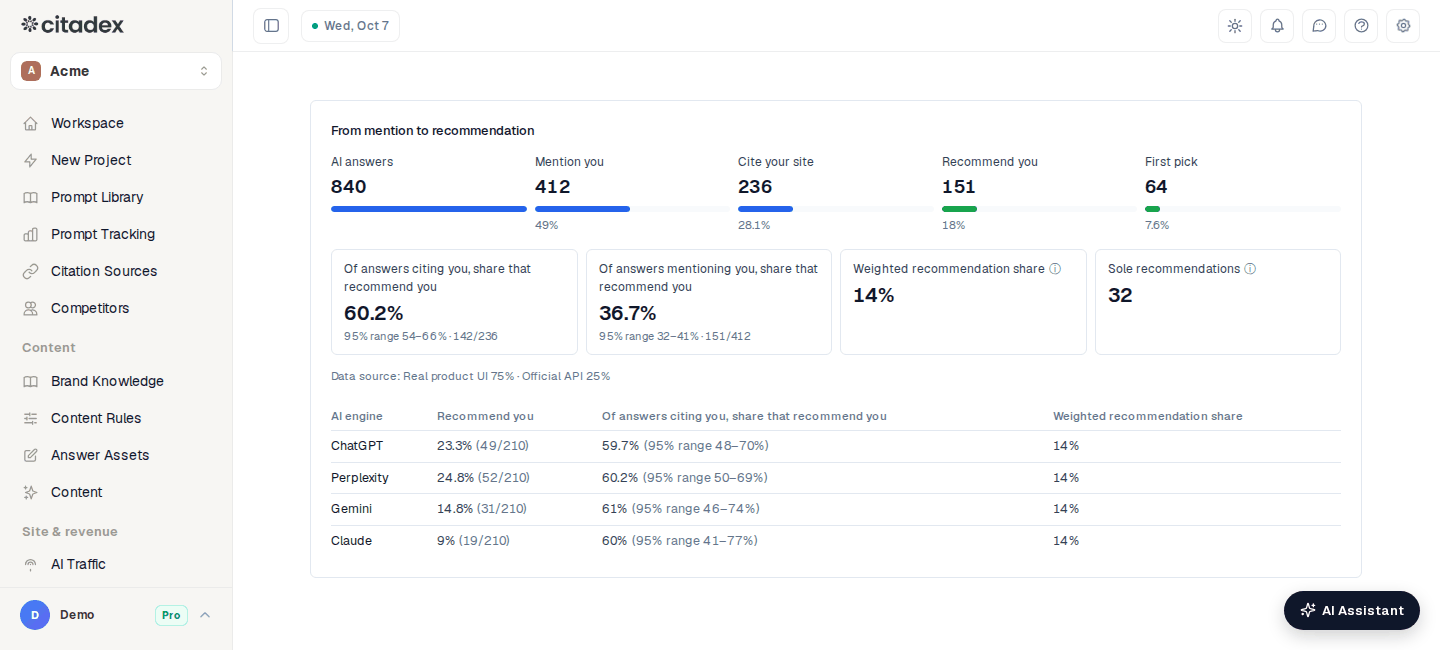
The “From mention to recommendation” card on the Workspace
Top row: five steps. AI answers → Mention you → Cite your site → Recommend you → First pick, each with the number of answers and its share of all answers. Recommend you includes both first picks and recommendations.
Second row: four figures.
| Figure | Meaning |
|---|---|
| Of answers citing you, share that recommend you | When AI used your site, how often it also recommended you |
| Of answers mentioning you, share that recommend you | When AI named you, how often it recommended you |
| Weighted recommendation share | Each recommendation is weighted by the tracked competitors in the same answer: recommended alone counts 1, alongside 3 competitors counts 1/4. Divided by all answers |
| Sole recommendations | Answers that recommend you and name no tracked competitor |
The first two show a 95% range and the counts, e.g. “95% range 41–63% · 23/45”. Under 10 answers they show only “x/n”.
Data source line: “Data source: Real product UI x% · Official API y%” tells you how many of these answers were captured from the AI product itself and how many from the official API.
By engine: with more than one engine selected, a table lists Recommend you, the cited-to-recommended share and Weighted recommendation share per AI engine. Hover an engine name to see the models used in the period.
The recommendation label on each answer
In Prompt Tracking, open a prompt. At the top of the answer tab you see this answer’s label for your brand, with a one-line reason:
| Label | Rule |
|---|---|
| Top pick | Ranked #1, or the answer explicitly calls it the best choice |
| Recommended | In the top 3, or the answer uses recommending language |
| Listed option | Appears in a list of options without being explicitly recommended |
| Mentioned only | Mentioned in passing only, not listed or recommended |
If a label looks wrong, correct it:
- 1
Open the correction
Under the answer, click Judged wrong?.
- 2
Pick the right result
Choose The brand IS mentioned, The brand is NOT mentioned, or Recommendation should be · Top pick / Recommended / Listed option / Mentioned only. Add a reason under Note (optional) if you like.
- 3
Submit
Click Submit correction. Saved, thank you confirms it. Corrections are kept beside the answer and the answer itself is never changed; in Earlier answers, corrected versions carry a Corrected tag.
Competitors: weighted recommendation per brand
Sidebar Competitors → the Share of Voice table has one row per brand: Appearance rate, Rec. share, Weighted rec., Avg. position and Sentiment. Weighted rec. divides each recommendation by the brands named in that answer (alone = 1, among 3 brands = 1/3), then by the number of answers. Two brands with similar appearance rates can differ a lot here: one is often recommended alone, the other always sits in a long list.
Citation retention, by AI engine
Sidebar Citation Sources → Citation retention tab. The upper part shows each cited page over the last 12 weeks (Steady, New, Dropped, Returned, Occasional), with an Only my site filter. Weeks without scan data never count as dropped.
The By AI engine table below shows how long each engine keeps citing pages:
| Column | Meaning |
|---|---|
| Cited pages | Pages this engine cited |
| Citation half-life | Median time from a page’s best week to the week its citations fell to half |
| Weekly churn | Pages cited last week, scanned this week and no longer cited (last 4 weeks) |
| Re-entry | Pages that dropped out and were cited again; median time in brackets |
A cell with fewer than 3 cases shows Not enough data.
Putting the numbers to work
- Mentioned often, recommended rarely: AI knows you but lacks reasons to put you first. Add facts that support a recommendation: comparisons, pricing, use cases, customer results.
- Cited but not recommended: your page is used as a reference but doesn’t say why to choose you.
- Weighted rec. far below appearance rate: you mostly appear in long lists. Target questions where AI names one answer, such as specific use cases.
- Short half-life on one engine: it rotates sources faster, so refresh your key pages more often for it.
FAQ
Why do I see “3/7” instead of a percentage? That figure has fewer than 10 answers, so the counts are shown directly.
How is weighted recommendation share different from share of voice? Share of voice counts mentions. Weighted recommendation counts only recommendations and discounts each one by how many brands were recommended alongside.
Why doesn’t the label match the position? The label looks at wording as well as position. An answer that lists you #2 but calls you the best choice is a top pick.
Was this article helpful?