
Citation Sources — Find Where AI Gets Its Answers and Get Cited There
The tabs of Citation Sources: citation analysis with kind chips and the "AI can read" column, citation gaps, each page’s citation status, and market health and repair.
What this page is for
AI answers cite a fixed set of sites. This page shows which ones, whether you and your competitors appear on them, and which sources to prioritise. Each tab has one filter row; Market and Prompts at its start apply to every tab; Translate all shows page titles and prompts in the language you pick.
Citation analysis
The filter row also has Engine, Site type, a domain search and the period. Four KPIs in one strip: own-site citation rate, times you were cited, cited domains, uncovered high-citation sources.
The domain table has one row per site:
| Column | Meaning |
|---|---|
| Type | The site category, plus a kind chip: Community, Creator, Government, Academic, Licensed (the publisher has announced a content deal with an AI company; this does not guarantee inclusion in AI answers) |
| Citations, detection rate | How often it was cited; the share of your prompts whose answers listed it |
| You | The share of its citations where your brand also appeared |
| Gap | The higher the gap score, the higher the priority |
| AI can read | From the site's robots.txt: whether the ChatGPT, Gemini, Claude and Perplexity crawlers can read it. Content you place on a site that blocks an AI usually doesn't appear in that AI's answers. Checked weekly |
Expand a row to see the cited pages and the prompts, and open the AI answer.
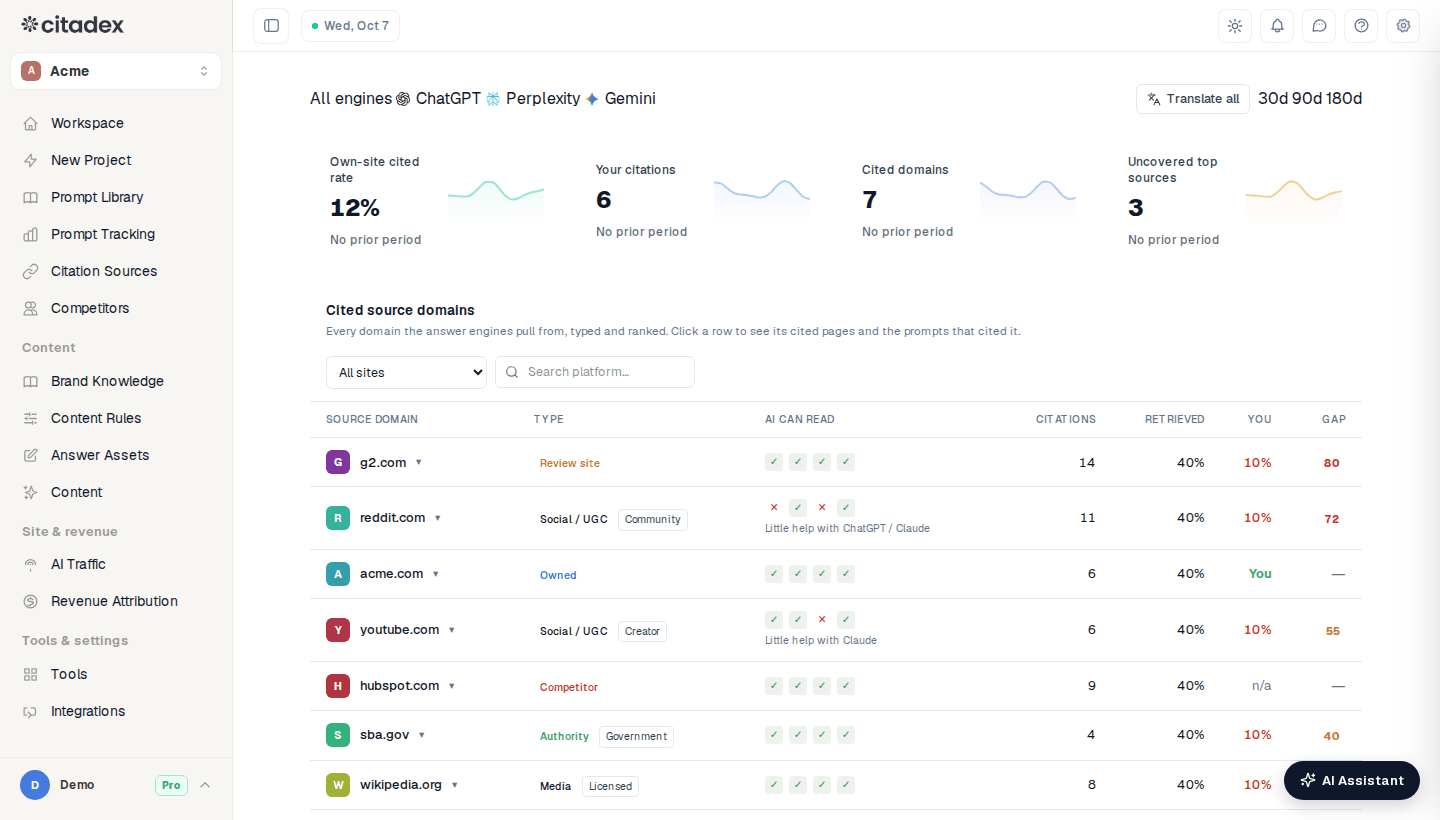
Citation table with kind chips and "AI can read"
Citation gaps
Citation gaps · priority sources lists sources AI cites often, with rivals on them and you missing, calculated for the selected market, and names the competitors mentioned on each site. Every site carries an ownership tag (own, competitor, third party): competitors' own sites never appear as gaps or outreach targets, and vendors' self-published pages rank after independent sources. Actions follow the source type: draft post / find threads / draft reply for communities, video script for video, "View fix" (writing brief) for everything else, plus Outreach for editorial sources.
The other tabs
- Rival-only / Neutral sources. Two buttons in Citation analysis's filter row (the former Citation landscape was merged in); expand a site and each page shows its co-mentioned rivals and N-week trend.
- Citation status. The most-cited pages and the pages in each site’s drill-down carry a citation status (last 12 weeks, this market, all engines): Stable, New (only recently started being cited), Decaying · half-life N wk (still cited, but the citation rate is falling; the drill-down also shows when it is expected to lose citations), Lost (cited before, then not cited in the last few weeks that had scans) or Returned. Weeks without scans never count as a drop; with too little data no status is shown. The Citation status filter shows one status at a time (pages, the domain table and the gap cards together). These are modeled; hover for how. Your own pages that are decaying or lost go to Weekly topics → Content refresh with a diagnosis and next step; when a rival’s page AI cites most is decaying, the New articles evidence says so, and you may want to publish on that topic. Each AI engine’s citation half-life, weekly churn and re-entry are an industry benchmark across customers (shown with at least 5 customers, aggregates only): ask the AI assistant “how long does ChatGPT keep citing a page?”, or use the MCP tool
get_industry_benchmark(citation_lifecycle). The old Citation retention tab was merged here; its links open Citation analysis filtered to Decaying. - Market health & repair. Each market's start-up checklist: for your industry, the sites AI actually reads where you should have official details (the built-in list plus every site AI really cites in answers), in two groups: get listed / claim, and encyclopedias & company databases. In each group a small number of sites, chosen by strength of evidence, are Must-do; the rest sit under N more (optional) and don't count. The header shows Start-up must-dos c/n. When AI cites a page of yours on a site, that site turns Listed by itself. China, Taiwan, Korea, Germany, France, Spanish-speaking markets and Brazil have their own local platform lists. Re-detect verifies on the web. Outreach to media and roundup articles is in Citation analysis: open a site and click Outreach next to the article; forums, Q&A, blogs and video are worked on there too (Find live threads, Draft reply, Draft post, Video script).
From gap to article
View fix → the writing brief dialog → Generate brief → Send to writing page → adjust prompts in Answer Assets → Generate. The resulting article carries a "counter" badge and the source shows "generated n times". Lost citations also show up in This week’s tasks on the Dashboard.
Frequently asked questions
I am cited, so why does it not count as a recommendation? A citation only means AI used content from that page. How many of the answers that cite you also recommend you is on the Dashboard card From mention to recommendation.
"AI can read" says Blocked. Is the site still worth it? It helps little with the AI that is blocked and still works for the others. The column reads “Blocks …” with the engines it blocks, or “All allowed”; hover it for each of the four engines.
Was this article helpful?