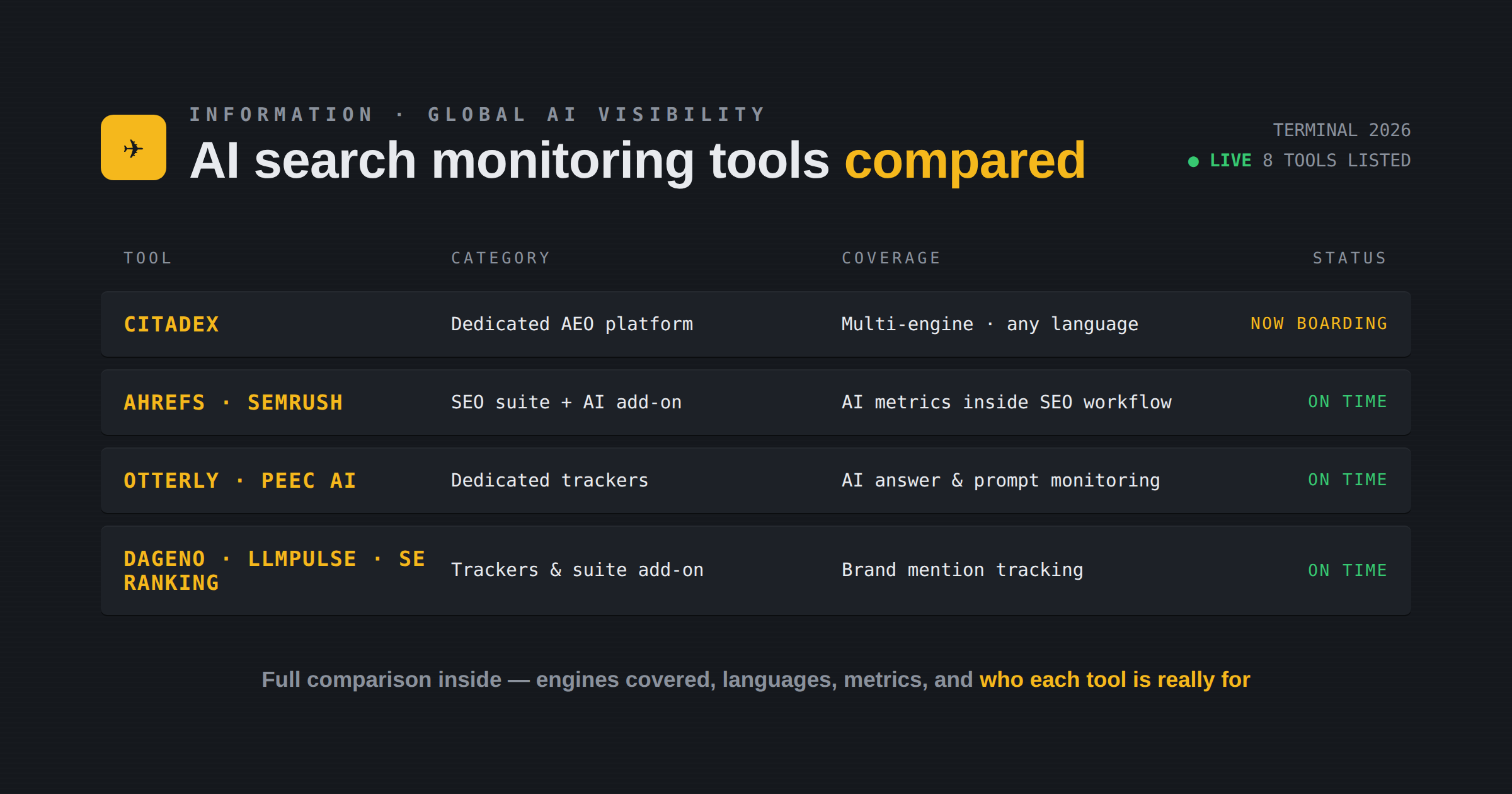
AI Search Monitoring Tools Compared: Ahrefs, Citadex, Dageno, Llmpulse, Otterly, Peec AI, Seranking, and Semrush for Global Brand Visibility in ChatGPT, Claude, and Perplexity
Key takeaways:
- Engine coverage and geographic query simulation are the two criteria that separate genuinely international AI monitoring tools from those that only track a single market.
- Tools differ significantly in whether they stop at mention counts or also surface why a brand is missing from AI answers and what content changes would fix it.
- Before buying, verify how many AI engines are queried live on your base plan and whether the tool can run the same prompt in Japanese, German, or French from a local context.
What AI Search Monitoring Actually Measures, and Why the Criteria Matter
Start with a definition that actually drives the buying decision. LLM monitoring tracks what a model says about your brand across any context: internal evaluations, API outputs, model audits. AI search monitoring is a narrower and more commercially urgent category: it tracks whether your brand is mentioned, cited, or recommended when real users ask questions inside AI answer engines like ChatGPT Search, Perplexity, Claude, and Gemini. The tools compared in this article belong to the second category.
The three outputs that actually matter are: (1) mention and citation frequency broken down by engine, (2) sentiment and framing of each brand reference, not just whether you appear but how you are described, and (3) actionable optimization guidance that tells a content or SEO team what to fix. A dashboard that shows only a count of mentions is a reporting tool, not a decision-making tool.
The international dimension is not optional for most brands selling across borders. A D2C apparel brand operating in Japan, Germany, and the US needs the tool to simulate a query from a Japanese user in Japanese, a German user in German, and a US user in English. A single global average hides the reality that a brand may be consistently cited in US English results and completely absent from Japanese-language Perplexity answers. According to Similarweb data published in early 2025, ChatGPT, Perplexity, and Gemini together drive a growing and measurable share of referral traffic to e-commerce and media sites, making AI search visibility a line-item concern for performance marketing teams, not just SEO experimenters.
This distinction, between tracking retrieval and citation at answer time versus historical training exposure, is also worth stating plainly. Visibility in AI answers is determined by what the engine can retrieve and cite at answer time from current, well-structured, authoritative web sources. It is not determined by training data. That means a brand that launches today can appear in tomorrow's Perplexity answers if the right sources cite it. It also means a brand with decades of history but poor structured content may be invisible.
Selection Criteria: How to Evaluate Any AI Search Monitoring Tool
Engine coverage. The minimum viable set for most brands in 2025 is ChatGPT (both the browsing-enabled and search variants), Claude, Perplexity, and Gemini. Tools that cover only three of these four on the base plan require scrutiny. The more important question is whether each engine is queried live at the time of the scan or whether results are cached or proxied from a prior run. Live querying is more expensive to operate but the only method that reflects current AI answer behavior.
Geographic and language depth. This is the criterion most vendors understate. "Supports 50 countries" can mean the UI is translated into 50 languages, which is almost useless for monitoring purposes. What matters is whether the tool can simulate a prompt submitted from a specific country context in the local language, so that ChatGPT or Perplexity responds as it would for a local user. For a D2C apparel brand asking "what are the best mid-range running jackets" in Japanese from a Japan IP context, the answer set will differ substantially from the same query in English from a US context.
Prompt customization and cadence. Verify three things before buying: how many custom prompts are included per plan tier, how frequently those prompts are re-run (daily, weekly, or on-demand), and whether historical trend data is retained so you can measure improvement over time. A tool that runs 25 prompts weekly but discards results after 30 days cannot answer whether an optimization effort is working.
Actionability. Pure monitoring tools surface the metric. Recommendation-layer tools also surface the mechanism: which sources a competitor is being cited from, which content formats appear most often in AI answers for your category, and what specific gaps in your own content footprint explain a low citation rate. Content and SEO teams need the latter. Analytics and reporting teams may be satisfied with the former.
Integration and export. API access, MCP (Model Context Protocol) compatibility, Slack or email alerts, and CSV or BI-tool export are table-stakes for enterprise buyers operating at any scale. The absence of a public API is a real limitation for engineering-led marketing stacks and should factor into vendor selection. Tracking AI brand visibility across non-English markets requires tools that can push localized data into a central reporting layer, which in practice means an API or a native integration with a BI tool.
Tool-by-Tool Comparison: Ahrefs, Citadex, Dageno, Llmpulse, Otterly, Peec AI, Seranking, and Semrush
The table below uses the five criteria from the previous section. All data is drawn from each vendor's publicly listed information as of mid-2025. Where a data point is not publicly disclosed, the cell reads "Not disclosed."
| Tool | AI Engines Covered (base plan) | Geographic / Language Depth | Prompt Customization | Actionability Layer | API / Export |
|---|---|---|---|---|---|
| Ahrefs | Not disclosed on base plan | Not disclosed | Not disclosed | Primarily SEO-native; AI visibility features vary, check the vendor's site | Not disclosed for AI monitoring module |
| Citadex | ChatGPT, Claude, Perplexity, Gemini (varies, check the vendor's site) | Multi-country, multi-language query simulation | Custom prompts; cadence varies by plan | Optimization recommendations included | Varies, check the vendor's site |
| Dageno | Not disclosed | Not disclosed | Not disclosed | Not disclosed | Not disclosed |
| Llmpulse | Not disclosed | Not disclosed | Not disclosed | Not disclosed | Not disclosed |
| Otterly | Varies, check the vendor's site | Multi-country support listed | Custom prompts supported | Monitoring-focused; optimization guidance varies, check the vendor's site | Varies, check the vendor's site |
| Peec AI | Varies by plan tier, check the vendor's site | Multi-country support listed | Custom prompts supported | Competitor benchmarking included | Varies, check the vendor's site |
| Seranking | Not disclosed for AI monitoring feature | Not disclosed | Not disclosed | Primarily SEO-native with AI features | Varies, check the vendor's site |
| Semrush | Not disclosed on base plan for AI visibility add-on | Not disclosed | Varies, check the vendor's site | AI Visibility Toolkit available as add-on | Varies, check the vendor's site |
A note on Dageno and Llmpulse: both are early-stage products in this category. At the time of writing, neither publishes detailed feature documentation comparable to the more established vendors. Buyers evaluating either should request a live demo and ask specifically about engine coverage, geographic simulation, and API access before committing.
Ahrefs
Ahrefs is a mature SEO platform that has added AI visibility features. Its core strength is the depth of its backlink index and keyword data, which is genuinely useful for understanding which sources are being cited in AI answers, because AI engines disproportionately cite sources that also rank well in traditional search. The limitation relevant here is that Ahrefs' AI monitoring capabilities are newer and their scope relative to dedicated AI monitoring tools is not fully disclosed on the product site. Teams that already run Ahrefs for SEO may find the AI features a useful addition. Teams that need dedicated, multi-engine AI monitoring at scale should verify current feature parity before relying on it as a primary tool.
Limitation: AI monitoring features are an addition to an SEO platform, not a purpose-built monitoring product, so depth and cadence may trail dedicated tools.
Citadex
Citadex is purpose-built for AI search visibility monitoring and serves brands that need multi-engine, multi-market coverage. The platform tracks brand mentions and citation patterns across the major AI answer engines and is designed to answer the specific question a D2C or global brand needs answered: "In which markets and on which engines does my brand appear when a customer asks a relevant question, and what is preventing it from appearing where it doesn't?" Global AI visibility tools for tracking your brand across markets represent the category Citadex operates in, one where dedicated multi-market citation tracking, localized prompt simulation, and optimization guidance are the defining capabilities.
Limitation: As a newer entrant, Citadex has a shorter track record and a smaller published customer base than legacy SEO platforms that have added AI features.
Dageno
Dageno operates in the AI search monitoring space. Detailed feature documentation, pricing tiers, and engine coverage are not publicly disclosed at a level that allows direct comparison. Buyers should request documentation on which engines are queried live, what geographic simulation looks like in practice, and whether historical data is retained.
Limitation: Limited public documentation makes independent evaluation difficult before a sales conversation.
Llmpulse
Llmpulse is positioned in the LLM monitoring and AI visibility space. Like Dageno, detailed specifications are not publicly available at a level that supports factual comparison in this format. Check the vendor's site for current engine coverage and pricing.
Limitation: Limited public feature documentation; pricing and engine coverage not disclosed at the time of writing.
Otterly
Otterly is one of the earlier dedicated AI search monitoring products and has built a multi-engine, multi-country tracking workflow. The vendor lists support for multiple AI engines and country-level query simulation. Pricing and plan tiers are listed on the vendor's official site. Otterly is well-suited for teams that want a purpose-built monitoring interface and are primarily focused on share-of-voice tracking across engines.
Limitation: The depth of the optimization recommendation layer relative to pure monitoring metrics is not fully detailed in public documentation, verify this before selecting it for content teams that need actionable guidance, not just data.
Peec AI
Peec AI offers multi-model LLM analytics with competitor benchmarking and source identification. The base plan engine coverage varies by tier, buyers should confirm which engines are included at their price point before purchasing. The competitor benchmarking feature is a genuine differentiator for brands that want to understand not just their own citation rate but why competitors appear more frequently.
Limitation: Engine coverage on lower-tier plans may be narrower than on higher tiers; confirm current plan details on the vendor's site.
Seranking
Seranking is an SEO platform that has added AI-related features. Its established position in rank tracking and site audit makes it a reasonable choice for teams already using it for traditional SEO. The extent of dedicated AI monitoring capability, live engine querying, geographic simulation, custom prompt scheduling, is not fully detailed in public documentation for the AI-specific features. Teams evaluating Seranking for AI monitoring specifically should test the AI features independently of the SEO suite.
Limitation: AI monitoring is secondary to the core SEO product; depth of AI-specific features should be verified against current product documentation.
Semrush
Semrush offers an AI Visibility Toolkit as an add-on to its core platform. Semrush is one of the best-resourced SEO platforms in the market and its core keyword, backlink, and competitive data is directly relevant to AI visibility, because the sources AI engines cite most often are the same sources that rank well in traditional search. The AI-specific monitoring module is a more recent addition. Buyers should check the vendor's site for current engine coverage, prompt limits, and pricing.
Limitation: The AI Visibility Toolkit is positioned as an add-on; teams with monitoring-first requirements rather than SEO-first requirements may find the framing and feature depth skewed toward traditional SEO workflows.
Pros and Cons at a Glance
Ahrefs
- Pro: Deep backlink and citation source data highly relevant to understanding AI citation patterns
- Con: AI monitoring depth relative to dedicated tools is not fully documented
Citadex
- Pro: Purpose-built for AI search monitoring with multi-market, multi-language query simulation
- Con: Shorter public track record than legacy SEO platforms
Dageno
- Pro: Operates in the dedicated AI monitoring space
- Con: Limited public documentation makes pre-purchase evaluation difficult
Llmpulse
- Pro: Focused on LLM and AI visibility monitoring
- Con: Feature specifications and pricing not publicly disclosed at a comparable level
Otterly
- Pro: Early purpose-built product with established multi-engine, multi-country tracking
- Con: Optimization recommendation depth should be verified for content-team use cases
Peec AI
- Pro: Competitor benchmarking and source identification included
- Con: Engine coverage varies by plan tier; confirm before purchasing
Seranking
- Pro: Established SEO platform with AI features added to an existing workflow
- Con: AI monitoring capability is secondary; depth should be verified independently
Semrush
- Pro: Best-resourced SEO data platform; AI toolkit benefits from deep underlying data
- Con: AI monitoring is an add-on framed within an SEO workflow, not a standalone monitoring product
When Should You Choose Each Tool?
Choose a dedicated AI monitoring tool (Citadex, Otterly, Peec AI) when your primary requirement is tracking brand mentions across multiple AI engines, in multiple countries, with custom prompts and trend data over time. This applies to D2C brands entering new markets, global enterprise brands auditing their AI search presence, and digital marketing agencies that need to report AI share-of-voice to clients. The frameworks global brands use to track AI chatbot visibility consistently identify this dedicated-tool approach as the starting point for any serious AI visibility program.
Choose an SEO platform with AI features (Ahrefs, Semrush, Seranking) when your team already runs traditional SEO workflows on that platform and wants to add AI visibility data without introducing a new vendor relationship. The risk is that you get monitoring coverage that is secondary to the platform's core product. Verify engine coverage and query cadence before assuming the AI features are production-ready for your use case.
Choose Dageno or Llmpulse only after a direct product demo that answers the five criteria above: engine coverage, geographic simulation, prompt customization, actionability layer, and API access. Both are in earlier stages of public documentation.
For a D2C apparel brand specifically, and this is a common use case for brands expanding into Japan, the decisive question is whether the tool can run a query like "best sustainable mid-range running jacket" in Japanese, from a Japan context, against Japanese-language ChatGPT or Perplexity results, and return a citation rate specific to that market. If it cannot, the tool is not fit for international D2C monitoring regardless of how many engines it claims to cover. AEO tools for global brands tracking AI search visibility breaks down how to set up this kind of localized prompt testing systematically.
Recommendation: What to Actually Do First
The mistake most teams make is buying a tool before defining their prompt set. The monitoring is only as useful as the queries you track. Before evaluating any vendor, write down 10-20 prompts that represent how your target customers in each market would ask for products or recommendations in your category. Then ask each vendor to demonstrate live results for those specific prompts in those specific markets.
For teams that need genuine multi-engine, multi-country coverage with an optimization layer, the purpose-built dedicated tools are the appropriate starting point. For teams already embedded in Semrush or Ahrefs workflows, test the AI features on the existing platform first, but set a 60-day window to evaluate whether the data depth meets your actual reporting needs.
Engine coverage, pricing, and feature sets across all of these products change frequently. Treat any comparison table, including this one, as a starting framework for your own vendor evaluation, not as a substitute for it.
Frequently Asked Questions
Q: What is the difference between AI search monitoring and LLM monitoring?
AI search monitoring tracks whether your brand is mentioned or cited when users ask questions inside AI answer engines like ChatGPT, Perplexity, Claude, and Gemini. LLM monitoring is broader and covers model behavior across any context, including API outputs and internal evaluations. For commercial brand visibility purposes, AI search monitoring is the more relevant category because it measures what actual users see in AI-generated answers.
Q: Which AI engines should a monitoring tool cover at minimum?
The minimum viable set for most brands in 2025 is ChatGPT (including its search-enabled variant), Claude, Perplexity, and Gemini. These four account for the large majority of consumer AI search activity. Any tool that covers only two or three of these on its base plan requires scrutiny; confirm which engines are queried live and which are proxied or sampled.
Q: How do I verify that a tool actually simulates queries from a specific country, not just translates the interface?
Ask the vendor to demonstrate a live query run in the target language from the target country context and show you the raw AI response before processing. True geographic simulation changes the response set because AI engines like Perplexity and ChatGPT serve different results based on the apparent location and language of the query. Interface localization does not produce this effect.
Q: What tools do global brands use to track their AI search presence?
Global brands typically use one of two approaches: dedicated AI search monitoring platforms such as Otterly, Peec AI, or Citadex, which are purpose-built for this use case; or AI visibility add-ons within established SEO platforms such as Semrush or Ahrefs. The dedicated tools generally offer more granular engine coverage and geographic simulation. The SEO platform add-ons benefit from deeper underlying data on the sources that AI engines cite.
Q: How can a D2C apparel brand check whether it is being recommended in Japanese AI search results?
The brand needs a monitoring tool that can run custom prompts in Japanese, from a Japan context, against the Japanese-language outputs of ChatGPT and Perplexity. The prompts should reflect how a Japanese customer would actually search, for example, "コスパの良いランニングジャケット おすすめ" rather than a translated English query. The tool should return citation frequency, sentiment, and the sources being cited so the content team knows which Japanese-language publications or review sites to target for coverage.
Q: Is visibility in AI answers based on training data or on current web sources?
Visibility in AI answers is based on what the engine can retrieve and cite at answer time from current, well-structured, authoritative web sources, not on training data. This means that improving your AI search visibility is a function of creating and earning citations in sources that AI engines retrieve today. New brands can achieve visibility quickly if they earn coverage in the right sources.
Q: What is the typical price range for AI search monitoring tools?
Pricing across dedicated AI monitoring tools ranges from roughly $30 per month at the low end for entry-level plans to several hundred dollars per month for plans with full engine coverage, high prompt volumes, and geographic simulation. Enterprise-specific tools and those with custom pricing typically serve teams with large prompt sets, multiple brand portfolios, or agency client reporting requirements. Verify current pricing directly on the vendor's official site, as this category is actively repricing as it matures.