Key takeaways:
- Agencies need per-project pricing, isolated client workspaces, and full white-label branding to profitably resell AI visibility as a service.
- Most AI visibility platforms price per seat or per prompt, not per client project, which erodes agency margins as the client roster grows.
- Full white-label control means client-facing dashboards, invite emails, and reports show the agency's brand, not the vendor's.
AI visibility platforms give brands the data to understand and improve how they appear inside ChatGPT, Perplexity, Gemini, and other AI engines. For agencies, the purchase decision is different from the one a brand makes directly: the platform needs to handle multiple clients cleanly, price predictably as the roster grows, and present itself entirely under the agency's name. This comparison evaluates seven platforms against those criteria, using each vendor's own published information.
What White-Label AI Visibility Actually Means for Agencies (and What It Does Not)
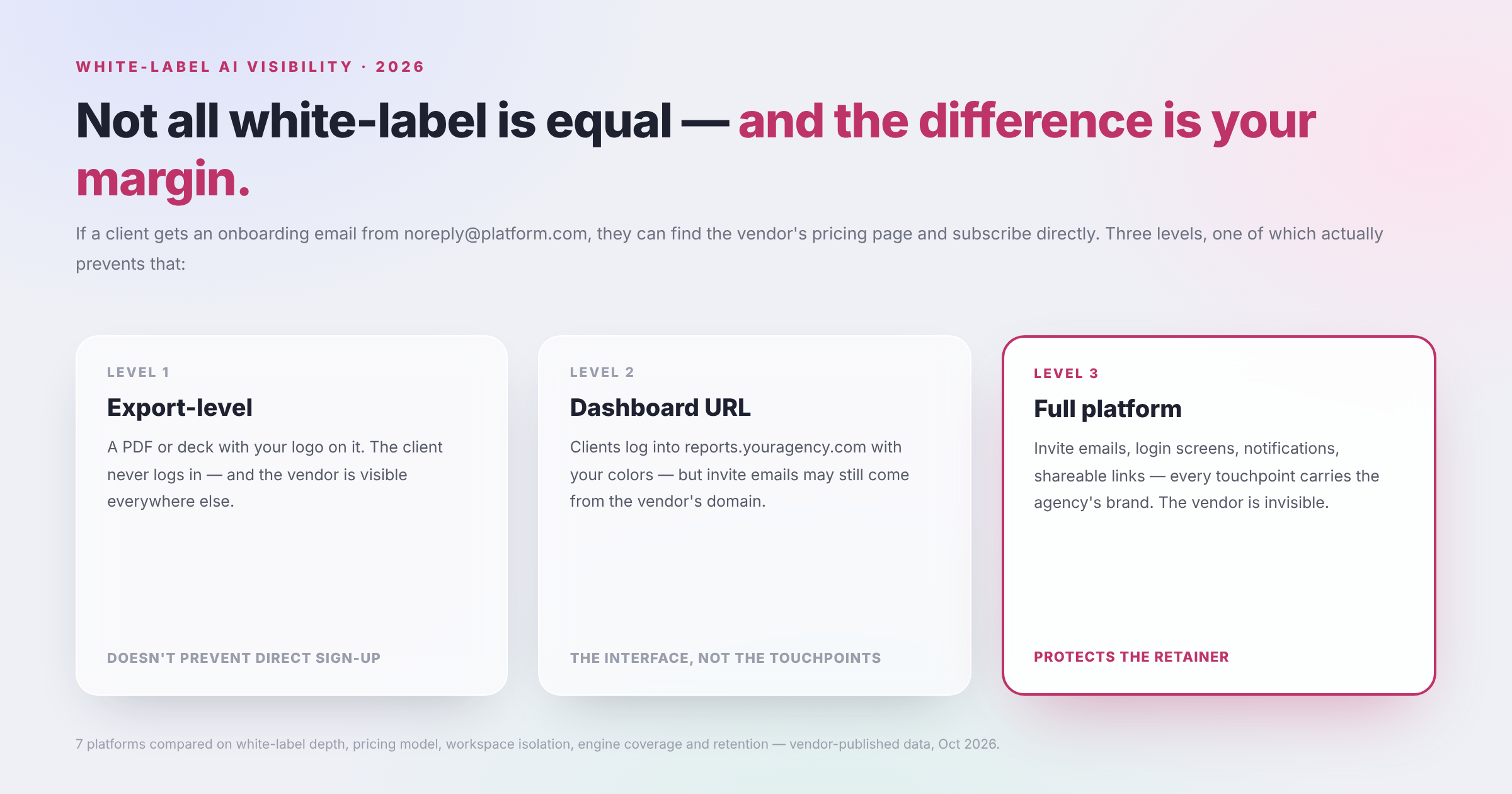
Not all white-labeling is equal, and the difference is commercially significant. There are roughly three levels:
Export-level white-label. The platform generates a PDF or slide deck with the agency's logo on it. The client never logs into anything. This is the most common offering and the easiest to build. It protects the agency's brand on deliverables but does nothing to hide the underlying vendor during day-to-day platform use.
Dashboard URL white-label. Clients log into a subdomain the agency controls, such as reports.youragency.com, and see the agency's logo and color scheme. The underlying vendor is obscured from the interface, but invite emails and account notifications may still arrive from the vendor's own domain.
Full platform white-label. Every client-facing touchpoint, including invite emails, login screens, in-app notifications, and shareable report links, carries the agency's brand. The vendor is invisible to the client at every stage of interaction.
The commercial reason this distinction matters is not subtle. If a client receives an onboarding email from noreply@platform.com, they can search that name, find the vendor's pricing page, and subscribe directly. The agency loses the recurring margin it was charging for that client. Export-only white-labeling does not prevent this. Full platform white-labeling does.
Beyond branding, reselling AI visibility as a service requires three additional capabilities that are often lumped under "white-label" but are separate concerns:
Client workspace isolation. Each client's prompt sets, competitor tracking data, historical records, and reports must be fully separated. No client should see another client's data, even accidentally. This is both a confidentiality requirement and a practical one: a shared workspace becomes unmanageable past three or four clients.
Agency-level account management. One login to manage all client projects, with the ability to control which features each client can access, set them as view-only or collaborative, and keep billing consolidated under a single invoice.
Pricing that scales with client count. A per-seat model charges based on users. Add two client stakeholders per client and a team of five and the seat count grows faster than the revenue. A per-prompt model is similarly unpredictable when clients request additional testing mid-month. Per-project flat pricing is the only model that lets an agency set a known cost floor per client at contract signing.
Most articles reviewing AI visibility tools treat any branded export as "white-label." The sections below apply the stricter three-tier definition to each platform in this comparison.
How to Evaluate an AI Visibility Platform as an Agency: Six Criteria That Matter
Choosing a platform for direct brand use and choosing one to resell as a service are different decisions. Six criteria separate tools that work well for agencies from those built primarily for in-house marketing teams.
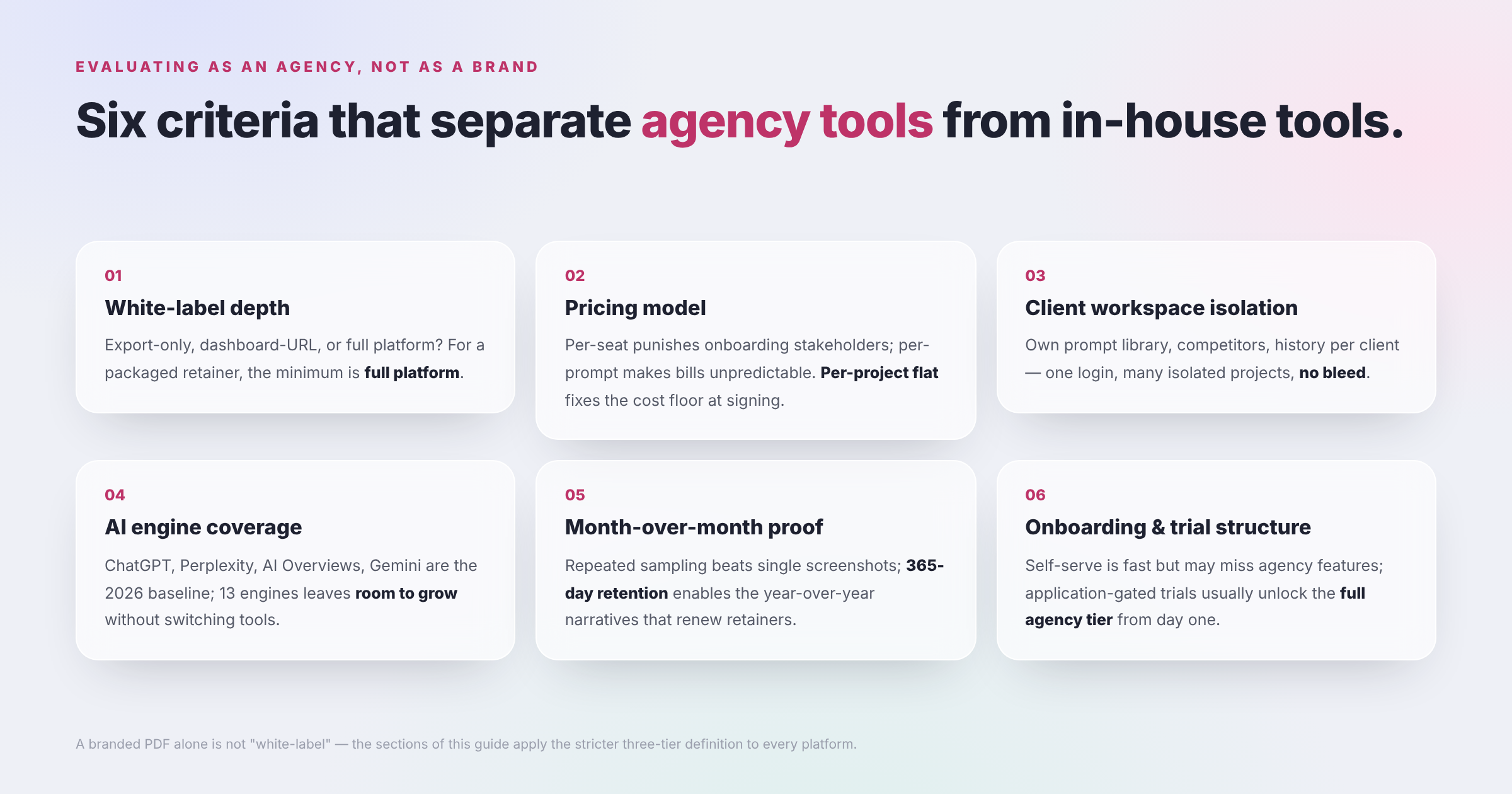
White-label depth. Does the tool reach export-only, dashboard-URL, or full platform white-label? The minimum useful level for a professional agency is dashboard-URL. The minimum required for a packaged retainer product where clients never know the vendor's name is full platform.
Pricing model. Per-seat pricing punishes agencies for onboarding client stakeholders. Per-prompt pricing creates unpredictable monthly bills when clients ask for re-tests or expanded keyword sets. Per-project flat pricing is the cleanest model: one monthly fee per client brand, regardless of how many people need access or how many internal re-tests the team runs. Some platforms also offer per-language-market add-ons at a flat rate, which keeps expansion costs predictable.
Client workspace isolation. Each project should have its own prompt library, competitor set, history, and reporting, with no bleed between clients. Platforms that handle this at the account level (one login, many isolated projects) are more manageable than those requiring separate logins per client.
AI engine coverage. Clients will ask whether they appear in the engines their customers use. ChatGPT, Perplexity, Google AI Overviews, and Gemini are the baseline for most markets in 2026. Agencies serving enterprise clients or non-English markets should look for coverage of Claude, Microsoft Copilot, DeepSeek, Grok, and market-specific engines. A platform covering 13 engines gives an agency room to grow without switching tools as client requirements expand.
Month-over-month proof. AI engine responses are non-deterministic: the same prompt can return different answers on different days. Platforms that query each prompt multiple times per period and average the results produce more statistically defensible visibility scores than single-point-in-time captures. Data retention matters here too. Ninety-day retention lets an agency show a quarter of trend. Three hundred sixty-five days of retention enables year-over-year comparisons and seasonal narratives, which are the kind of evidence that keeps retainer clients renewing.
Onboarding and trial structure. A self-serve free trial with a credit card is fast to start but may not include the multi-client features an agency actually needs to evaluate. An application-gated trial takes longer to access but typically comes with full agency-tier capabilities from day one, including the white-label and workspace isolation that matter most. Agencies evaluating quickly should confirm which platform tier the trial unlocks.
Side-by-Side Comparison: Seven AI Visibility Platforms Evaluated for Agency Use
The table below covers the seven platforms for which verified, per-tool data is available from each vendor's official site. LLM Pulse is not included because no independently verifiable per-feature data from its own official site was available at time of writing; it appears briefly in the decision framework below on the basis of what is publicly observable.
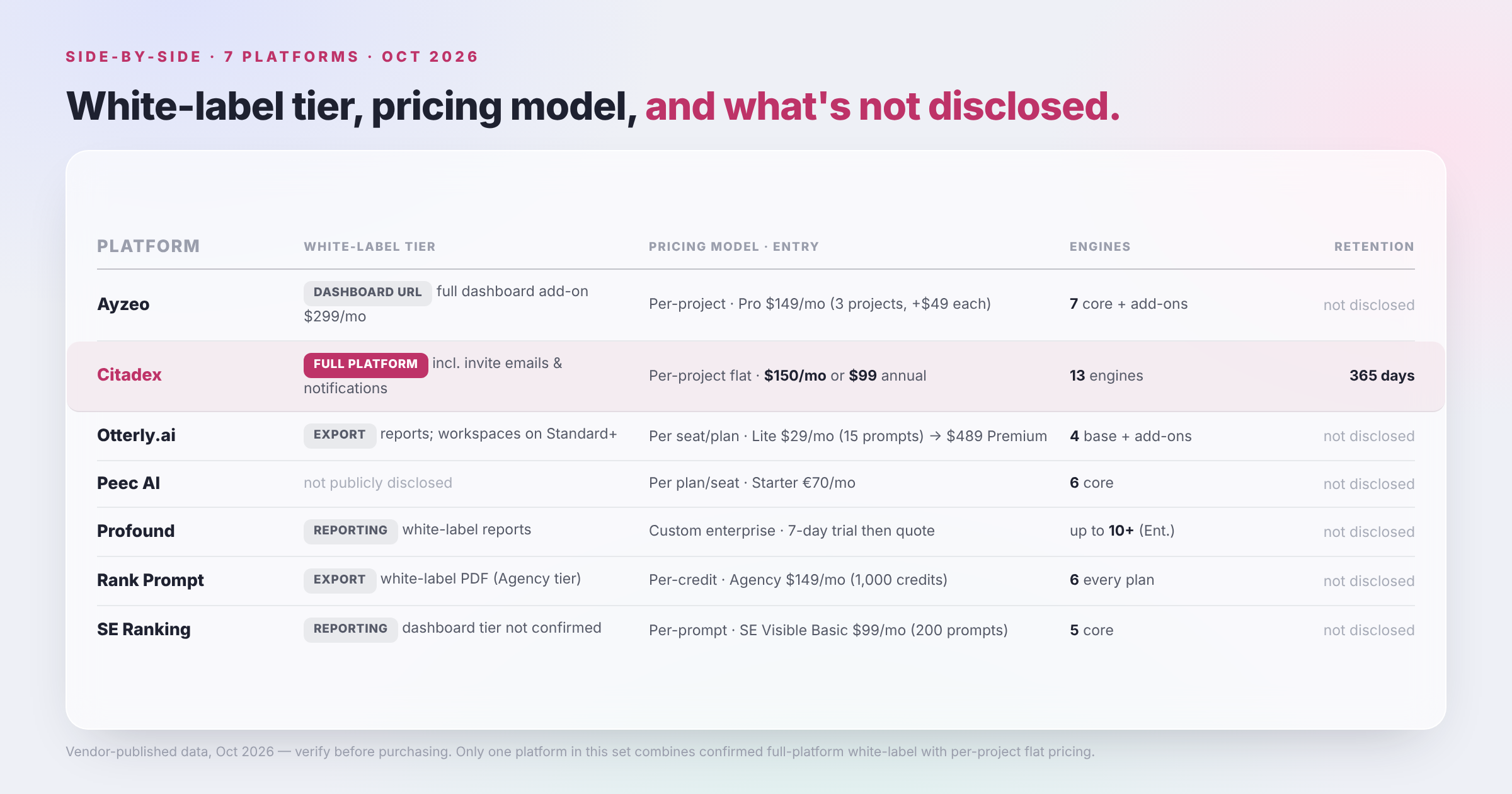
| Platform | White-Label Tier | Pricing Model & Entry Price | AI Engines Covered | Client Workspace Isolation | Historical Data Retention | Free Trial |
|---|---|---|---|---|---|---|
| Ayzeo | Dashboard URL (Pro); Full dashboard add-on $299/mo | Per-project (3 included in Pro); $49/mo each additional | 7 core + modular add-ons | Yes (per-project model) | Not publicly disclosed | Free analysis tool; no trial listed |
| Citadex (Agency Plan) | Full platform (dashboards + invite emails + notifications) | Per-project: $150/mo (monthly) or $99/project/mo (annual) | 13 AI engines | Yes, fully isolated per project | 365 days | 14-day trial (application-gated); 1 project, up to 3 markets |
| Otterly.ai | Export-level (white-label reports); workspace isolation on Standard+ | Per seat/plan; Lite $29/mo (15 prompts); Standard $189/mo; Premium $489/mo | 4 base + add-ons (Gemini, Claude, AI Mode at $9–$149/mo) | Yes on Standard+ (unlimited workspaces) | Not publicly disclosed | 7 days, no card |
| Peec AI | Not publicly disclosed | Per plan/seat; Starter €70/mo; Pro €180/mo; Advanced €360/mo | 6 core; Enterprise adds Claude, DeepSeek, Grok | Not publicly disclosed | Not publicly disclosed | Yes (15% discount annual) |
| Profound | White-label reporting available | Custom Enterprise pricing; 7-day trial then custom quote | Starter: ChatGPT only (legacy); Growth: 3 engines; Enterprise: 10+ | Not publicly disclosed | Not publicly disclosed | 7 days |
| Rank Prompt | White-label PDF reports (Agency tier) | Per-credit; Agency $149/mo (1,000 credits); Enterprise custom | 6 on every plan (ChatGPT, Claude, Gemini, Grok, Perplexity, Google AI Mode/Overviews) | Yes (Agency tier: multi-client management for 10+ brands) | Not publicly disclosed | 7 days, no card (50 credits) |
| SE Ranking | White-label reporting (SE Visible plans); not confirmed at dashboard-URL tier | Per-prompt/plan; SE Visible Basic $99/mo (200 prompts); Core $189/mo (450 prompts) | 5 core (ChatGPT, Google AI Mode, Google AI Overviews, Gemini, Perplexity); Claude coming soon | Not publicly disclosed | Not publicly disclosed | 14 days (no card for SE Visible) |
Plain-English summary: Citadex is the only platform in this set with confirmed full platform white-label (invite emails, dashboards, and notifications under the agency's brand) combined with per-project flat pricing. Rank Prompt and Ayzeo offer white-label at the export or dashboard level. SE Ranking, Otterly.ai, Peec AI, and Profound offer varying white-label depths; workspace isolation and per-project pricing are either absent or not publicly disclosed for most of them.
Tool-by-Tool Breakdown: Agency Fit, Strengths, and Gaps
Ayzeo
Ayzeo covers 7 AI engines at its core tiers (ChatGPT, Google AI Overviews, Claude, Perplexity, Gemini, DeepSeek, and Grok), with modular add-ons at $29 per month each. The Pro plan at $149 per month includes 3 client projects and white-label PDF and DOCX report exports, alongside GA4 integration and brand sentiment tracking. A full white-label dashboard is available as a separate add-on at $299 per month.
The per-project structure (3 included in Pro, $49 per month each additional) is a reasonable foundation for agencies managing up to roughly 10 clients, though the add-on dashboard cost raises the effective price for agencies that need clients to log into a branded environment. Unlimited seats across plans removes one cost variable.
The gap worth noting: data retention period is not publicly disclosed, which makes it difficult to confirm whether the platform can support year-over-year trend reporting. Agencies should ask directly before committing.
Citadex
Citadex's agency plan is built around the reseller use case. White-label is not an add-on but a default feature of approved agency accounts: client-facing dashboards run under the agency's own domain, invite emails arrive from the agency's brand, and clients see only the projects they have been granted access to. Each project is fully isolated, with its own prompt library, competitor tracking, and history.
The pricing model is per-project flat rate: $150 per month on monthly billing or $99 per project per month on annual billing. Each project includes one market; additional language or country markets cost $10 per month each on annual billing. Unlimited team seats are included, meaning onboarding two or three client stakeholders per project does not increase the monthly bill. Thirteen AI engines are covered across all agency projects.
Data retention runs to 365 days, which supports seasonal trend reporting and year-over-year comparisons. The platform also includes a repeated-sampling feature (querying the same prompt multiple times per engine per period) for more statistically stable scores, available on agency accounts. Answer-asset generation, which produces AI-optimized content for prompts where the client does not currently appear, adds a billable deliverable to the agency's service offering.
The practical gap: onboarding is application-gated. Agencies cannot self-serve into a trial; they apply, go through a review, and then receive a 14-day trial with one project and up to three markets. For agencies evaluating quickly, that lag is worth factoring in.
Otterly.ai
Otterly.ai has the lowest self-serve entry price in this set at $29 per month for the Lite plan, covering 15 prompts and 4 base engines (ChatGPT, Google AI Overviews, Perplexity, and Microsoft Copilot). Additional engines (Gemini, Claude, AI Mode) are available as paid add-ons ranging from $9 to $149 per month depending on the plan tier.
For agency use, unlimited workspaces and Looker Studio integration are available on the Standard plan ($189 per month) and above. The 7-day no-card trial makes it easy to evaluate. White-label is offered at the export level.
The limiting factor for multi-client agency work at the entry tier is prompt volume. Fifteen prompts covers a single small client. An agency managing 10 clients at 20 prompts each needs 200 prompts, which requires the Premium plan at $489 per month. That math works for some agencies but reduces the initial price appeal. Historical data retention is not publicly disclosed.
Peec AI
Peec AI covers 6 core engines (ChatGPT, Perplexity, Gemini, Microsoft Copilot, Google AI Overviews, and Google AI Mode), with Claude, DeepSeek, and Grok available via API on Enterprise plans. Language support is broad: 80+ countries with no extra language cost, which is relevant for agencies serving non-English clients.
The Starter plan at €70 per month (approximately $82 USD) includes 50 prompts across 3 chosen models and unlimited users. Agency-specific bundles are listed as available, though the specifics of white-label depth and workspace isolation at those bundles are not publicly disclosed. All plans include unlimited seats.
The gap: white-label tier and client workspace isolation details are not confirmed on the official pricing page, making it difficult to assess how well the tool supports full agency platform white-labeling without direct inquiry.
Profound
Profound positions toward enterprise accounts. Its Growth plan covered 3 engines (ChatGPT, Perplexity, Google AI Overviews); the Enterprise tier extends to 10 or more engines including Gemini, Claude, Grok, DeepSeek, Meta AI, and Copilot. White-label reporting is available, and SOC 2 Type II compliance makes it a viable option for enterprise clients with security requirements.
Self-serve plans were removed in September 2026. Pricing is now entirely custom, with a 7-day free trial available as the entry point. The implication for agencies is that cost at scale is determined through a sales conversation, not a pricing page.
Historical data retention, workspace isolation specifics, and the mechanics of per-client pricing are not publicly disclosed. For agencies that need a definitive cost structure before signing, Profound requires a more involved evaluation process.
Rank Prompt
Rank Prompt covers 6 engines on every plan (ChatGPT, Claude, Gemini, Grok, Perplexity, and Google AI Mode/Overviews). The Agency tier at $149 per month includes 1,000 credits and multi-client management designed for 10 or more brands. White-label PDF reports are available at the Agency tier.
The credit-based pricing model means usage is metered: re-testing prompts after content changes or expanding a client's prompt set mid-month draws down the credit pool. That makes costs somewhat variable, though the Agency tier's 1,000-credit allocation is generous enough for most mid-sized agency workloads.
White-label at the dashboard-URL or full-platform tier is not confirmed from the official site. Agencies that need clients to log into a branded environment, rather than just receive branded reports, should verify this before committing. Rank Prompt launched in June 2025, making it the newest entrant in this comparison.
SE Ranking
SE Ranking's AI visibility offering comes in two forms: an add-on to existing SE Ranking SEO subscriptions, and a standalone product called SE Visible. SE Visible Basic covers 200 prompts across 5 engines (ChatGPT, Google AI Mode, Google AI Overviews, Gemini, and Perplexity) for $99 per month; the Core tier offers 450 prompts for $189 per month. Claude is listed as coming soon. Annual billing reduces both by 20%.
For agencies already paying for SE Ranking's SEO suite, the AI add-on may be the most cost-efficient route to adding AI visibility tracking without a separate platform subscription. The practical limitation is that AI visibility is layered onto an SEO-first tool rather than being the primary purpose.
White-label client reporting is listed as a feature, but dashboard-URL or full-platform white-label is not confirmed. Data retention and client workspace isolation are not publicly disclosed. This makes SE Ranking most appropriate for agencies that want AI visibility data alongside traditional SEO metrics in a single interface, rather than agencies building a standalone AI visibility retainer product.
Pricing Models Decoded: Why Per-Project Beats Per-Seat for Agency Margins
Three pricing structures appear across AI visibility platforms, and they produce materially different outcomes as an agency's client count grows.
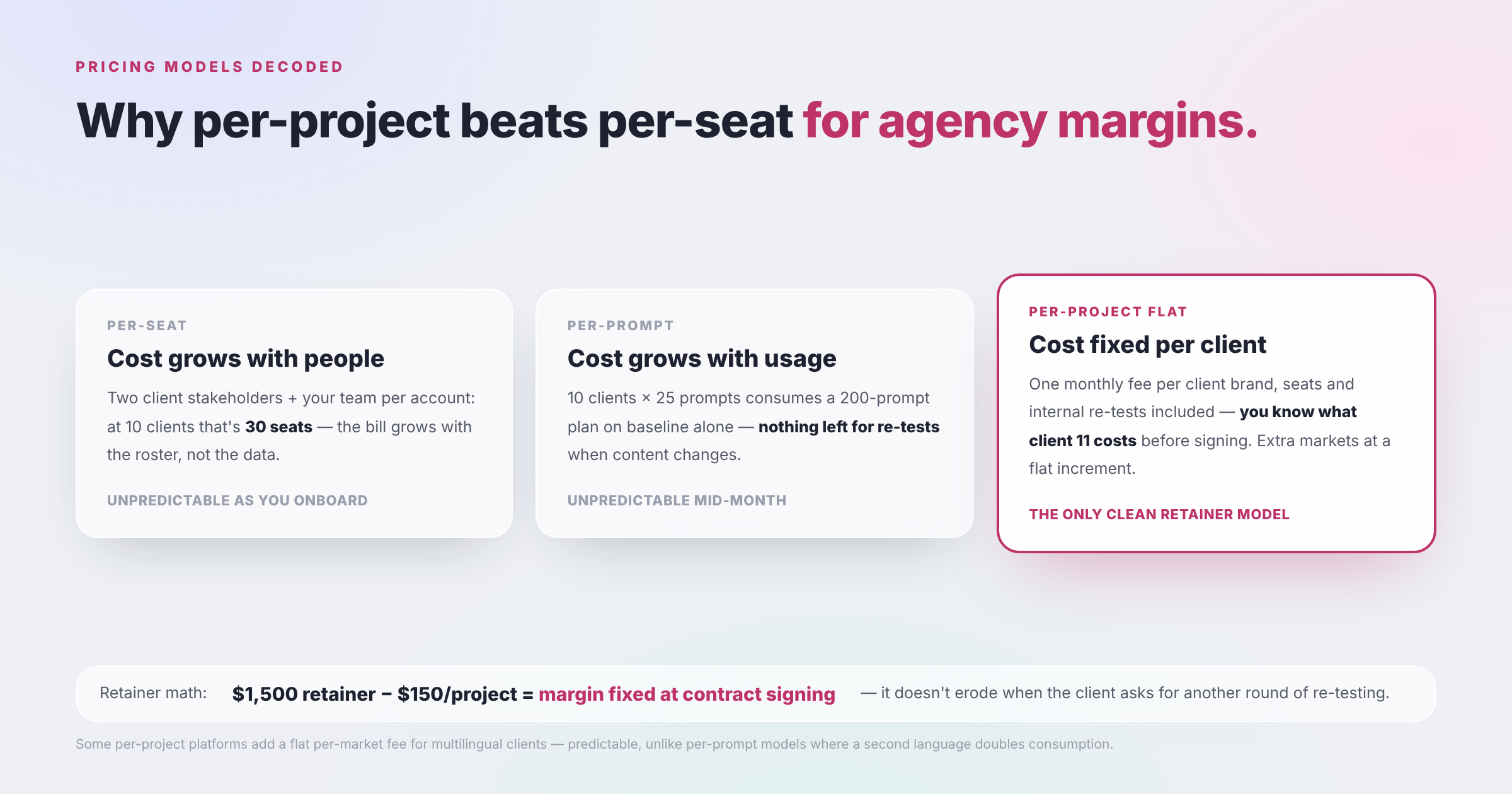
Per-seat. Seat-based pricing charges for every user who needs access. If an agency needs to invite two client stakeholders per account plus one internal team member, that is three seats per client. At 10 clients, 30 seats. The cost grows with the roster regardless of how much data is actually consumed. For platforms with unlimited seats (Peec AI, Otterly.ai, Ayzeo, and Rank Prompt all include unlimited users at their respective tiers), this problem disappears, but the prompt or plan volume may still hit limits.
Per-prompt. Platforms that meter by prompt create unpredictable monthly bills. SE Visible's Basic plan at $99 per month for 200 prompts illustrates the constraint: an agency managing 10 clients at 25 prompts each consumes that entire allocation on baseline tracking with nothing left for re-tests when a client's content changes or new competitors need to be added. Upgrading to the Core tier at $189 per month restores headroom, but the cost step is significant.
Per-project flat rate. One monthly fee per client brand, regardless of seats or internal re-testing volume (within the plan's terms). An agency knows exactly what client 11 will cost before signing the contract. That predictability is what makes a packaged retainer product commercially viable. If the retainer is priced at $1,500 per month and the platform costs $150 per project, the margin is fixed at contract signing and does not erode when the client asks for an extra round of re-testing after publishing new landing pages.
Some per-project platforms add a flat per-market fee when a client needs tracking in multiple languages or countries, rather than multiplying the base project price. That structure remains predictable because each market costs a known increment. Compare this to per-prompt models, where a French-language client requiring separate prompt sets for the French market effectively doubles the prompt consumption and the bill.
The practical implication for agencies building a recurring service: per-project flat pricing is the only model that supports a clean retainer structure. Per-prompt and per-seat models require either a cost buffer or constant monitoring of consumption, both of which erode the margin the retainer was meant to protect.
How Agencies Prove AI Visibility Results to Clients Month Over Month
The core challenge with AI visibility reporting is that AI engine responses are non-deterministic. Send the same prompt to ChatGPT on Monday and Thursday and the answers may differ. That makes a single screenshot essentially useless as evidence of trend.
Platforms that address this run repeated sampling: querying the same prompt multiple times per engine per tracking period and averaging the results into a visibility score. The resulting trend line is statistically more defensible than a point-in-time capture, and it gives an agency something to show a skeptical client: not "your brand appeared once on Tuesday," but "your brand appeared in 74% of sampled responses this month, up from 51% last month."
Building that narrative requires three things to be in place before month one ends. First, a consistent prompt set that mirrors the actual questions the client's target customers type into AI engines. Second, a platform that retains historical data long enough to show trend. Ninety days of retention supports a quarterly review. Three hundred sixty-five days supports year-over-year comparisons and seasonal analysis. Third, a metric that distinguishes brand mention from brand recommendation. A client's brand appearing in a list of ten options is not the same as being the top recommendation. Platforms that surface this distinction let agencies report on quality of visibility, not just frequency.
The attribution layer is what converts the reporting from interesting to financially defensible. Platforms that connect AI referral traffic (via analytics integrations) to pipeline or revenue give agencies data that CMOs and CFOs recognize. "AI-referred sessions increased month-over-month" is useful. "AI-referred sessions contributed to a measurable increase in qualified pipeline" is a retainer-renewal argument.
In practice, a credible agency workflow looks like this: establish a baseline measurement in month one across the agreed prompt set. Run optimizations in months two and three: content creation targeting underperforming prompts, citation building on high-authority sources, corrections to any factual errors AI engines are surfacing about the client's brand. Use the platform's re-test feature after publishing to confirm whether specific changes improved visibility on targeted prompts. Compile a monthly report carrying the agency's brand (not the platform vendor's) showing mention rate, recommendation rate, sentiment shifts, engine-level breakdown, and traffic contribution. That report is the client's evidence. The platform's job is to make it credible and reproducible.
Decision Framework: Which Platform Fits Which Agency Situation
Solo consultant or boutique agency (1-5 clients). The priority here is low entry cost and minimal setup friction. Otterly.ai's 7-day no-card trial and $29-per-month Lite entry point make it easy to start, though 15 prompts at that tier covers only a single small client. For a consultant with two or three active clients wanting basic monitoring and branded PDF exports, Rank Prompt's Agency tier at $149 per month covering up to 10+ brands with 1,000 credits is a more practical fit. Full platform white-label is not confirmed for either, meaning clients may receive branded reports but log into the vendor's environment if they need platform access.
Growing agency adding AI visibility as a new service line (5-20 clients). This is the scenario that exposes per-seat and per-prompt pricing most clearly. An agency at this stage needs per-project flat pricing, isolated client workspaces, and full white-label so client stakeholders who log in see only the agency's brand. Citadex's agency plan fits this profile: per-project pricing, full platform white-label including invite emails, and unlimited seats mean the cost structure is predictable and the agency's brand is protected at every client touchpoint. Ayzeo's per-project model is also worth evaluating, with the white-label dashboard add-on required for full branding.
Enterprise agency or consultancy (20+ clients, multinational accounts). Multi-market support becomes a requirement: clients in Germany, Japan, and Brazil need AI visibility tracked in German, Japanese, and Portuguese, respectively. Platforms that charge a flat per-market increment (rather than multiplying the base rate) keep costs manageable. Citadex's per-market add-on pricing is structured this way. Profound's enterprise positioning and 10+ engine coverage are relevant here, though its custom pricing requires a sales conversation to scope total cost.
SEO agency already using SE Ranking. If the agency pays for SE Ranking's SEO suite, adding the SE Visible AI module may be the lowest-friction path to offering basic AI visibility monitoring. The standalone SE Visible Basic plan at $99 per month covers 200 prompts across 5 engines. The practical question is whether that volume and the available white-label depth are sufficient for client-facing retainer work, or whether a dedicated AEO platform better serves the agency's needs.
Agency building a packaged monthly AI visibility retainer. This use case has the most specific requirements: full platform white-label (invite emails included), per-project pricing, and a client-facing dashboard the agency can demo to prospects. Among the platforms with confirmed, verified capabilities on these three points, Citadex's agency plan is the clearest fit. Rank Prompt covers the multi-client management and export-level white-label for agencies that are comfortable with clients receiving branded reports rather than accessing a branded platform.
Three questions to answer before choosing:
- How many clients do you realistically expect in the next 12 months?
- Do clients need to log into a platform under your brand, or is a branded report sufficient?
- Do any of your clients operate in non-English markets requiring language-specific AI tracking?
Common Pitfalls When Agencies Choose an AI Visibility Platform
Confusing export white-label with platform white-label. A tool that generates a branded PDF but sends all client invite emails from the vendor's domain is not a white-label platform. Clients who receive those emails can search the vendor name, find the pricing page, and subscribe directly. Agencies should ask vendors specifically: "What domain and brand name appear on client invite emails?"
Underestimating prompt volume at entry pricing. Fifteen to fifty prompts at entry level works for a single small client. An agency managing 10 clients at 20 prompts each needs 200 prompts just for baseline monitoring, before any re-testing. Calculate total prompt requirements across the expected client roster before signing. The math often pushes agencies to higher plan tiers than the entry price suggests.
Ignoring language and market support. Agencies with non-English clients need platforms that track AI visibility in the relevant language and market. Not every platform publishes its language coverage clearly. Peec AI is explicit about 80+ countries with no extra language cost. Other platforms' coverage should be confirmed directly before committing, particularly for clients in markets where local AI engines are relevant.
Accepting 90-day data retention. A platform that retains 90 days of history forces the agency to manually export and archive data to build year-over-year narratives. Seasonal clients (retail, travel, finance) need year-over-year comparisons to contextualize performance. Prioritize platforms that retain at least 365 days of history natively.
Treating AI mentions as equivalent to AI recommendations. A brand appearing as option seven in a list of ten is not the same outcome as being the top recommendation for a specific query. Agencies that report raw mention frequency without distinguishing recommendation quality will face hard questions from clients who notice their sales pipeline is not moving. Choose platforms that surface this distinction explicitly.
Locking into annual contracts before validating with real clients. Per-project annual pricing is more economical per project, but committing to annual billing across a full client roster before running a real trial with at least one active client is a meaningful financial risk. Use the trial period to run a real client project through the full workflow: prompt setup, baseline measurement, a round of optimization, and a client report. If the platform fails at any of those steps during the trial, the annual commitment is not worth the savings.
Frequently Asked Questions
Q: What is the difference between AEO and GEO?
AEO (Answer Engine Optimization) focuses specifically on optimizing content so that AI engines select a brand as an authoritative answer to a query. GEO (Generative Engine Optimization) is a broader term covering the practices that make content discoverable, citable, and retrievable by generative AI systems across different surfaces. In practice, the two terms are often used interchangeably; the distinction matters mainly when a vendor's methodology is narrowly focused on one surface (such as AI Overviews only) versus a broader cross-engine approach.
Q: Do these platforms work for non-English brands or multilingual agencies?
It depends on the platform. Peec AI explicitly supports 80+ countries with no additional cost per language. Citadex's agency plan supports additional language markets at a flat per-market rate. For other platforms in this comparison, language coverage is not publicly disclosed in verifiable detail. Agencies serving non-English clients should confirm language support directly with each vendor before purchasing.
Q: How long does it take for an agency to show measurable AI visibility improvements to a client?
Content optimizations generally take several weeks to be retrieved and surfaced by AI engines, because retrieval indexes and model knowledge update on their own schedules. Practitioners typically plan for a period of 4 to 12 weeks between publishing optimized content and observing consistent shifts in visibility scores. Agencies should set that expectation with clients at the start of an engagement and establish a baseline in month one so that any improvement is measured against a documented starting point, not a retrospective claim.
Q: Can an agency track a client's ChatGPT mentions without paying for a dedicated platform?
Manual testing in ChatGPT is possible but not viable for agency-scale work. It produces non-deterministic, single-point results; leaves no historical record; cannot be automated or scheduled; and cannot be formatted into a branded client deliverable. A platform that runs repeated sampling, stores historical data, and generates reports under the agency's brand is a different category of tool from manual prompt testing, not just a more convenient version of the same thing.
Q: Which AI engines should agencies prioritize tracking for clients?
ChatGPT, Perplexity, Google AI Overviews, and Gemini cover the majority of AI-assisted search interactions for most English-language markets in 2026. For clients in enterprise or technical audiences, Claude and Microsoft Copilot are also relevant. For clients with exposure to Chinese-language markets, engines such as DeepSeek and domestic Chinese AI platforms matter. Agencies working across multiple markets benefit from platforms that cover a wider engine set, so client tracking can expand without switching tools.
Q: Are AEO/GEO platforms different from traditional SEO tools?
Yes, in a fundamental way. Traditional SEO tools measure keyword rankings in link-based search results, where the ranking signal is primarily based on backlinks, on-page factors, and domain authority. AEO and GEO platforms measure whether a brand is mentioned, cited, or recommended inside AI-generated answers, which operate on different retrieval and ranking logic. The same brand can rank well in traditional search and be absent from AI answers, or vice versa. Agencies that serve clients in both channels need visibility into both surfaces.
Q: Can agencies resell AI visibility monitoring as a standalone monthly retainer service?
Yes, if the platform offers per-project flat pricing and full platform white-label. Those two conditions together allow an agency to set a fixed cost per client, present a branded platform to the client, and build a retainer margin. Platforms with per-seat or per-prompt pricing make retainer packaging harder because the cost per client is variable. Platforms with export-only white-label require the agency to ensure client stakeholders never access the platform directly, which is a constraint on service delivery.