Key takeaways:
- Most AI visibility tools default to English-only tracking, but a small number support multilingual and multi-market monitoring across engines like ChatGPT, Perplexity, and Gemini.
- Tracking brand mentions by language and market separately gives global teams more actionable data than aggregated country-level reports alone.
- The right tool depends on whether you need broad multilingual coverage, competitor benchmarking, agency-style reporting, or enterprise-scale attribution.
AI visibility monitoring tracks how and whether a brand appears inside AI-generated answers, not ranked blue-link results. This has become a core operational practice for any brand competing across more than one market. Seven platforms now offer meaningful coverage of this space: AthenaHQ, BrightEdge, Citadex, Goodie, Otterly.ai, Peec AI, and Profound. Each takes a different approach, and the differences matter far more once a buyer's prompts are in Japanese, Korean, or German rather than English.
What Global AI Visibility Monitoring Means and Why It Differs from Standard SEO
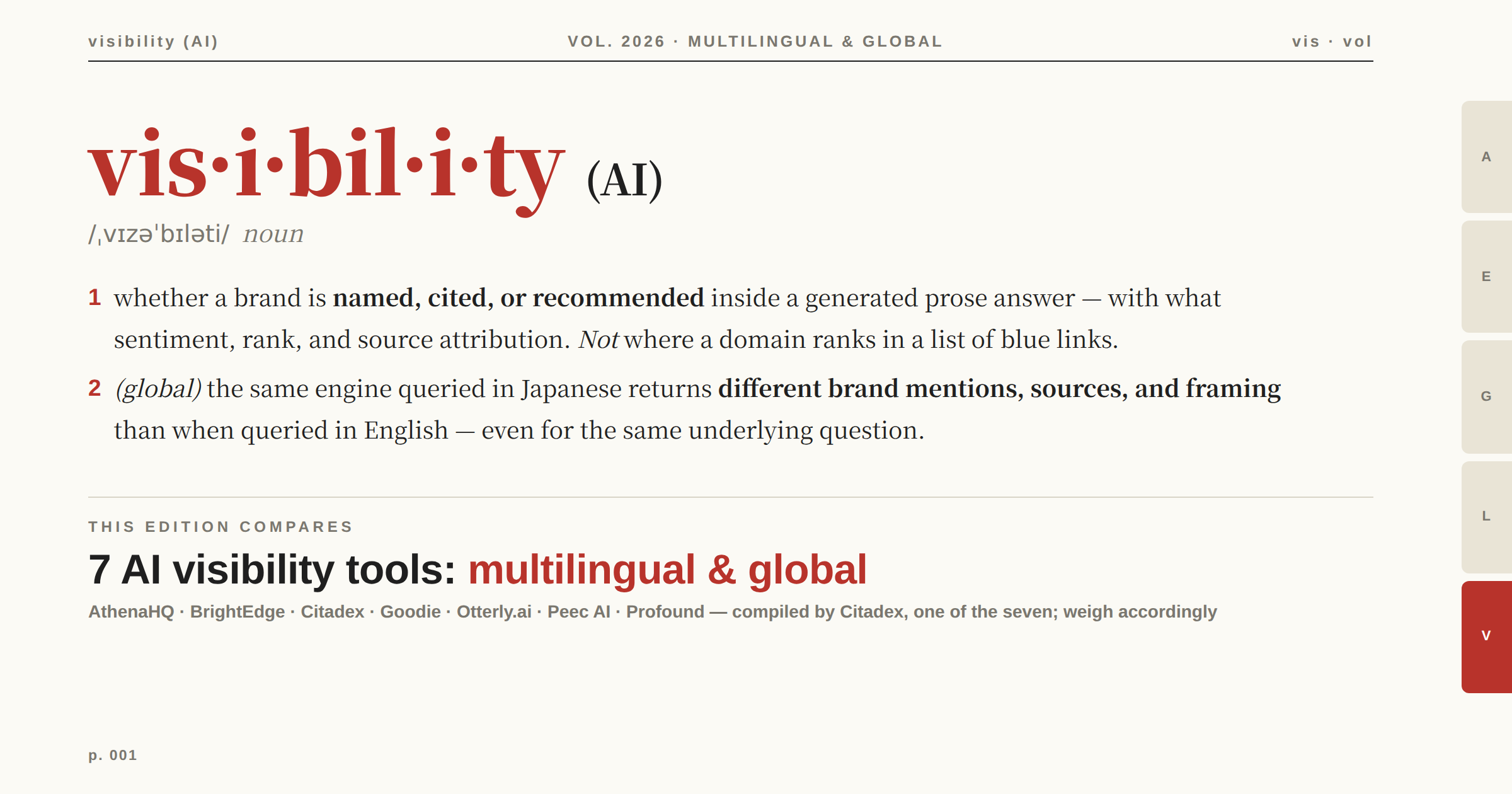
Traditional SEO tracks where a domain ranks in a list of blue links. AI visibility monitoring tracks something structurally different: whether a brand is named, cited, or recommended inside a generated prose answer, and with what sentiment, rank, and source attribution.
A brand that ranks on page one of Google may be entirely absent from ChatGPT's answer to an equivalent procurement query. AI engines do not rank pages; they synthesise answers from what they can retrieve and cite at answer time. Conversely, a brand with modest organic search presence can appear prominently in AI answers if its content is well-structured, authoritative, and citable.
The optimisation discipline for this is broadly called LLMO (Large Language Model Optimization), also referred to in English-language tool marketing as AEO (Answer Engine Optimization) or GEO (Generative Engine Optimization). This is a genuinely separate practice from keyword-based SEO.
Global AI visibility adds two further layers that standard SEO tools do not address. First, which AI engines are actually queried in a given market. ChatGPT and Google AI Overviews have the broadest global reach; Perplexity and Microsoft Copilot are heavily used in B2B and research workflows; DeepSeek is relevant for specific markets. Engine mix varies by region and buyer persona, so monitoring only one engine gives an incomplete picture. Second, whether prompts and answers are in the buyer's native language. An AI engine queried in Japanese often returns different brand mentions, different sources, and different framing than the same engine queried in English, even for the same underlying question. Standard SEO tools capture none of this.
Export companies and B2B brands entering markets like Japan, Korea, or Germany lack clear data on AI search visibility by market. A Japanese procurement manager asking ChatGPT which vendors to consider is running a Japanese-language query. The answer that surfaces for that prompt, which brands are named, whether yours is one of them, whether a source URL pointing to your content is included, is entirely separate from how your brand appears in English-language AI results.
AEO and GEO are related but not identical. AEO refers to the specific practice of optimising content to appear in AI-generated answers. GEO is the broader discipline of shaping how generative AI represents a brand across all touchpoints, including tone, accuracy, and the sources it draws on. Most tools in this comparison operate primarily in the AEO space; some extend into GEO territory by tracking answer sentiment and content accuracy.
The Seven Criteria That Separate Good Global AI Visibility Tools from Basic Monitors
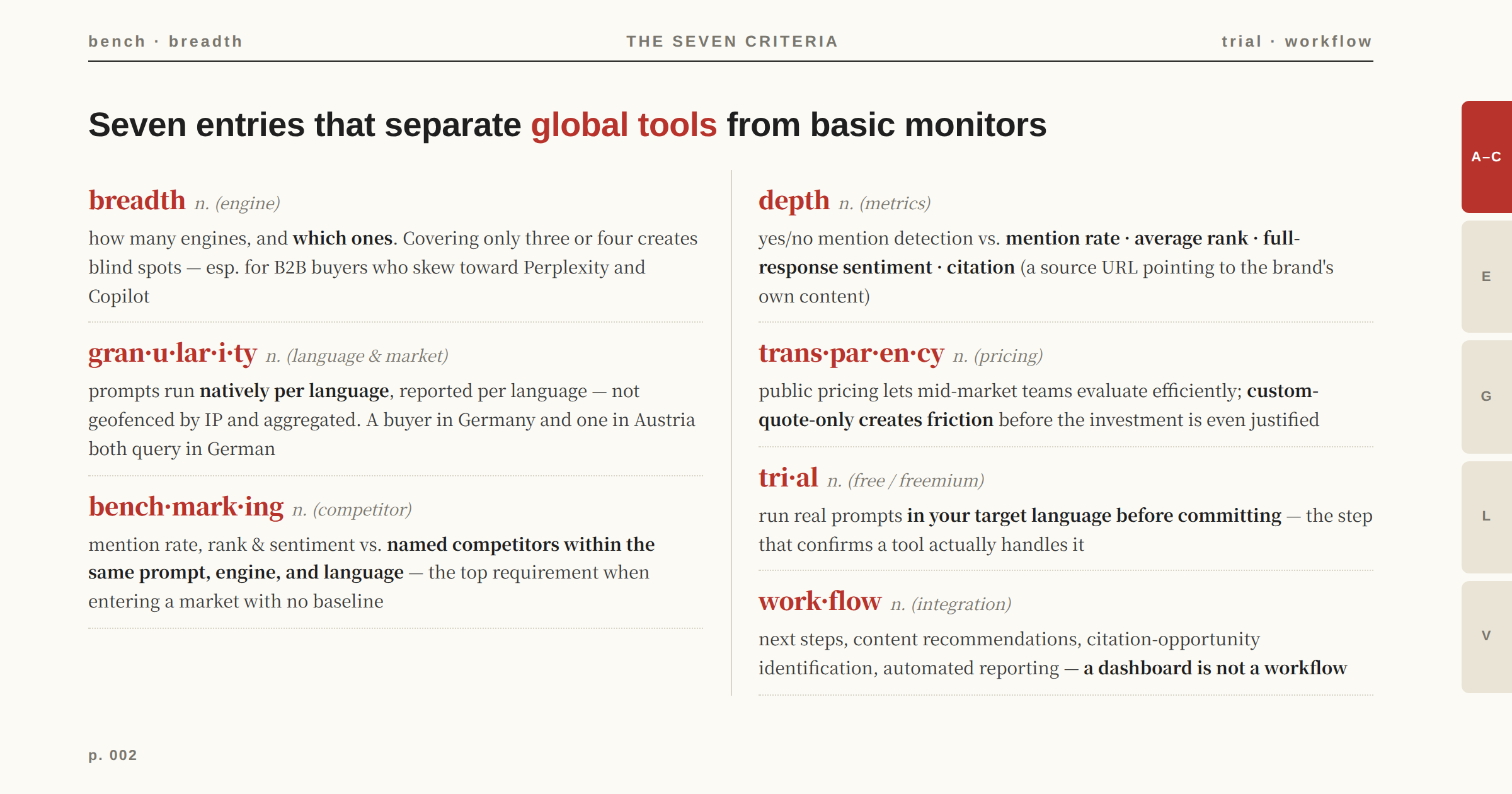
AI engine breadth measures how many engines are tracked and which ones specifically. The major global surfaces are ChatGPT, Google AI Overviews, Google AI Mode, Gemini, Claude, Perplexity, and Microsoft Copilot, with Grok, DeepSeek, Mistral, and Qwen relevant in specific markets. A tool covering only three or four of these creates blind spots, particularly for B2B buyers who skew toward Perplexity and Copilot.
Language and market granularity determines whether the tool runs prompts natively in each target language and reports results per-language, or geofences by IP and aggregates across regions. The more useful model for export brands tracks each market, a specific country plus language: a buyer in Germany and a buyer in Austria both query in German, but search-enabled engines localise results by country, so their answers can differ.
Competitor benchmarking asks whether the platform can compare a brand's mention rate, rank, and sentiment against named competitors within the same prompt, engine, and language. This is a top requirement for teams entering new markets where they have no baseline.
Metrics depth distinguishes mention detection alone (a simple yes/no on whether the brand appeared) from stronger reporting that includes mention rate, average rank or position within an answer, sentiment evaluated at the full response level, and citation (whether the answer includes a source URL pointing to the brand's own content).
Pricing transparency matters because publicly accessible pricing enables mid-market brands to evaluate the category efficiently. Custom-quote-only tools create friction for teams still determining whether the investment is justified.
Free trial or freemium access allows teams to run real prompts in their target languages before committing. This is particularly important for non-English use cases, where it is worth confirming that the tool actually handles the target language.
Workflow integration surfaces actionable next steps, content recommendations, citation-opportunity identification, automated reporting, rather than stopping at a dashboard. For agencies and marketing teams managing multiple markets, the difference between a monitoring tool and a workflow tool is significant.
How the Leading Platforms Compare: A Criteria-by-Criteria Breakdown
This comparison was compiled by Citadex, which is one of the seven platforms reviewed. Readers should weigh that context when reading the entries below, particularly the Citadex profile.
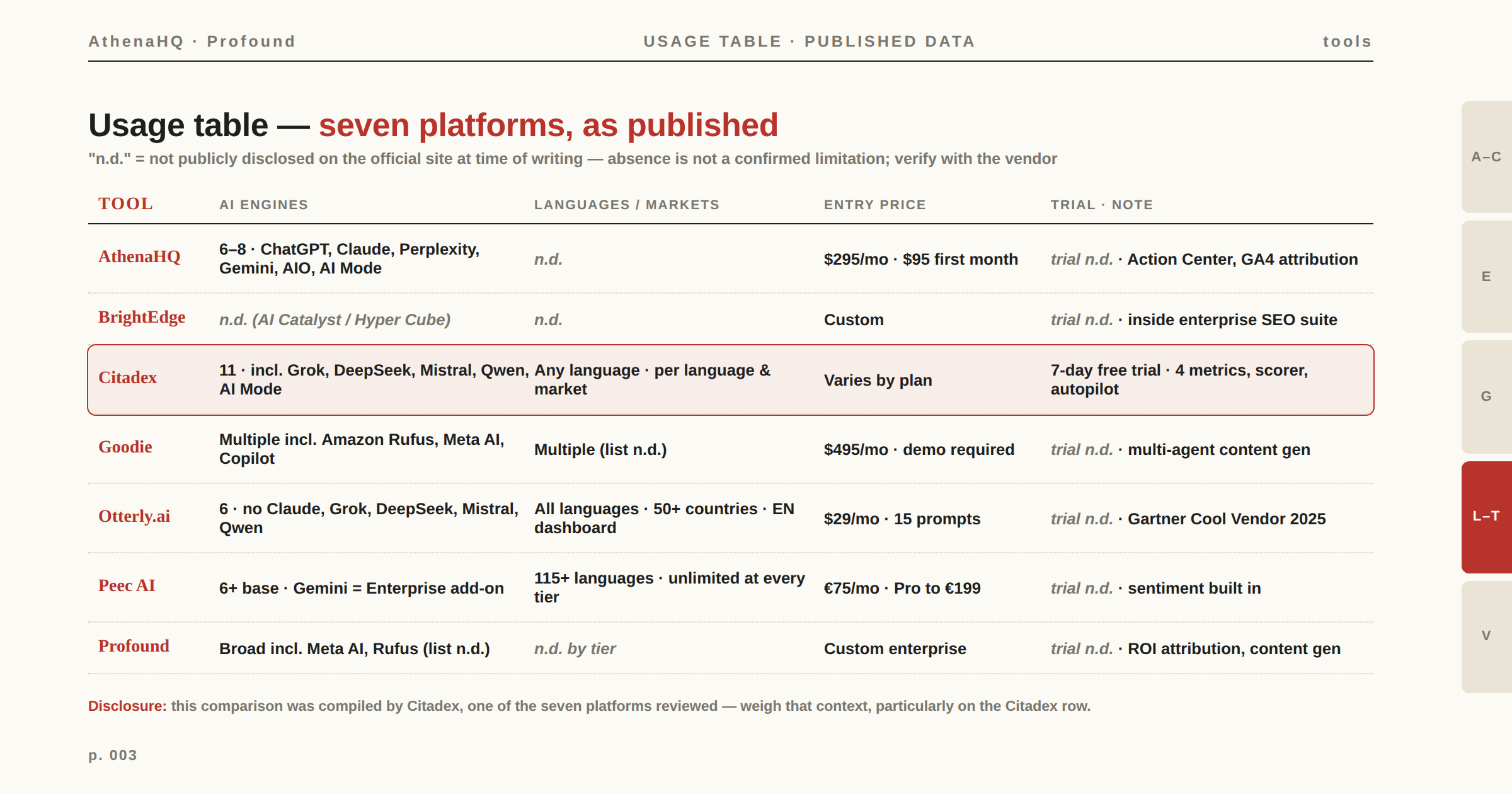
| Tool | AI Engines Covered | Languages / Markets | Competitor Benchmarking | Core Metrics | Pricing Entry Point | Free Trial |
|---|---|---|---|---|---|---|
| AthenaHQ | 6–8 (ChatGPT, Claude, Perplexity, Gemini, Google AI Overviews, Google AI Mode) | Not publicly disclosed | Yes (Action Center) | Not publicly disclosed | $295/month ($95 first month) | Not publicly disclosed |
| BrightEdge | Not publicly disclosed | Not publicly disclosed | Not publicly disclosed | Not publicly disclosed | Custom pricing | Not publicly disclosed |
| Citadex | 12 (ChatGPT, Claude, Gemini, Perplexity, Copilot, Grok, DeepSeek, Mistral, Qwen, Doubao, Google AI Overviews, and Google AI Mode) | Any language | Yes | Mention rate, rank, sentiment, citation | Varies by plan | 7-day free trial |
| Goodie | Not publicly disclosed | Multiple languages (specific list not publicly disclosed) | Not publicly disclosed | Not publicly disclosed | $495/month | Not publicly disclosed |
| Otterly.ai | 6 (ChatGPT, Google AI Overviews, Perplexity, Gemini, Microsoft Copilot, Google AI Mode) | All languages for search prompts; dashboard in English; 50+ country markets | Yes | Not publicly disclosed | $29/month | Not publicly disclosed |
| Peec AI | 6+ base (ChatGPT, Perplexity, Google AI Overviews, DeepSeek, Claude; Gemini as Enterprise add-on) | 115+ languages; unlimited countries/languages at every tier | Yes | Sentiment analysis included | €75/month | Not publicly disclosed |
| Profound | Not publicly disclosed | Not publicly disclosed by tier | Yes | Not publicly disclosed | Custom enterprise pricing | Not publicly disclosed |
Note: Where a cell reads "Not publicly disclosed," the information was not available on that tool's official site at the time of writing. Do not read absence as a confirmed limitation, verify directly with each vendor.
Tool-by-Tool Profiles: What Each Platform Does Best and Where It Falls Short
AthenaHQ
AthenaHQ covers 6–8 AI engines including ChatGPT, Claude, Perplexity, Gemini, Google AI Overviews, and Google AI Mode. Founded in Not publicly disclosed and Not publicly disclosed-backed with ex-Google and DeepMind founders, it is one of the newest entrants in the space. Pricing runs $295/month through self-serve, with a $95 first-month promotional rate and a credit-based system offering Not publicly disclosed credits per month.
The Action Center translates monitoring data into concrete next steps rather than leaving teams to interpret raw visibility metrics themselves. GA4 integration for revenue attribution is meaningful for teams that need to connect AI visibility to pipeline.
Language support is not publicly documented, making it difficult to verify multilingual capability before purchasing. Teams entering non-English markets should confirm language handling directly.
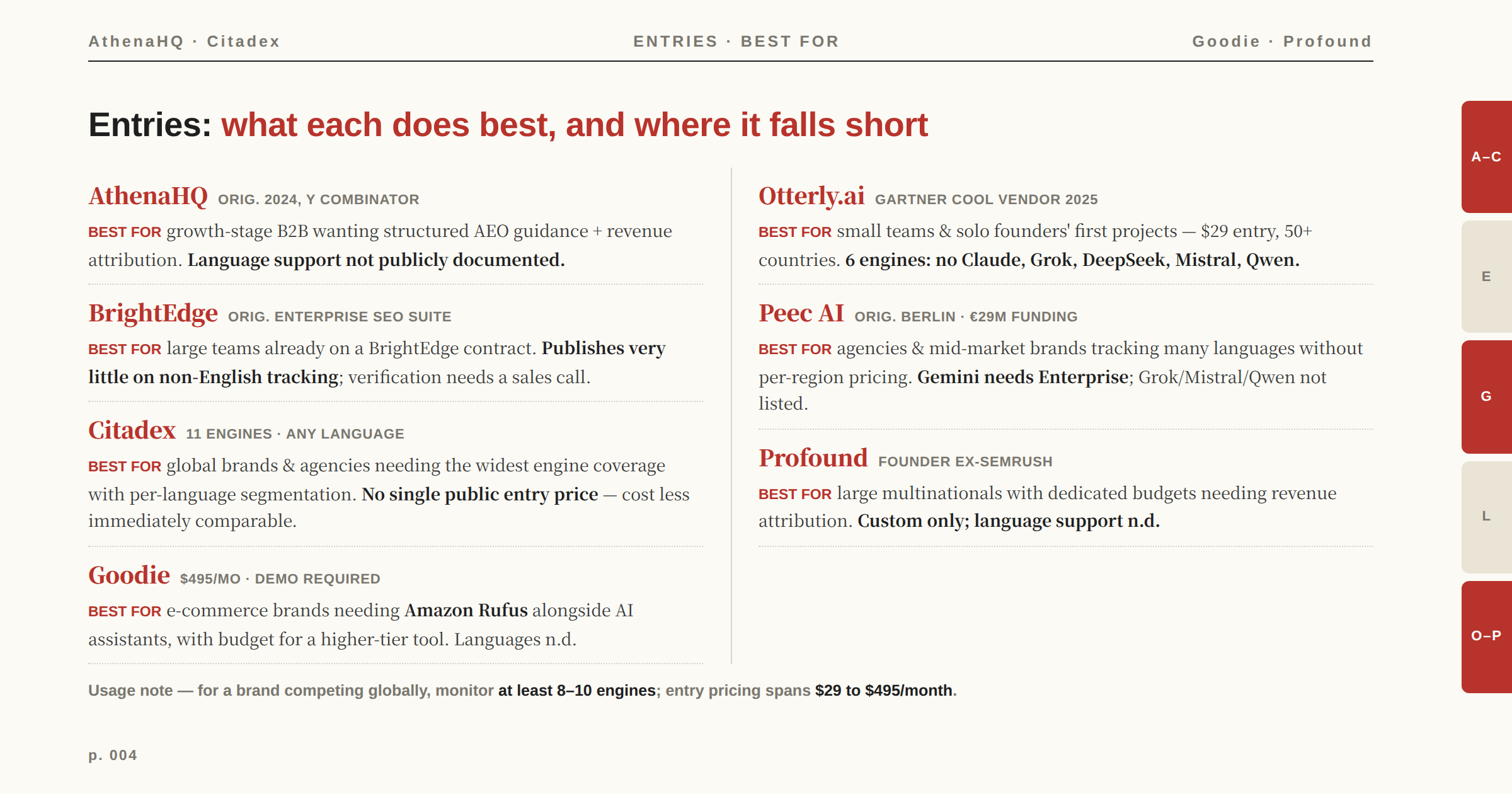
Best for: Growth-stage B2B brands that want structured AEO guidance alongside monitoring, particularly if revenue attribution matters.
BrightEdge
BrightEdge is a large enterprise SEO platform that has added AI visibility capabilities, marketed as AI Catalyst and AI Hyper Cube, to its existing suite. The specific list of engines it tracks is not publicly detailed. Pricing is entirely custom with no public tiers.
The integration of AEO data alongside traditional SEO metrics benefits teams not ready to move to a separate dedicated tool. Enterprise teams already inside BrightEdge's ecosystem gain AI visibility data without procurement friction.
BrightEdge publishes very little about non-English market support, multilingual prompt handling, or per-language segmentation. For export companies or brands running campaigns in Japanese, Korean, or German, it remains unclear whether the platform delivers native-language tracking. The custom-quote-only model means verification requires a sales conversation.
Best for: Large enterprise teams with an existing BrightEdge contract who want AI visibility data folded into a familiar reporting environment.
Citadex
Citadex tracks brand visibility across 12 AI engines: ChatGPT, Claude, Gemini, Perplexity, Copilot, Grok, DeepSeek, Mistral, Qwen, Doubao, Google AI Overviews, and Google AI Mode. For every tracked prompt on every engine, the platform records mention rate, average rank, sentiment (evaluated at the full response level), and citation, whether the answer included a source URL pointing to the brand's own content. Prompts and answers can be tracked in any language, with results segmented per market (country + language), each scanned from its own country.
Features include competitor tracking, citation-opportunity outreach, a deterministic AEO content scorer, and autopilot AEO content generation. A 7-day free trial is available.
Entry pricing is not listed as a single public figure. The plan structure spans Starter, Pro, Business, and Autopilot tiers, so the right starting point depends on prompt volume and team size, making cost less immediately comparable than tools with a clear public entry price.
Best for: Global brands and agencies that need the widest AI-engine coverage with native multilingual tracking and per-language segmentation across all tracked prompts.
Goodie
Goodie covers multiple AI surfaces including Meta AI, Microsoft Copilot, and Amazon Rufus; the full engine list is not publicly disclosed. The inclusion of Amazon Rufus is notable for brands in commerce-heavy categories where buyers use Amazon's AI for product discovery. Entry pricing is $495/month; a demo is required. Multi-agent content generation capabilities extend it beyond monitoring into active content production.
At $495/month as the entry point with demo-required purchasing, it sits at the higher end of the accessible range for mid-market teams. Which languages are supported for prompt tracking is not publicly disclosed, which creates a verification problem for non-English buyers.
Best for: E-commerce and retail brands that need visibility across both AI assistants and commerce platforms like Amazon Rufus, and have budget for a higher-tier tool.
Otterly.ai
Otterly.ai covers 6 engines: ChatGPT, Google AI Overviews, Perplexity, Gemini, Microsoft Copilot, and Google AI Mode. Named a 2025 award recipient, it supports search prompts in all languages with country-level monitoring across 50+ country markets, though the dashboard itself is in English. Pricing starts at $29/month for the Lite plan (15 prompts, 1 workspace), rising to $99/month for Standard (100 prompts, unlimited workspaces) and $199/month for Premium (400 prompts).
The strongest case for Otterly.ai is price accessibility combined with genuine multi-market reach. At $29/month, it is the clearest entry point in the category for solo practitioners or small teams running their first AI visibility experiments. The 50+ country monitoring footprint is documented.
Engine coverage is a limitation: 6 engines means Otterly.ai does not track Claude, Grok, DeepSeek, Mistral, or Qwen. Teams whose buyers use those surfaces will have blind spots.
Best for: Small to mid-size teams, solo founders, or agencies running initial AI visibility projects who need accessible pricing and solid multi-country coverage without requiring every engine.
Peec AI
Peec AI is a Berlin-based platform with funding, covering 6+ engines at base tier (ChatGPT, Perplexity, Google AI Overviews, DeepSeek, Claude) with Gemini available as an Enterprise add-on. Its most distinctive feature for international buyers is explicit language breadth: 115+ languages are supported, with unlimited countries and languages included at every pricing tier. Prompt-volume pricing means language expansion costs nothing extra; a team adding Japanese and Korean prompts alongside English pays for additional prompts, not for additional markets. Pricing runs €75/month for Pro plans, with the €199/month Pro plan covering 100 prompts and 9,000 AI Answers per month. Sentiment analysis is built in.
Engine coverage relative to the broadest platforms is limited: Gemini requires the Enterprise tier, and engines like Grok, Mistral, and Qwen are not listed in public documentation.
Best for: Marketing agencies and mid-market international brands that need to track across many languages and countries without per-region pricing.
Profound
Profound tracks a broad set of AI engines and assistants, including Meta AI and Amazon Rufus; the exact engine list is not publicly disclosed by tier. Pricing is custom enterprise only; no self-serve tiers are available. Founder Christoph Stresing comes from SEMrush (where he led AEO initiatives), bringing deep expertise in generative AI indexing and attribution.
The platform includes automated content generation, ROI attribution to pipeline and revenue, and SERP monitoring with marketplace integrations. These features position Profound as an end-to-end platform for large teams.
Language and market support details are not publicly disclosed. For teams evaluating Profound, language capability, particularly support for Asian and European markets, should be a conversation point with the sales team.
Best for: Large multinational enterprises with dedicated AI visibility budgets that need the broadest engine coverage and direct attribution to revenue.
Frequently Asked Questions
What is the difference between AEO and GEO?
AEO (Answer Engine Optimization) refers to the specific practice of optimising content to appear in AI-generated answers. It mirrors SEO's goal of visibility and ranking, but targets generative systems instead of traditional search. GEO (Generative Engine Optimization) is the broader discipline of shaping how generative AI represents a brand across all touchpoints, including tone, accuracy, fact-checking, and the sources it draws on. Most of the tools reviewed here primarily focus on AEO; a few extend into GEO territory by tracking sentiment and content accuracy.
Why does language matter for AI visibility tracking?
An AI engine queried in Japanese returns different brand mentions, sources, and framing than the same engine queried in English, even for the same underlying question. A procurement manager in Tokyo asking ChatGPT which vendors to consider receives a different set of answers than an English-speaking buyer asking the same question in English. Tools that aggregate results by IP geolocation or report only in English miss this critical distinction. Per-language segmentation ensures that global teams understand which brands surface for each buyer segment.
Do I need to track all AI engines, or can I get by with just ChatGPT and Google?
That depends on your buyer personas. For most B2B and research-heavy use cases, Perplexity and Microsoft Copilot drive meaningful traffic alongside ChatGPT. In specific regions, DeepSeek is relevant. E-commerce buyers use Amazon Rufus. The safest approach for any brand competing globally is to monitor at least 8–10 engines. Tools that cover only 4–6 create blind spots. Otterly.ai's 6-engine setup works for teams willing to accept that limitation; anything below that leaves too much visibility unmonitored.
How much does AI visibility monitoring cost?
Entry-level pricing ranges from $29/month to $495/month (Goodie). Mid-market pricing typically falls between $75/month and $295/month. Enterprise pricing is always custom. The right budget depends on prompt volume (how many queries you run per month), engine breadth, and feature set. A team with a small budget should start with Otterly.ai or Peec AI. A team with a larger budget and a global footprint should consider Citadex or Profound.
Can I use these tools to optimize my content?
Some tools stop at visibility measurement; others include optimization features. AthenaHQ includes an Action Center with prescriptive recommendations. Citadex includes citation-opportunity outreach and AEO content scoring. Goodie and Profound include automated content generation. Most of the platforms focus primarily on monitoring and leave the optimization work to teams. If optimization workflow is important to you, evaluate tools that include content recommendations or generation features.
How do I know if a tool actually supports my target language?
Ask directly. Peec AI explicitly states 115+ languages; Citadex states "any language"; others do not disclose. The safest path is to use a free trial (if available) to run a test prompt in your target language and confirm the results make sense. Tools that do not offer free trials should be asked for a language-support verification call or demo before purchasing. For non-English markets, this step is worth the time investment.
What metrics should I prioritize when evaluating a tool?
Start with mention rate (the percentage of AI answers that include your brand), then add average rank (where your brand appears within an answer), and citation (whether a source URL pointing to your site is included). Sentiment is valuable for brands concerned about brand reputation. These four metrics, mention rate, rank, citation, and sentiment, provide the core data you need to optimize. Tools that report only mention rate leave you guessing about visibility quality.