Key takeaways:
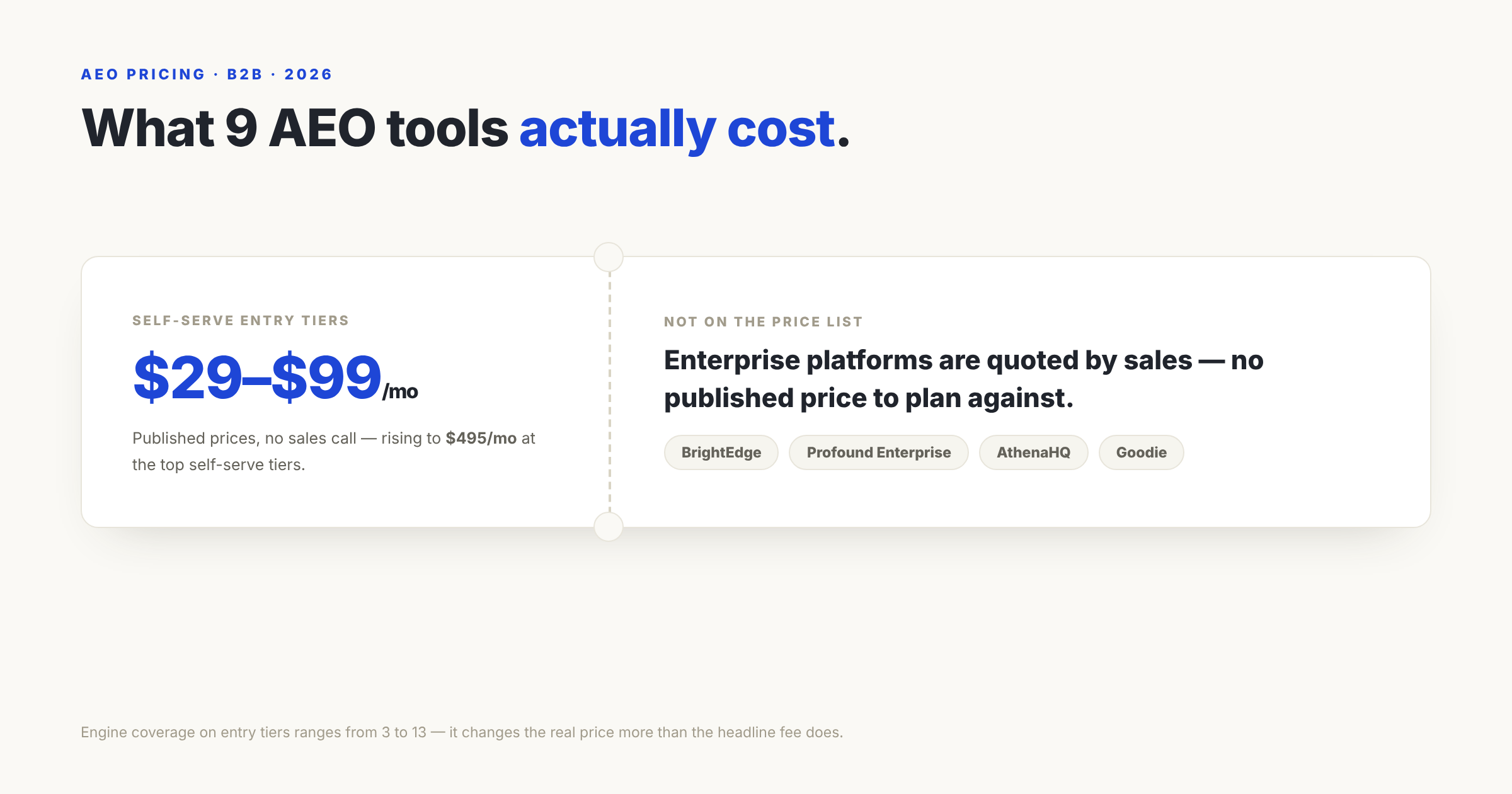
- Self-serve AEO tools for in-house B2B teams start at $29 to $99 a month; enterprise platforms sell through sales calls and do not publish prices.
- The number of AI engines a plan covers ranges from 3 to 13, and it changes the real price more than the headline fee does.
- Check three things before you buy: the engines on the tier you can afford, the prompt limit, and whether you can test it with your own brand first.
AEO and GEO tools show whether a brand appears inside AI-generated answers, which is now where many B2B buyers start their research. This comparison covers nine platforms: their published prices, the AI engines each tier covers, and an honest tradeoff for each, so B2B marketing teams can compare what they would actually pay.
One disclosure up front: this comparison was written by Citadex, one of the nine tools covered. Every tool is described the same way, from its own pricing page, checked in October 2026. Keep that in mind when you read the Citadex entry.
What AEO and GEO Tools Do, and Why B2B Teams Need Them Now
Answer Engine Optimization (AEO) responds to one shift: buyers increasingly form their first impression of a category, and of specific vendors, from an AI-generated summary instead of a list of links. Generative Engine Optimization (GEO) is the broader term for optimizing any generative output, including comparisons, summaries and multi-step research. In practice the same tools serve both.
This matters more in B2B than in consumer markets. Mid-market and enterprise buyers often build a vendor shortlist by asking ChatGPT, Perplexity or Claude something like "what are the best [category] tools for a SaaS company?" A brand that does not appear in those answers never reaches the shortlist, and nothing in its analytics shows that it happened.
The platforms below do three things: they run the prompts that matter for a brand's category across AI engines, they benchmark how often the brand appears against named competitors, and they help teams publish or improve content that AI engines are more likely to cite. That replaces manual prompt testing, which does not scale past a handful of questions and produces no trend data.
How We Evaluated These Tools: Six Criteria That Matter for B2B Pricing Decisions
AI engines covered. Which AI platforms the tier monitors (ChatGPT, Claude, Perplexity, Gemini, Google AI Overviews, Google AI Mode, Copilot and others) and how many. Share-of-voice data only means something when it covers the engines your buyers actually use.
Entry price. The lowest tier a single in-house team can buy without a sales call. Where a vendor does not publish prices, we say so.
Free trial or free plan. Whether you can test the tool with your own brand before paying.
Prompt limit. How many prompts the entry tier tracks. A cheap plan with 15 prompts and an expensive plan with 350 are different products.
Best-fit customer. Solo founders, growing brands, enterprises and agencies need different things: seats, white-labeling, multi-client management and data history.
One strength and one weakness. Drawn from each vendor's own pricing and product pages.
Side-by-Side Comparison: AEO Tool Pricing for B2B Teams
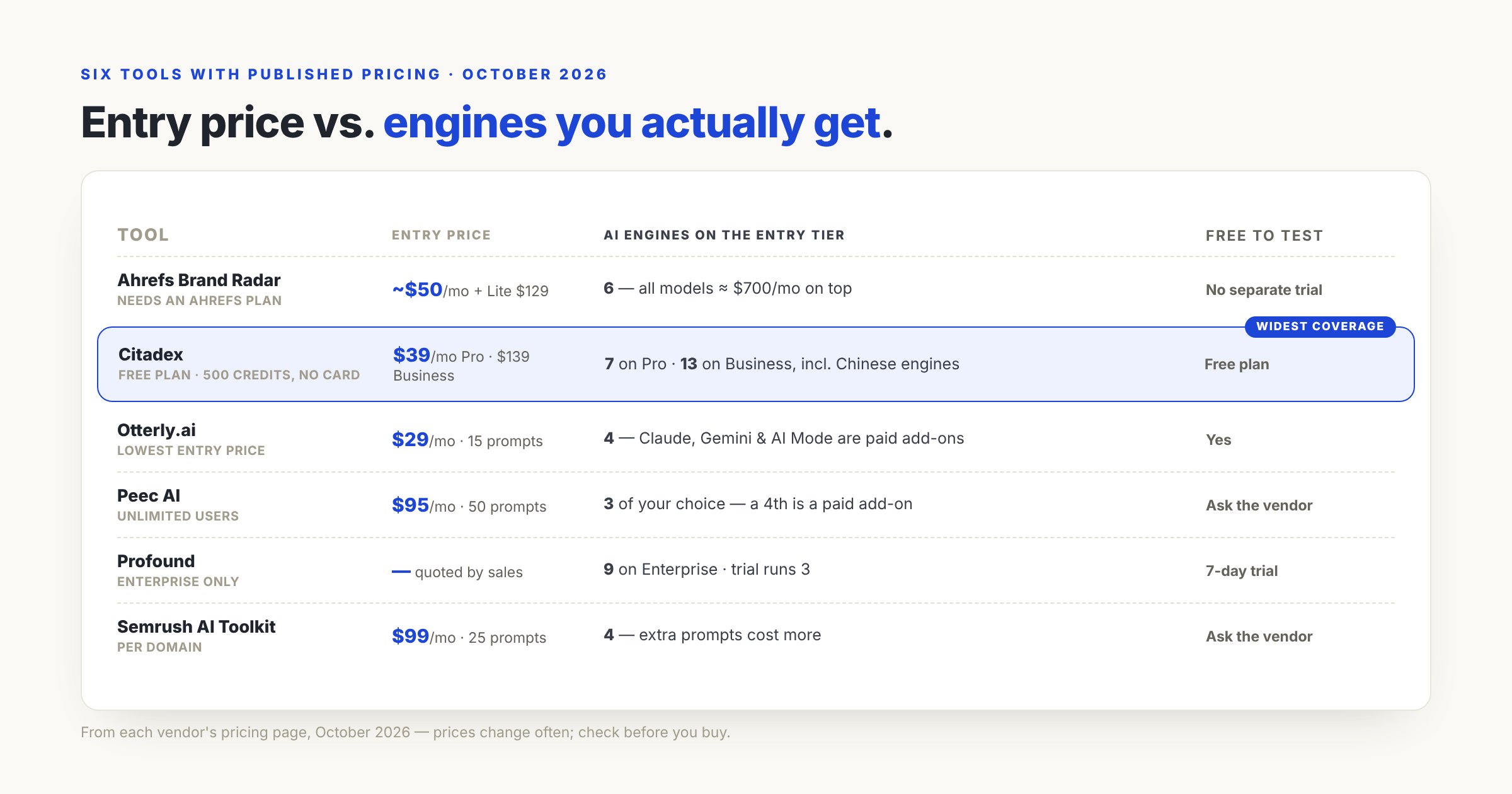
The table covers the six tools that publish enough pricing and engine information to compare fairly. AthenaHQ, BrightEdge and Goodie publish little or no pricing; they are covered in the tool-by-tool section instead.
| Tool | AI engines on the entry tier | Entry price | Free trial / free plan | Notable strength | Notable weakness |
|---|---|---|---|---|---|
| Ahrefs Brand Radar | 6 (ChatGPT, Google AI Overviews, AI Mode, Gemini, Perplexity, Copilot) | Custom prompts from about $50/mo (about $700/mo for all models), on top of a paid Ahrefs plan (Lite from $129/mo) | No separate trial | 495M+ prompt database tied to Ahrefs' search data | Needs an Ahrefs subscription; the cost climbs quickly when you track every model |
| Citadex | 7 on Pro (ChatGPT, Claude, Gemini, Perplexity, Copilot, Google AI Overviews, AI Mode); 13 on Business | Free plan (500 credits on sign-up); Pro $39/mo (about $33/mo billed annually); Business $139/mo (about $99/mo billed annually) | Free plan, no card; no free trial on paid plans | Widest engine coverage in this set (13 on Business); content generation with publishing to WordPress, Shopify, Webflow and Ghost | Repeated sampling (asking each prompt several times for steadier numbers) is on Business and agency plans only |
| Otterly.ai | 4 (ChatGPT, Google AI Overviews, Perplexity, Copilot); AI Mode, Gemini and Claude are paid add-ons | Lite $29/mo (15 prompts); Standard $189/mo (100 prompts) | Yes | Lowest self-serve entry price | Add-on engines cost extra on every tier (Claude $29 to $439/mo); API and MCP access start on Standard |
| Peec AI | 3 of your choice (from ChatGPT, Google AI Overviews, AI Mode, Gemini, Copilot and others) | Starter $95/mo (50 prompts); Pro $245/mo (150); Advanced $495/mo (350) | Check with the vendor | Unlimited users on every plan | Each self-serve tier covers 3 models; a fourth is a paid add-on |
| Profound | Trial: ChatGPT, Gemini, Google AI Overviews; Enterprise: up to 9 | Not published; Enterprise is quoted by sales | 7-day free trial (50 prompts) | Broad enterprise coverage, including DeepSeek and Exa Search | No published self-serve prices; full coverage requires an Enterprise contract |
| Semrush AI Visibility Toolkit | 4 (ChatGPT, Google AI Overviews, Gemini, Perplexity) | $99/mo per domain (25 tracked prompts) | Check with the vendor | Fits into an existing Semrush SEO workflow | Prompt allowance is small; extra prompts cost more |
Prices are taken from each vendor's pricing page in October 2026 and change often. Check the vendor's site before you buy.
Tool-by-Tool Breakdown: Strengths, Weaknesses, and Who Each Platform Is Built For
Ahrefs Brand Radar
Ahrefs approaches AI visibility from its search data. Brand Radar tracks mentions across Google AI Overviews, AI Mode, ChatGPT, Perplexity, Gemini and Copilot, backed by a database of more than 495 million prompts. Custom prompt tracking starts at about $50 a month and is available on paid Ahrefs plans, so the realistic entry cost is a Lite plan ($129/month) plus custom prompts. Tracking every model costs about $700 a month on top of the base plan, and the AI Visibility Index, a separate product, starts at about $199 a month.
The tradeoff is cost and dependence: the AI features sit on top of an Ahrefs subscription, and the price grows with each model you add.
Best fit: B2B teams that already pay for Ahrefs and want AI visibility inside the same tool.
AthenaHQ
AthenaHQ does not publish prices, engine counts or a detailed feature list on its site. Ask for a demo that covers the engines monitored, language support and pricing before comparing it with tools that publish self-serve plans.
BrightEdge
BrightEdge is an enterprise SEO platform that has added AI answer tracking to its suite. It sells through enterprise contracts and does not publish prices, engine counts or a self-serve trial. For a team already on BrightEdge, AI tracking inside a familiar interface has real workflow value; for a team choosing an AEO tool on its own merits, it belongs in a formal vendor review rather than a self-serve comparison.
Best fit: large B2B marketing teams already under a BrightEdge contract.
Citadex
Citadex tracks which AI engines mention a brand, how they rank it, the sentiment, and which sources they cite, with competitor benchmarking, content generation for weak prompts, and publishing to WordPress, Shopify, Webflow, Ghost or a Citadex-hosted blog. Results can be read in your own language whatever market is being tracked.
The Free plan gives 500 credits on sign-up with no card, running the same features as Pro. Pro costs $39 a month (about $33 billed annually) with 1,500 credits a month, 1 project and 7 AI engines: ChatGPT, Claude, Gemini, Perplexity, Copilot, Google AI Overviews and Google AI Mode. Business costs $139 a month (about $99 billed annually) with 5,000 credits a month, 5 projects and all 13 engines, adding Grok, DeepSeek, Mistral, Qwen, Doubao and Kimi. There is no free trial on paid plans.
One concrete limitation: repeated sampling, which asks the same prompt several times per engine for steadier numbers, is available only on Business and agency plans. Pro works with single-sample data.
Best fit: growing B2B brands that want wide engine coverage, including Chinese AI engines, without enterprise pricing, and agencies running several client brands.
Goodie
Goodie does not publish pricing or detailed feature information. As with AthenaHQ, evaluate it through a live demo before comparing it with tools that publish their plans.
Otterly.ai
Otterly.ai has the lowest self-serve entry price here: Lite at $29 a month (about $25 billed annually) with 15 prompts. Standard is $189 a month with 100 prompts and Premium $489 a month with 400 prompts. Every plan includes ChatGPT, Google AI Overviews, Perplexity and Microsoft Copilot.
Other engines are paid add-ons on every tier: Google AI Mode and Gemini cost $9 to $149 a month each depending on the plan, and Claude $29 to $439 a month. A team that needs six or seven engines can end up paying well above the headline price. API and MCP access start on Standard. A free trial is available.
Best fit: small B2B teams that want low-cost monitoring of the four default engines.
Peec AI
Peec AI includes unlimited users on every plan, which matters when several stakeholders need access. Starter is $95 a month with 50 prompts, Pro $245 with 150 prompts and Advanced $495 with 350 prompts; annual billing takes roughly 15% off.
Each self-serve tier lets you choose 3 models from a pool that includes ChatGPT, Google AI Overviews, Google AI Mode, Gemini and Microsoft Copilot. A fourth model is a paid add-on, and broader coverage moves you to Enterprise, which is priced by sales.
Best fit: B2B teams with several stakeholders who are happy to track a focused set of three engines.
Profound
Profound no longer publishes self-serve prices. Its pricing page offers a 7-day free trial (50 prompts run daily on ChatGPT, Gemini and Google AI Overviews) and an Enterprise plan, quoted by sales, that covers up to 9 answer engines: ChatGPT, Perplexity, Google AI Mode, Gemini, Microsoft Copilot, DeepSeek, Claude, Google AI Overviews and Exa Search.
The strength is breadth at the enterprise level; the weakness for a mid-market team is that there is no published price to plan against.
Best fit: enterprise B2B teams ready for a sales-led evaluation.
Semrush AI Visibility Toolkit
Semrush's AI Visibility Toolkit costs $99 a month per domain and tracks 25 custom prompts with daily updates across ChatGPT, Google AI Overviews, Gemini and Perplexity. Extra prompts are sold separately. Most teams use it alongside an existing Semrush plan, so check whether your account needs one before you budget.
Best fit: teams already working in Semrush who want AI visibility next to their SEO data.
Pricing Reality Check: What B2B Teams Actually Pay
The most common budgeting mistake is comparing headline prices. Three things change the real cost.
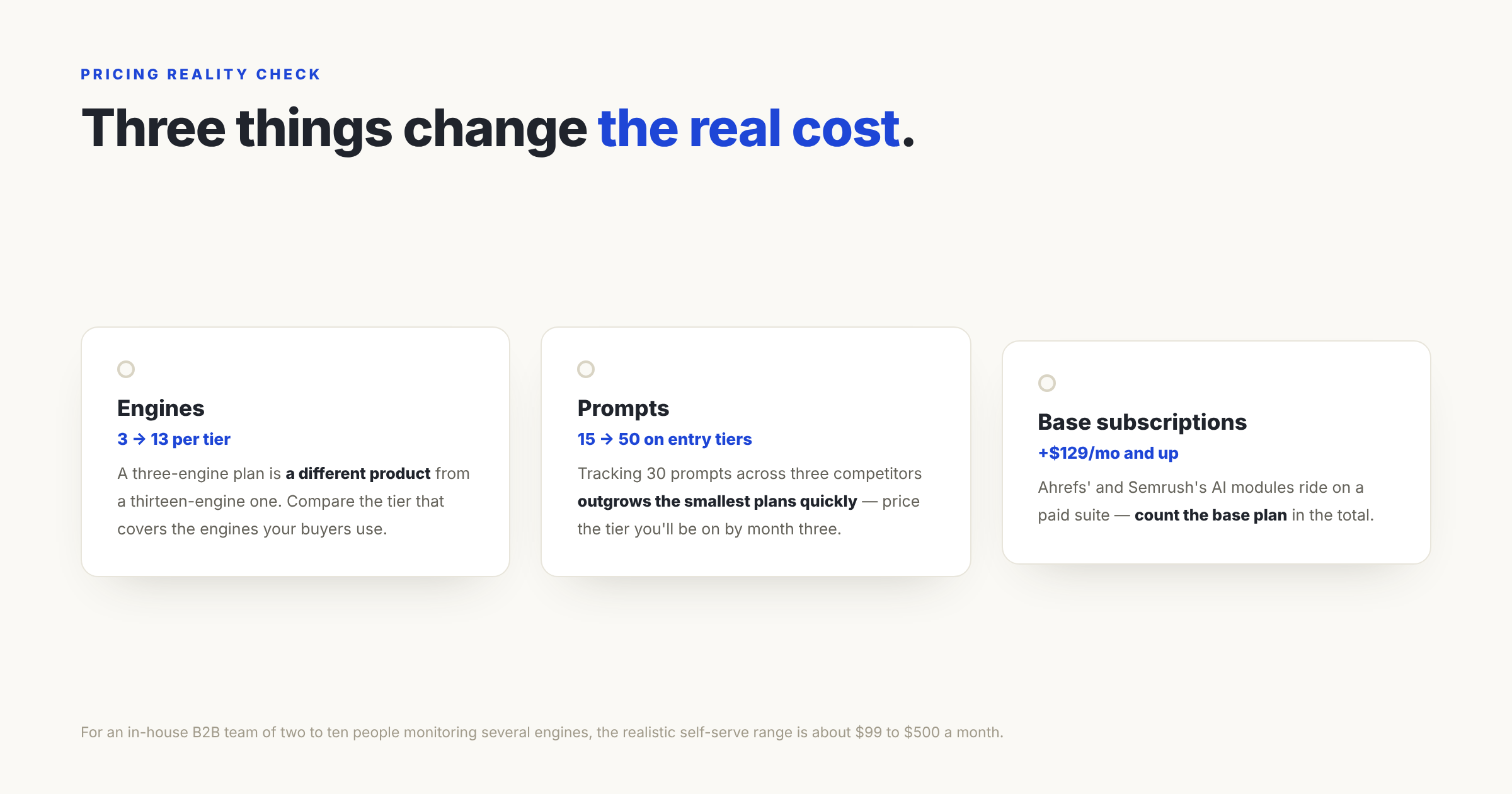
Engines. A plan that covers three or four engines is not the same product as one that covers seven or thirteen. Otterly's add-ons and Peec's choose-three model show how the price rises once you add Claude, Gemini or Google AI Mode. Build your comparison on the tier that covers the engines your buyers use.
Prompts. Entry tiers range from 15 prompts (Otterly Lite) to 50 (Peec Starter). A team tracking 30 prompts across three competitors will outgrow the smallest plans quickly.
Base subscriptions. Ahrefs' AI features sit on top of a paid Ahrefs plan, and Semrush's toolkit is usually bought with a Semrush plan. Count the base plan in the total.
For an in-house B2B team of two to ten people monitoring several engines, the realistic range among self-serve tools is about $99 to $500 a month. Enterprise platforms with unpublished pricing (BrightEdge, Profound Enterprise, AthenaHQ, Goodie) belong to a separate, sales-led buying process.
How to Choose: A Decision Framework for Four Common B2B Buyer Situations
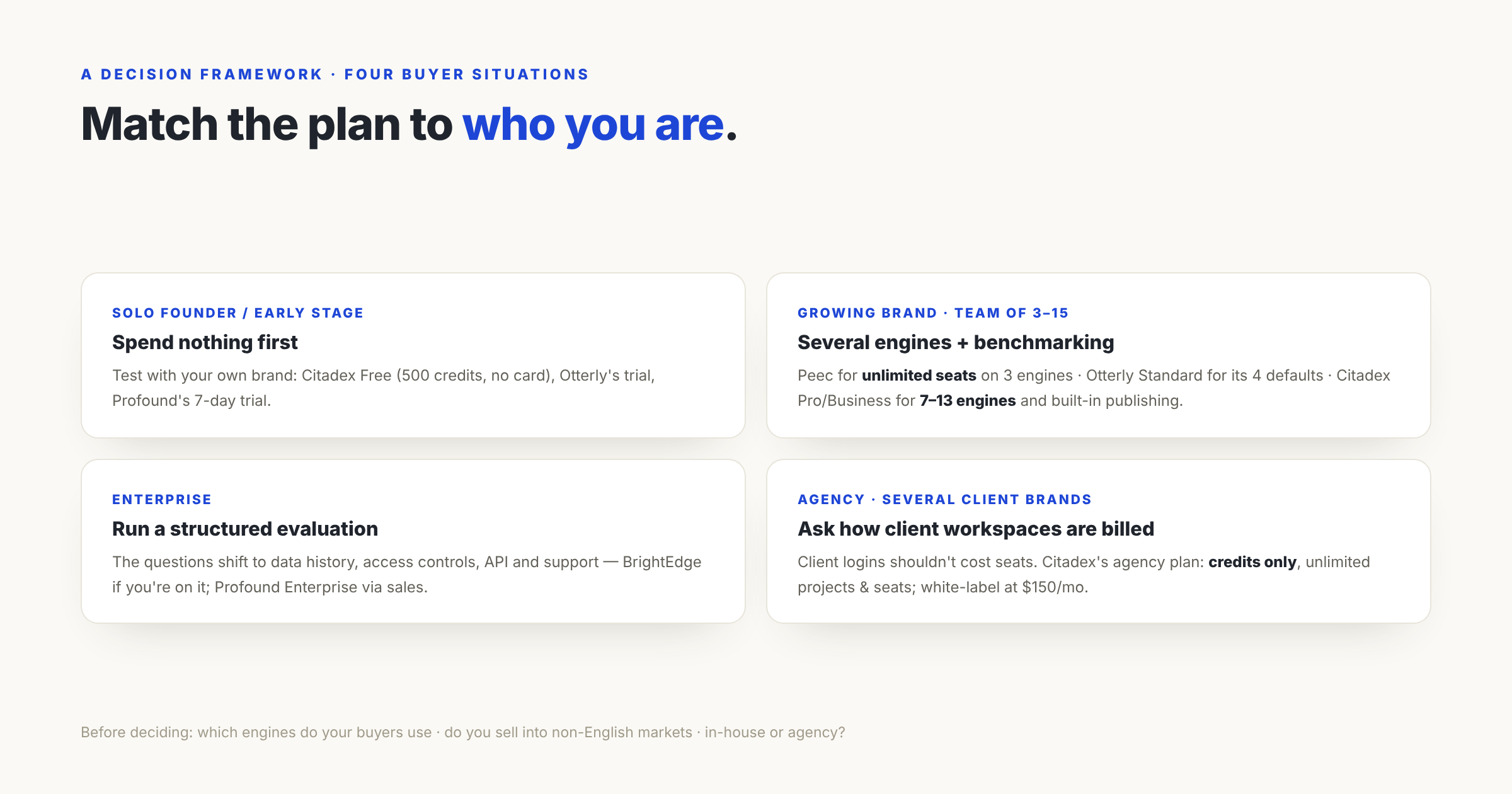
Solo founder or early-stage startup. Spend nothing until you know whether AI engines mention you at all. Citadex's Free plan (500 credits, 7 engines, no card), Otterly's trial and Profound's 7-day trial all let you test with your own brand name.
Growing brand (Series A to B, marketing team of 3 to 15). You need several engines, competitor benchmarking and a way to act on the gaps. Peec Starter or Pro suits teams that want unlimited seats and three engines; Otterly Standard suits teams happy with its four defaults; Citadex Pro ($39) or Business ($139, about $99 billed annually) suits teams that want seven to thirteen engines and built-in publishing.
Enterprise or large B2B brand. The questions shift to data history, access controls, API connections and support terms. BrightEdge suits teams already on it for SEO; Profound Enterprise and the enterprise tiers of the other tools need a structured evaluation with security and integration questions in scope.
Marketing agency managing several client brands. Each client's prompts, competitors and history must stay separate, and client logins should not cost extra seats. Citadex's agency plan has no monthly fee and no per-project price: agencies pay only for credits and get unlimited projects and seats, all 13 engines and their own logo on reports. The white-label subscription ($150/month or $1,188/year) adds a custom domain, the agency's brand on every page and email, and client logins. Whatever tool you evaluate, ask how client workspaces are billed and whether client logins count as seats.
Before deciding, answer three questions: which AI engines do your buyers use, do you sell into non-English markets, and are you an in-house team or an agency?
Common Mistakes B2B Teams Make When Evaluating AEO Tools
Assuming your SEO tool's add-on is enough. The AI modules of Ahrefs and Semrush are convenient if you already pay for those suites, but check the engines, the prompt allowance and the base plan you need before treating them as the cheap option.
Treating language coverage as optional. A tool that only tracks English answers cannot tell a brand how it appears to buyers in Japan, Germany or Brazil. Ask whether you can run prompts in the target language, read results in your own, and cover the AI engines popular in that market.
Comparing entry prices without modelling usage. The $29 plan rarely reflects what a team tracking 30 prompts across four engines and three competitors pays by month three. Add engine add-ons, extra prompts and base subscriptions before comparing.
Skipping the test. AI answers vary by industry, brand name and phrasing. Test every shortlisted tool with your real brand, real competitors and real prompts before you buy.
Treating AI visibility like rank tracking. AEO tools measure whether and how a brand is mentioned or recommended inside an AI answer: mention rate, sentiment, citations and share of voice. That is a different data model from a URL's position on a results page.
Frequently Asked Questions
Q: Do these tools work for non-English brands?
It depends on the tool. Some let you track prompts in other languages and markets and read the results in your own language; others focus on English. Confirm language and market support before you buy if you sell outside English-speaking regions.
Q: How long does it take to see results from AEO?
Changes from new or improved content usually take several weeks to show in tracked answers, depending on how often each engine refreshes its sources. Treat the first four to twelve weeks as a baseline period; results vary by category and engine.
Q: Can I track ChatGPT mentions without paying for a tool?
You can type prompts into ChatGPT and log the answers in a spreadsheet, but that does not scale past a few prompts, produces no trend data and cannot cover several engines or competitors. Free plans and trials are a better way to start.
Q: Which AI engines should a B2B brand track first?
ChatGPT, Perplexity and Google AI Overviews are a practical starting point for most B2B teams, with Claude and Gemini where buyers do deeper research. Brands selling in China should add DeepSeek, Doubao or Qwen, which few tools cover.
Q: How are AEO tools different from SEO tools like Semrush or Ahrefs?
SEO tools measure rankings, backlinks and keyword volume on web pages. AEO tools measure brand presence, sentiment and citations inside AI-generated answers. Semrush and Ahrefs now sell AI modules on top of their SEO suites, but the data they produce is different from classic SEO reporting.
Q: Is there a free way to start with AEO before paying?
Yes. Citadex has a Free plan (500 credits on sign-up, no card), and Otterly and Profound offer free trials. Start with your real brand name and five to ten priority prompts to see whether a tool's engine coverage and data match what you need.