AI may describe your scope of service, indications, certifications or medical advice too broadly.
CITADEX FOR HEALTHCARE
Get healthcare information understood and cited correctly by AI
Healthcare needs more than visibility — it needs accuracy, caution and verifiability. Citadex helps healthcare services, health-tech and medical-device brands monitor how AI describes credentials, scope, safety boundaries and clinical evidence.
For brand, medical-content, compliance, PR and growth teams
AI search is rewriting the healthcare buyer journey
Most pages explain the market shift first. Citadex’s industry page goes straight to where AI is changing your exposure, trust and conversion.
Users and buyers first ask AI whether you’re credible, who you’re right for, and what alternatives exist.
Professional content is scattered across your site, papers, clinician profiles, certifications and media — AI may not cite it fully.
Wrong advice, misattribution and over-promising create brand and compliance risk.
Patient Question Intelligence
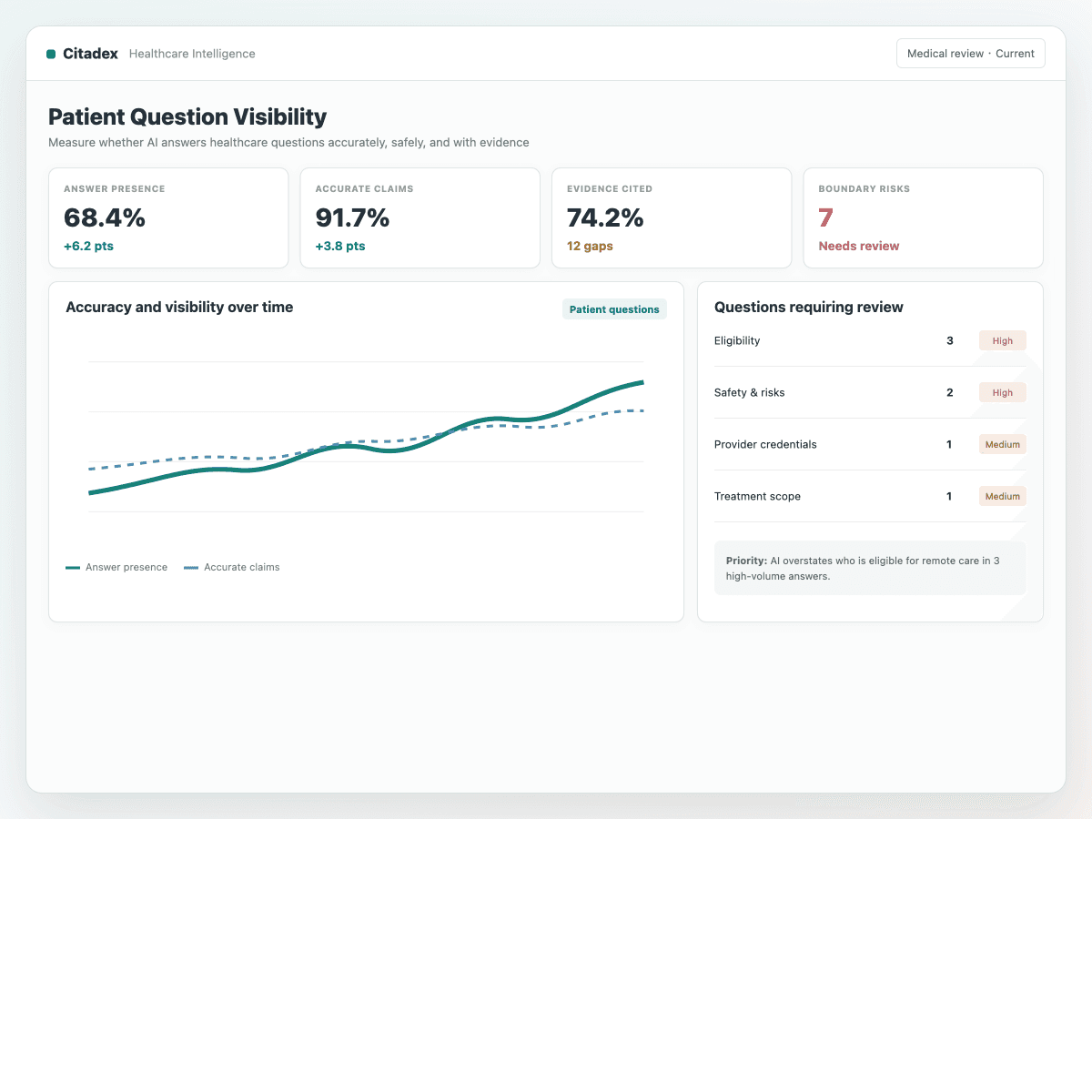
Visibility, accuracy and safety have to be read on one screen
Track brand appearance in the questions patients and buyers ask most — while checking professional statements, evidence citations and safety boundaries.
- Patient- and buyer-question coverage
- Correct-statement rate and evidence-citation rate
- High-risk-answer prioritization
Provider Recommendation Match
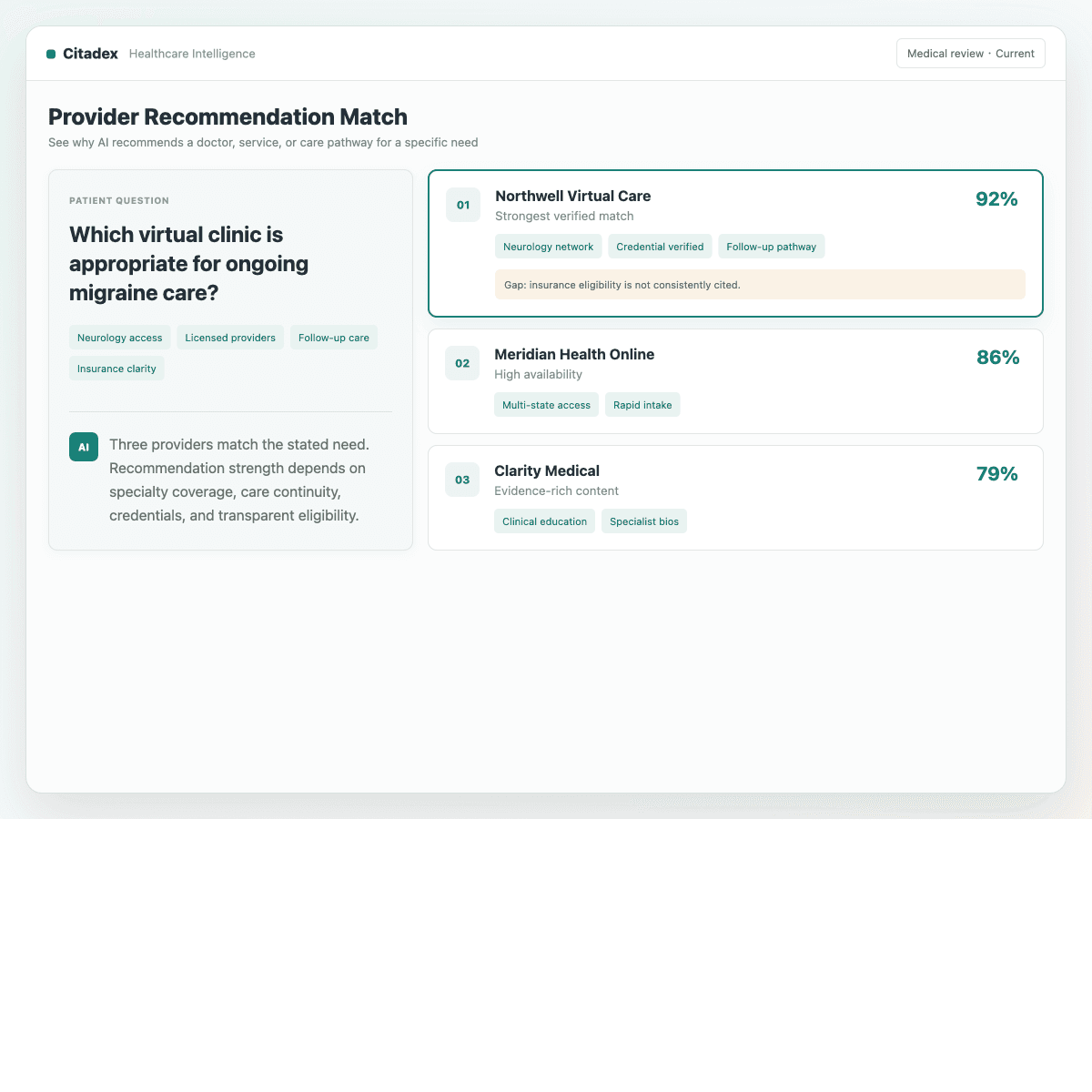
Reconstruct why AI recommends a given clinician, facility or service
Match user needs to specialty capability, licensure, continuity of care and insurance, item by item — and find the gaps in the recommendation rationale.
- Clinician / facility match reasons
- Credential and scope verification
- Info gaps that affect recommendation ranking
High-intent healthcare prompt map
Find the questions patients and buyers actually ask AI, then see whether your brand appears, who replaces you, and which sources AI cited.
is this telehealth provider legitimate
Monitor brand ordering, cited sources, reasons recommended and competitor placement in the answer.
who is a good candidate for remote care
Monitor brand ordering, cited sources, reasons recommended and competitor placement in the answer.
FDA cleared device alternatives for clinics
Monitor brand ordering, cited sources, reasons recommended and competitor placement in the answer.
risks and benefits of digital therapeutics
Monitor brand ordering, cited sources, reasons recommended and competitor placement in the answer.
Credential & Safety Audit
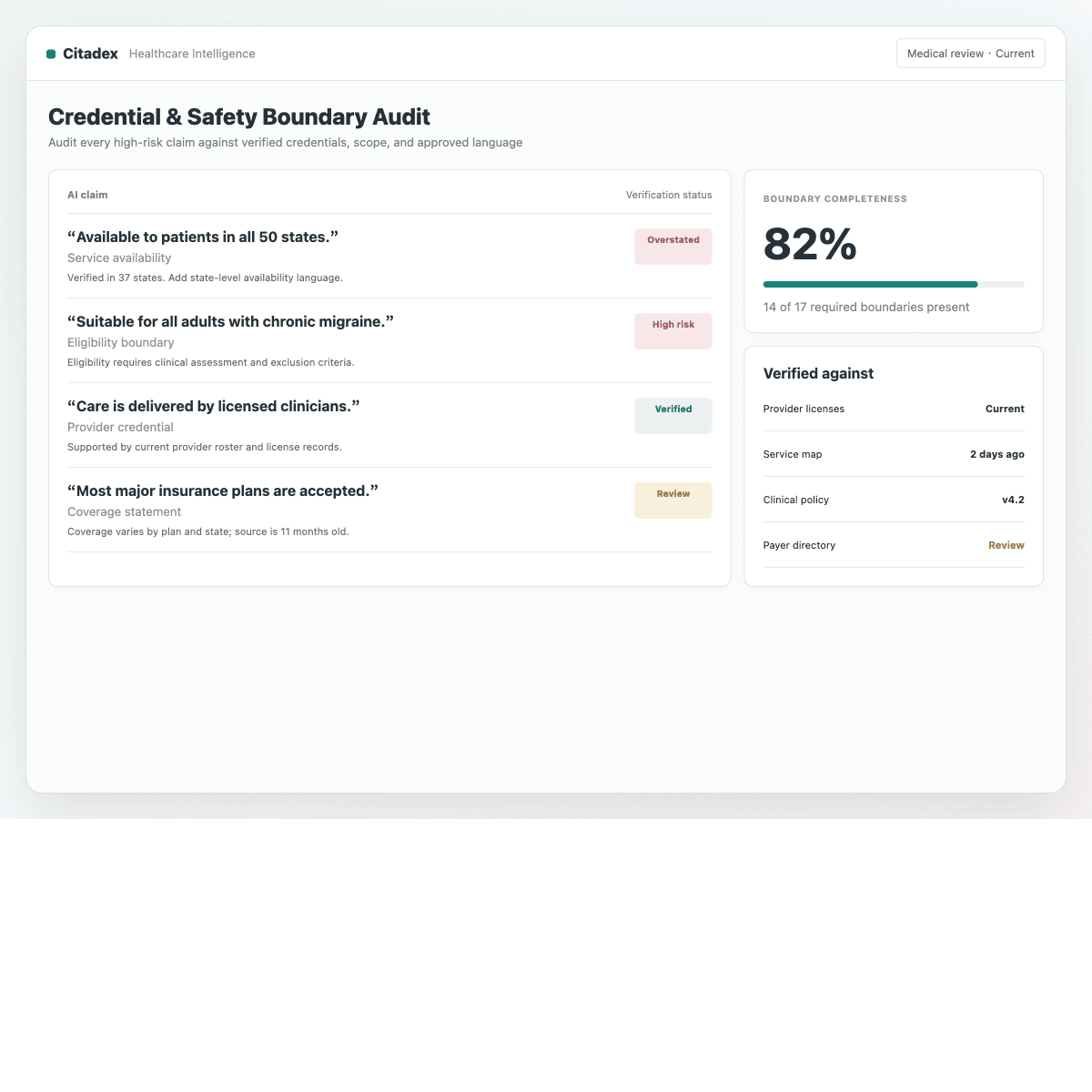
Audit credentials, scope and safety boundaries — line by line
Put high-risk medical claims, their evidence and compliance-approved copy into one review, so AI doesn’t overstate scope, indications or safety.
- High-risk claims and evidence sources
- Credential and scope verification
- Safety-boundary and contraindication accuracy
The Citadex industry solution
Monitor, sources, content and narrative governance — the modules that turn AI-answer data into accurate, defensible brand action.
Medical Answer Audit
Monitor how AI describes credentials, scope of service, eligible populations, contraindications and risks.
Evidence Mapping
Connect papers, guidelines, certifications, clinician profiles, institution pages and professional media sources.
Boundary Content
Generate clearer boundary statements for FAQs, medical-review pages, credential pages and safety notes.
Reputation Watch
Track negative narratives, misattributed sources and shifts in professional credibility in competitor comparisons.
Medical Evidence Map
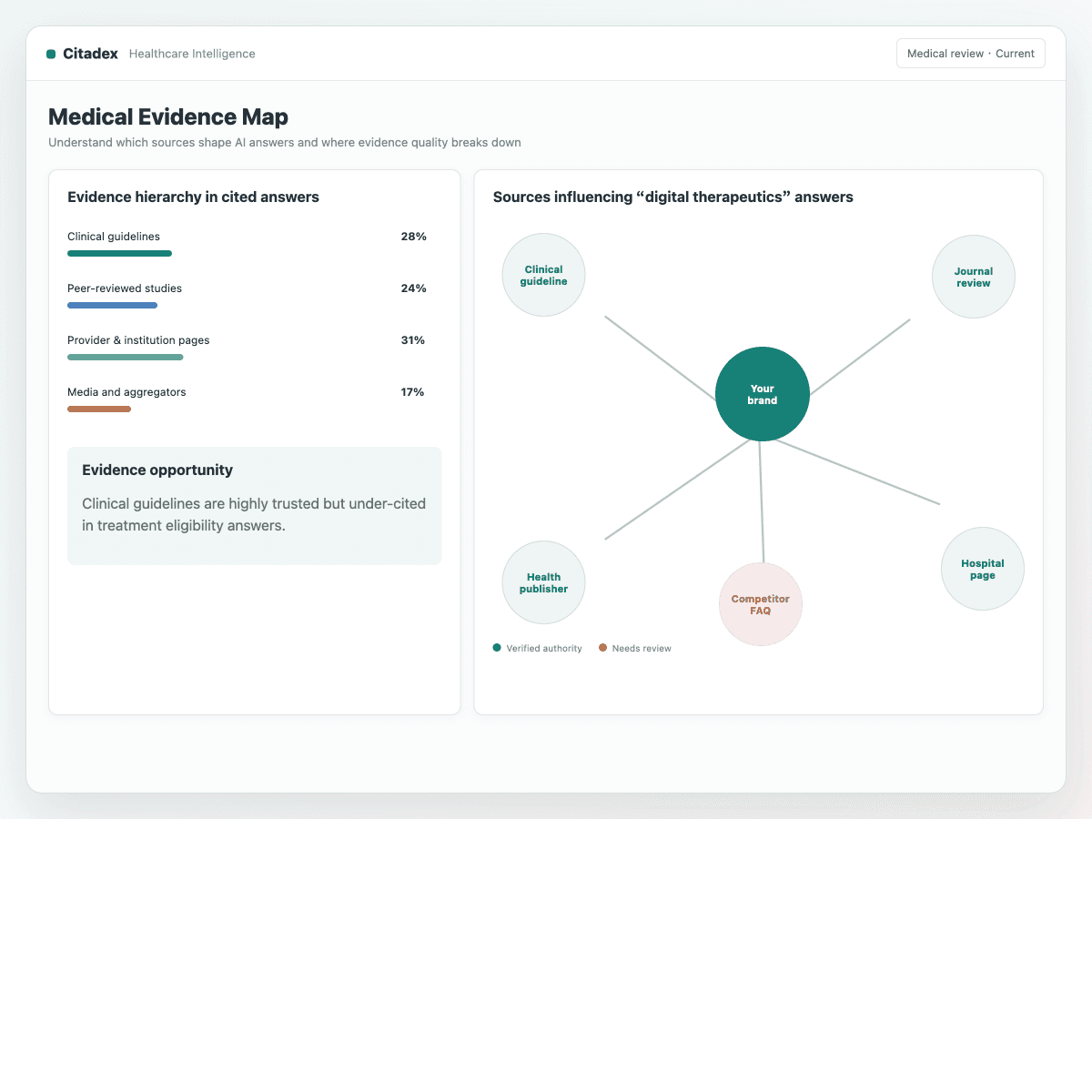
Let guidelines, papers and institutional sources form the evidence backbone
See which sources are shaping AI answers, and tell apart the influence of clinical guidelines, peer-reviewed research, institution pages and aggregator media.
- Medical source hierarchy and citation share
- High-impact evidence relationship map
- Low-quality and competitor-source alerts
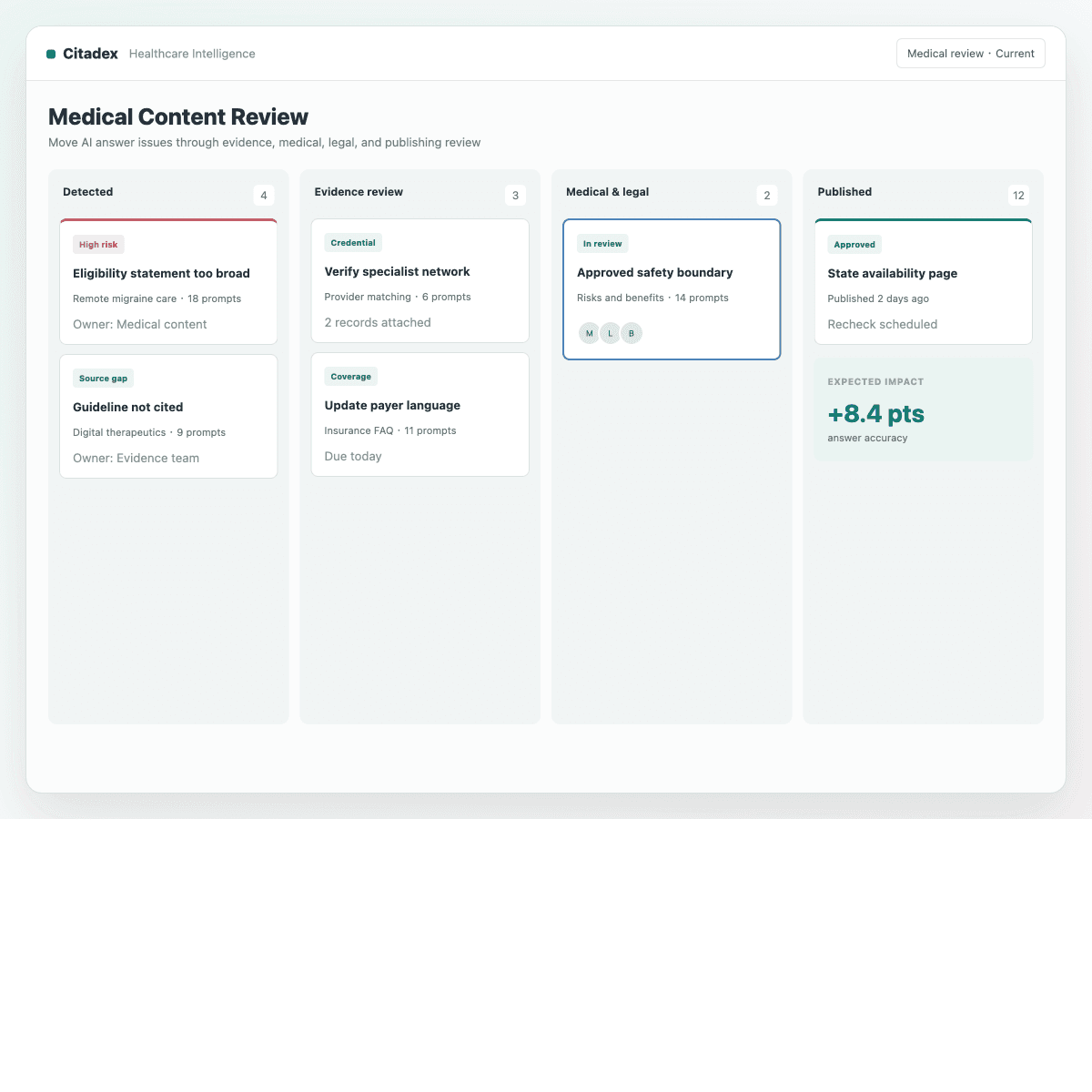
Medical Content Review
Send the issues you find into medical, legal and publishing review
High-risk answers don’t just sit in a report — they enter a full governance flow with evidence, an owner and an impact scope.
- Risk and evidence task routing
- Joint medical + legal sign-off
- Post-publish effectiveness re-check
From finding the gap to landing in the answer
Build an AI Prompt Library around what patients, clinicians, buyers and partners commonly ask.
Assess whether answers correctly cite credentials, evidence, scope and safety boundaries.
Output the site pages, medical content, FAQs, schema and third-party sources to revise.
Regularly sync risks and opportunities to compliance, medical-content, brand and growth teams.
Pages that earn the citation
Credential & certification pages
Scope-of-service pages
Medical-review pages
Device spec pages
Patient FAQ
Clinical evidence pages
Core metrics
Frequently asked questions
A clear definition, boundaries and answers — for patients, buyers and the AI models reading this page.
Is healthcare a good fit for AI visibility work?
Yes — but the goal should be accuracy and trust, not inflated exposure. The focus is getting AI to cite the right sources, understand boundaries and reduce the risk of wrong answers.
Does Citadex give medical advice?
No. Citadex focuses on how your brand and content appear in AI answers, helping teams find misattribution, missing sources and content-governance issues. It does not provide medical advice.
Which AI engines does Citadex cover?
Citadex tracks 11 core AI engines — ChatGPT, Claude, Gemini, Perplexity, Copilot, Grok, DeepSeek, Mistral, Qwen, Doubao, Google AI Overviews and Google AI Mode — across any language.
Related industries
Adjacent industries that form the Citadex solutions cluster — not isolated pages.
Legal & Professional Services
Clients first ask AI how to solve a problem and which provider to trust. Citadex builds an authoritative source matrix for legal, consulting and tax firms — lowering the risk of bad advice and misattribution.
Education & E-learning
Learners use AI to plan careers, compare courses, judge credential value and choose providers. Citadex turns course strengths, outcomes and proof into citable decision criteria.
B2B SaaS
When buyers use ChatGPT, Perplexity, Gemini or Google AI Overviews to compare tools, find alternatives and evaluate integrations, Citadex tracks whether AI understands, cites and recommends you.
Start auditing your healthcare AI visibility
Enter your brand, competitors and target markets — Citadex generates the Prompt Library, Share of Voice, citation sources and a prioritized content plan.