How to Give Clients Reliable AI Visibility Reports When ChatGPT Answers Keep Changing
Key takeaways:
- A reliable AI visibility report measures a fixed set of prompts on the same engines on a fixed schedule and reports the trend, never a single answer.
- ChatGPT, Perplexity, Gemini and Claude cite different sources for the same question, so every metric has to be broken out per engine.
- Mention rate, average rank, sentiment and citation rate answer different questions; a client report needs all four, plus competitor share of voice.
Reliable AI visibility reporting means asking the same prompts to the same AI engines on a recurring schedule and reporting the direction of the numbers, not any one answer. A ChatGPT answer to "best project management software for small teams" can name different tools on Tuesday than it did on Monday. That is normal behavior for these systems, and a reporting method has to treat it as expected variance and look for the signal underneath.
Why do ChatGPT and Perplexity answers change from week to week?
Search-enabled assistants such as ChatGPT with search, Perplexity, Google AI Overviews and Copilot build each answer from pages they retrieve at the moment of the question, on top of what the model already knows. When the retrieved pages change, the answer changes. A Reddit thread that gained traction this week, a newly published comparison page or a refreshed review listing can all shift which brands get named.
Each engine also retrieves from different places. Perplexity shows its sources prominently and often leans on recent pages. Gemini and Google AI Overviews draw on Google's index. So a client can appear in Perplexity's answer and be missing from ChatGPT's answer to the same question on the same afternoon.
The practical consequence for agencies: one answer is an observation, not a finding. A competitor showing up once in a spot check is not something to report. It becomes reportable when it repeats across runs.
What is a reliable method for measuring AI visibility?
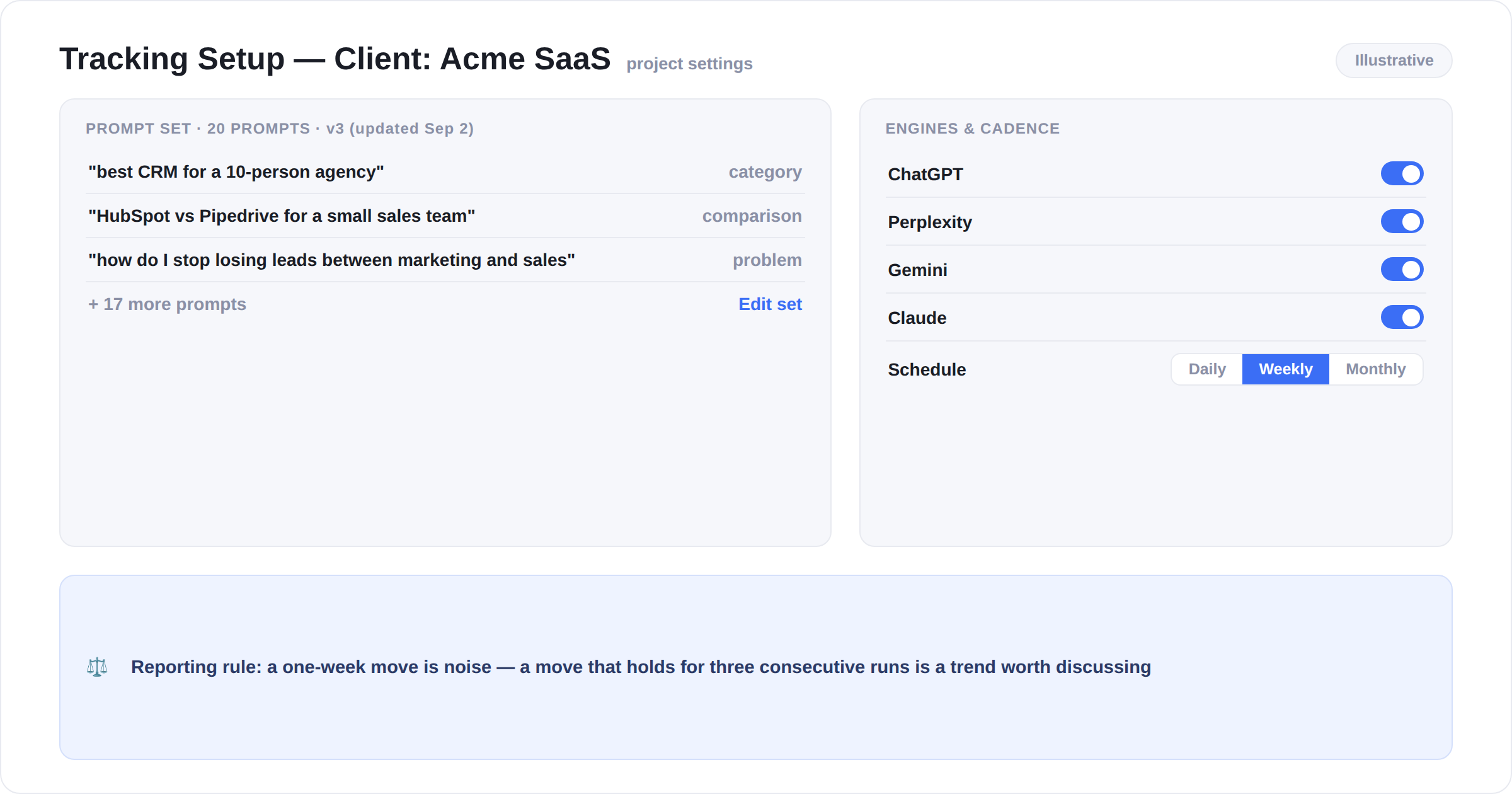
Fix the prompts, fix the engines, run on a schedule, and report only what holds across several runs.
- Build a prompt set per client. Collect 15 to 30 questions the client's buyers would actually ask an AI assistant: category questions ("best CRM for a 10-person agency"), comparisons ("HubSpot vs Pipedrive for a small sales team") and problem questions ("how do I stop losing leads between marketing and sales"). SEO keyword lists are a starting point, but AI prompts are longer, conversational and often comparative.
- Track every prompt on every engine that matters for the client. Checking one engine gives a partial picture that cannot go in front of a client.
- Record four metrics per prompt, per engine, per run:
- Mention rate: did the brand appear in the answer at all.
- Average rank: where it appeared when the answer listed several options.
- Sentiment: how the answer described the brand.
- Citation rate: whether the answer linked to the brand's own pages as a source.
- Run on a fixed cadence. Weekly is a sensible default for most retainers; daily makes sense for crowded categories or launch periods. Consistency matters more than frequency, because a client asking "why did we drop?" needs a comparable earlier data point.
- Report the trend, not the snapshot. As a rule of thumb, treat a one-week move as noise and a move that holds for three consecutive runs as a trend worth discussing.
The fifth step is the one most often skipped. AI answers vary from week to week with no change on the brand's side. Reporting every fluctuation as meaningful teaches the client to distrust the report the first time a number bounces back by itself.
Worked example: one client's month in numbers
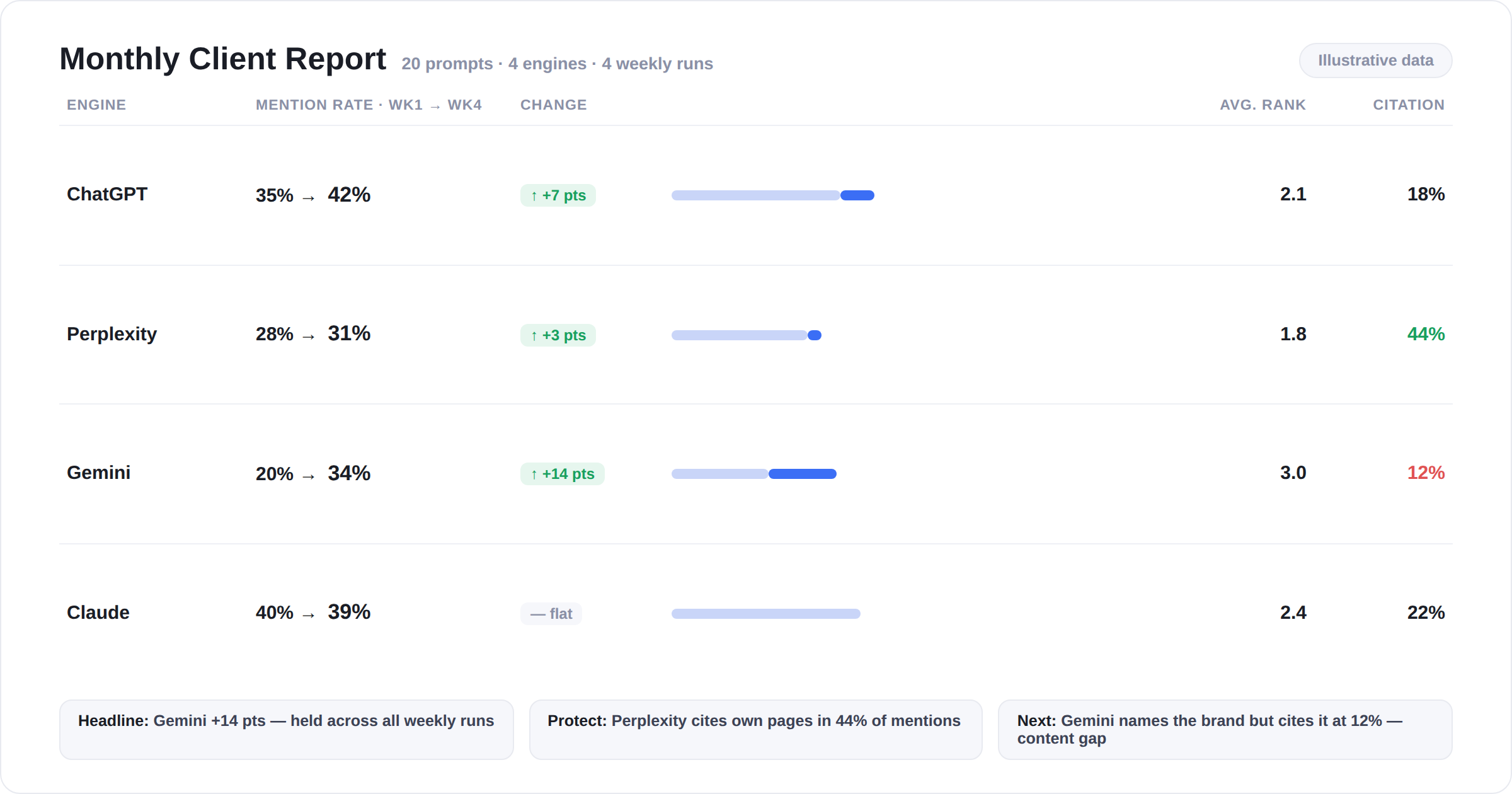
Say you run GEO for a mid-size SaaS client with 20 prompts tracked on four engines: ChatGPT, Perplexity, Gemini and Claude. That is 80 prompt and engine combinations per run. The numbers below are illustrative, aggregated across the 20 prompts per engine.
| Engine | Mention rate, week 1 | Mention rate, week 4 | Avg. rank when mentioned | Citation rate |
|---|---|---|---|---|
| ChatGPT | 35% | 42% | 2.1 | 18% |
| Perplexity | 28% | 31% | 1.8 | 44% |
| Gemini | 20% | 34% | 3.0 | 12% |
| Claude | 40% | 39% | 2.4 | 22% |
How to read it:
- Gemini moved the most, up 14 points in four weeks. That is the headline of the monthly report, provided it held across the weekly runs in between.
- Claude is flat. That is a legitimate finding: not every engine moves in the same window.
- Perplexity cites the client's own pages in 44% of the answers that mention it. That is a stronger signal than mention rate alone, and those pages are worth keeping current.
- Gemini's citation rate of 12% says the brand is being named without its own content being used as a source. The next content work should target that gap.
The client summary writes itself from the table: mention rate is up on two of four engines, Perplexity citations are strong and worth protecting, and Gemini needs content that engine can cite.
How do you show clients that competitors are recommended more often?
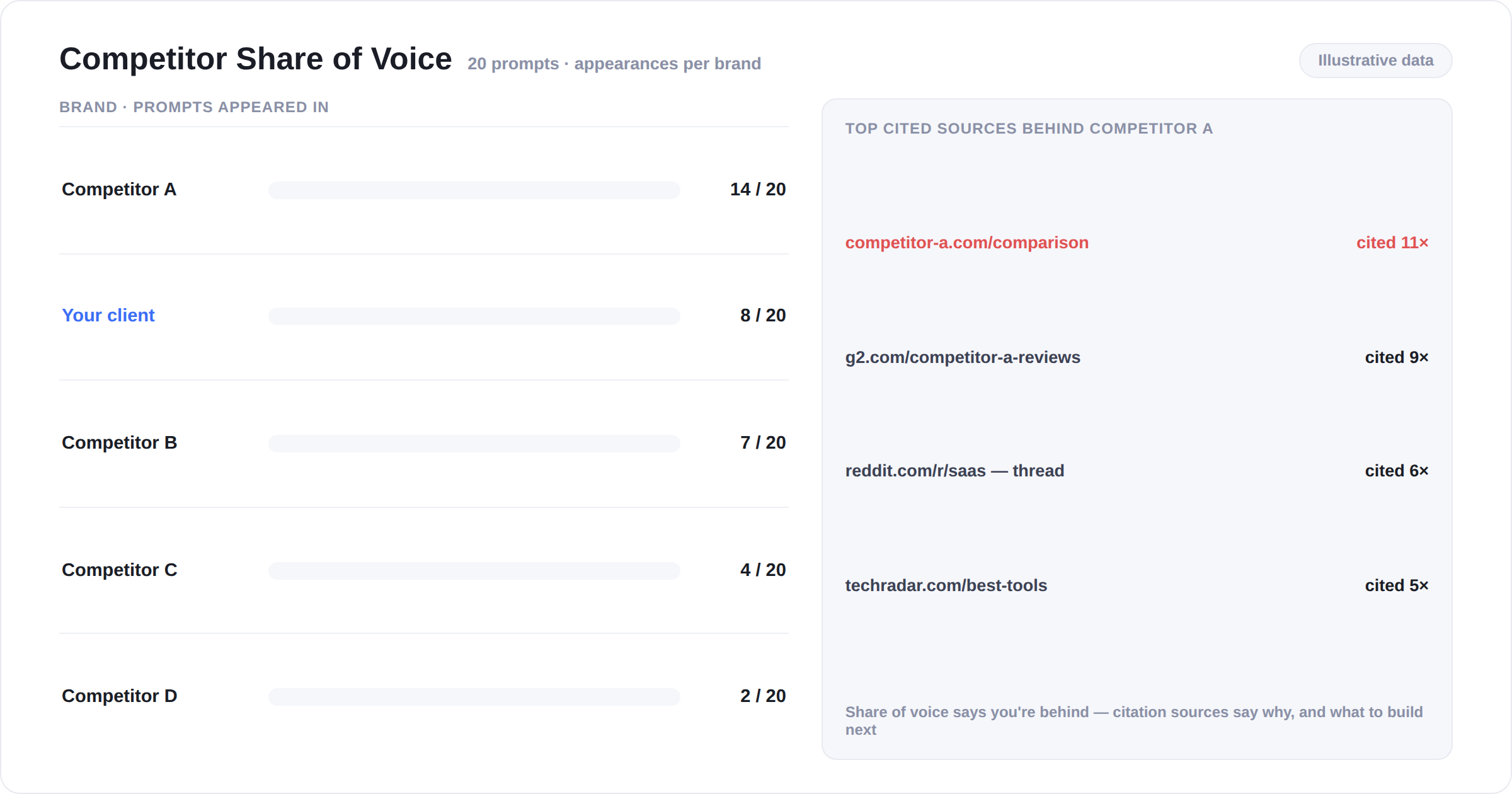
Track the competitors inside the same prompt set and report share of voice. For every prompt, log which brands the answer named, in what order, and which pages it cited to justify them.
If the client appears in 8 of 20 prompts and a named competitor appears in 14, that is a gap you can quantify and put on one slide. The more useful half is the citation detail. If the competitor wins because engines keep citing its comparison page or its G2 listing, the client knows exactly which kind of page to build or which listing to improve. Share of voice tells the client they are behind. Citation sources tell them why and what to do next.
Should an agency use a platform, a white-label partner or build in-house?
Start from what you need to protect: speed to the first client report, margin per client, or long-term ownership of the service.
| Approach | Time to first client report | Who does the work | Cost logic | Best fit |
|---|---|---|---|---|
| Dedicated AI visibility platform | Days | Your team, using the platform's tracking and reports | Subscription plus usage, scales with clients | Agencies that want to own delivery |
| White-label partner | Days to weeks | The partner delivers, you brand the output | Per engagement or revenue share | Agencies that want the service live without building expertise |
| Build in-house | Months | Your team builds tracking, storage and reporting | Engineering time plus ongoing maintenance | Agencies with developers and a long time horizon |
Building in-house means maintaining connections to a dozen engines, handling rate limits, storing every answer and producing client-ready output, then keeping all of it working as engines change. Few agencies can justify that before GEO is a proven revenue line. A white-label partner gets the service live fastest but puts the expertise, and much of the margin, outside the agency. A platform sits in between: the tracking is handled, and your team keeps the client relationship and the interpretation, which is the part clients pay for.
How Citadex supports multi-client AI visibility reporting
Citadex is an AI visibility platform that tracks how AI engines answer a brand's buyer questions across 12 engines: ChatGPT, Google AI Overviews, Google AI Mode, Gemini, Perplexity, Microsoft Copilot, Claude, Grok, DeepSeek, Mistral, Qwen and Doubao. For agencies it maps directly onto the method above:
- Per-prompt, per-engine metrics. Every tracked prompt logs mention rate, average rank, sentiment and citation for each engine, on a daily, weekly or monthly schedule set per prompt.
- Markets by country and language. Each client market is a country plus a language, and its prompts are asked from that country, so an English prompt for the UK and one for the US are measured separately.
- Evidence behind every number. The full answer each engine gave is kept with the result, so you can show a client what was actually said instead of a screenshot.
- Citation sources. Citadex shows which domains and pages the engines cite for a chosen set of prompts, including the competitor pages that win those answers.
- Agency setup. Each client is its own project, prompts are unlimited, and team members work in a shared workspace. Client reports can carry the agency's logo, and a full white-label portal is coming soon. Agencies can start with a 14-day trial.
How do you automate monitoring across many clients?
Let a scheduled system run each client's prompt set and spend your time on the exceptions. Pasting prompts into ChatGPT and Perplexity by hand takes an afternoon for a handful of clients and stops scaling at three or four accounts.
Three habits matter more than any single feature:
- Keep prompt sets separate per client and versioned. When the client's positioning changes, update the set deliberately and note the date, so later trend lines stay comparable.
- Separate the tracking cadence from the review cadence. Track weekly, but read the trend lines every two weeks. That keeps you from reacting to daily noise.
- Keep the answer text. When a client asks what an engine said about them last quarter, the stored answer settles it.
A retainer built on manual checks has a fixed labor cost per client. A retainer built on scheduled tracking scales, because adding a client mostly means setting up a new prompt set.
What mistakes make AI visibility reports look unreliable?
- Reporting one answer as the result. The client checks ChatGPT an hour later, sees something different, and stops trusting the report. State the basis in the report itself, for example "4 weekly runs, 20 prompts, 4 engines".
- Treating mention rate as the whole story. A brand can be named often while its own pages are rarely cited. That usually means the model knows the brand but the brand's content is not what gets retrieved, which calls for different work than low visibility does.
- Averaging engines into one score. A single "AI visibility score" hides the engine where the real movement is, and that is the engine that should decide where content effort goes next.
- Ignoring sentiment and accuracy. A frequent mention that repeats outdated pricing or a discontinued feature does more harm than a missing one. Read the full answer, not only whether the brand appeared.
FAQ
Q: Should an agency use one prompt set for all its clients?
No. Each client's buyers ask different questions depending on category, market and company size. A shared generic set misses the comparisons and objections that matter for each client and makes competitor share-of-voice numbers less meaningful.
Q: Can an agency offer GEO reporting without a dedicated AI specialist?
Yes, if the platform runs the tracking and calculates the metrics. The skill that matters is interpretation: connecting a drop in citation rate to a specific missing or outdated page. Most SEO and content strategists already have that skill.
Q: How do you explain a sudden visibility drop to a client?
Show the full tracked period, not just the bad week. If the number dropped once and recovered, say so plainly. If it declined across several runs, pair the finding with a specific cause you can see in the data, such as a competitor page now cited on those prompts, and the next step you will take.
Q: Is it worth tracking DeepSeek, Qwen or Doubao for clients?
Only where the client's buyers use them. For a client selling in China or to Chinese-speaking buyers, those engines matter as much as ChatGPT does in the US. For a client selling only in Western markets, they are usually not a priority. Choose engines by where the audience asks questions, not by how many engines a tool can cover.