Google Says GEO Is Just SEO: Do You Still Need a Dedicated AEO Tool?
Key takeaways:
- Google's guidance that AEO/GEO is "still SEO" applies to Google Search and Google AI Overviews specifically, not to how ChatGPT, Perplexity, or Claude select and cite brands.
- llms.txt and AI-specific content chunking don't change how Google crawls or ranks pages for AI Overviews, since Googlebot still reads and indexes standard HTML.
- Measuring whether ChatGPT and Perplexity actually recommend your brand requires prompt-level tracking of mention rate, citation rate, and sentiment, which standard SEO reporting was never built to do.
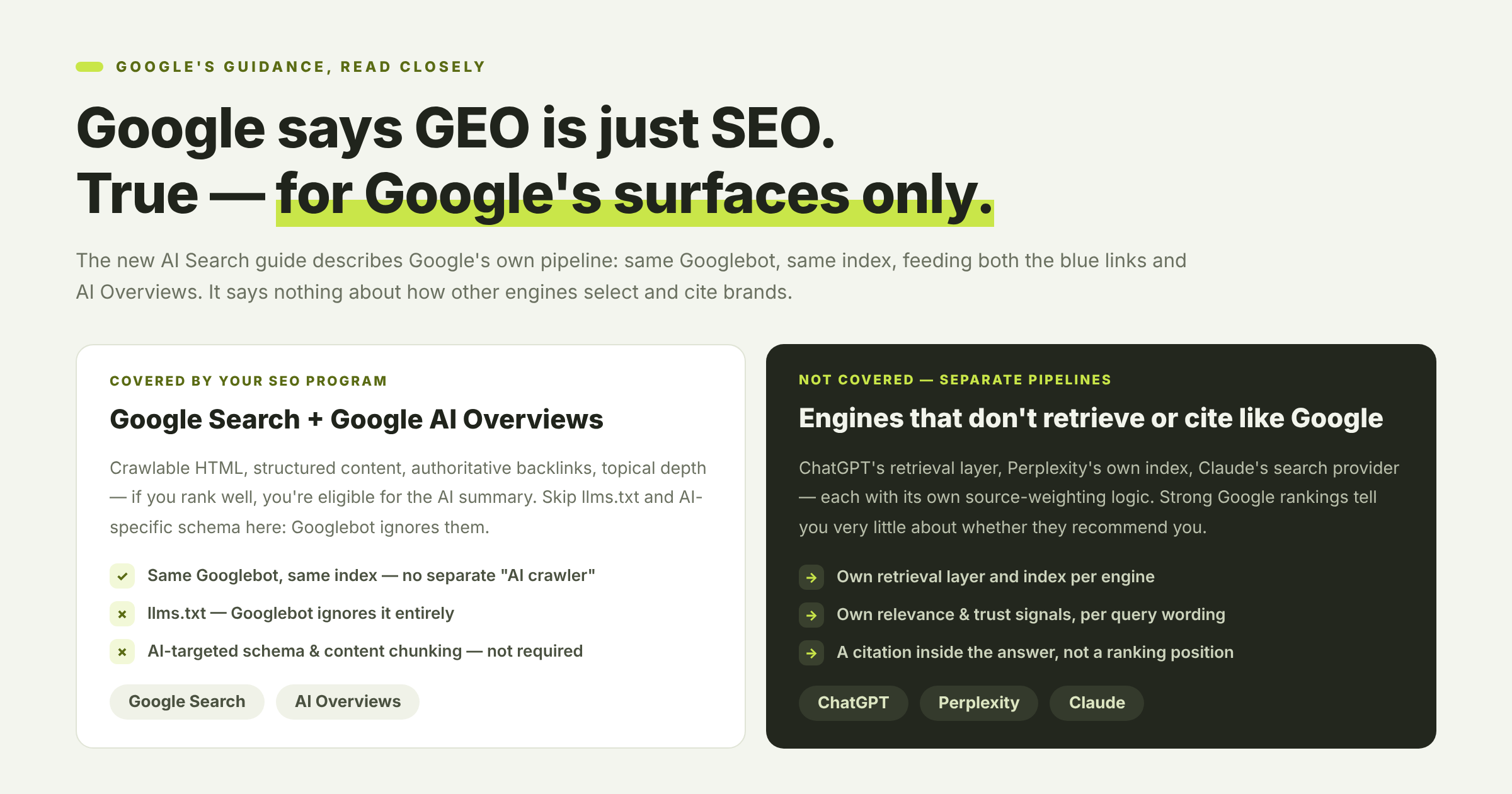
Google's position that generative AI search optimization is "still SEO" is correct for Google's own surfaces. If your brand only needs to show up in Google Search and Google AI Overviews, the fundamentals you already know (crawlable HTML, structured content, authoritative backlinks, topical depth) carry you most of the way there. But if you also need to show up when someone asks ChatGPT, Perplexity, or Claude to recommend a product in your category, Google's guidance doesn't apply, because those engines don't retrieve, rank, or cite the way Google does.
What does Google's "GEO is just SEO" guidance actually say?
Google's new AI Search guide states that AEO and GEO are not a separate discipline from SEO. Site owners can skip tactics like llms.txt files, content chunking designed for AI consumption, and special AI-targeted schema markup, according to Search Engine Journal. The reasoning is straightforward: if your content already ranks well in classic Google Search through solid technical SEO and genuine expertise, it's also well positioned to be surfaced and cited in Google's AI Overviews.
Google controls both the crawler and the generative layer sitting on top of its own index. There's no separate "AI crawler" with different quality signals; it's the same Googlebot, the same index, feeding both the ten blue links and the AI-generated summary above them. An analysis of the guidance makes this distinction explicit: from Google Search's perspective, optimizing for generative AI search is optimizing for the search experience, so it's still SEO. Googlebot reads your HTML directly and ignores llms.txt entirely when deciding what to crawl and cite, according to an analysis of the guide. The guidance describes Google's pipeline, not a universal law about every system that generates an AI answer.
When this guidance circulates as a general AI SEO talking point, the qualifier "Google" gets lost. The guide says nothing about how OpenAI's retrieval layer decides which sources to cite in a ChatGPT answer with search enabled, or how Perplexity ranks and weights sources differently from Google's own ranking signals. It can't, because Google doesn't operate those systems.
Do llms.txt and content chunking help with Google AI Overviews?
No, not for Google specifically. If your goal is appearing in Google AI Overviews, llms.txt files and AI-oriented content chunking don't help, because Googlebot crawls and ranks the same HTML it always has. Google has confirmed this directly, according to Search Engine Journal. Google decides what to summarize in an AI Overview using the existing search index. If a page already earns a strong ranking through normal technical SEO and topical authority, it's eligible to be pulled into the generative summary.
A fair amount of GEO advice since 2024 treated llms.txt as a kind of sitemap for AI crawlers, assuming that if you tell an AI system which pages matter, it will prioritize those pages when generating an answer. For Google's own crawler, that assumption doesn't hold. Googlebot reads your HTML and ignores llms.txt entirely, per the same analysis cited above (nohacks.co). Content chunking, splitting pages into discrete, extractable blocks aimed at AI retrieval, similarly isn't required for AI Overviews eligibility. Normal page structure, clear headings, and crawlable content do the same job Google's ranking system already rewards.
This doesn't mean llms.txt or chunking are pointless everywhere. It means they shouldn't influence Google AI Overviews specifically, because that's not how Google's pipeline uses them. Whether a given third-party AI engine's own crawler reads or respects an llms.txt file is a separate question for that engine, and one worth checking against that engine's own documentation rather than assuming a single AI-wide standard exists.
Why doesn't Google's SEO-only framing cover ChatGPT, Perplexity, and Claude?
Those engines retrieve and cite sources through entirely different pipelines than Google's own index. SEO earns a page a ranking position in a results list. GEO earns a brand a mention or citation inside the generated answer itself, and those answers in tools like ChatGPT, Perplexity, and Gemini are built on retrieval systems that are not Google's search index, as one explainer frames it (christopherjanb.com). Perplexity pulls from its own web index and ranks sources by its own relevance and trust signals. ChatGPT with search enabled calls out to a retrieval layer with its own source-weighting logic. Claude, when search-enabled, does the same through its own provider. None of these share Google's ranking algorithm, so being well-optimized for Google tells you very little about whether any of them will cite or recommend you.
The stakes here are concrete. AI Overviews have been shown to cut click-through rates by as much as 58% for pages that rank first in traditional results, according to SoftwareSuggest. Even a perfectly Google-optimized page sends less traffic than it used to, win or lose on the AI citation front. Success in this environment is harder to track than classic rank monitoring, since what you're watching is how often an engine cites you and how often your brand gets named in generated answers, not where a URL sits on a page. SEO work strengthens GEO and GEO work exposes gaps SEO alone won't catch, each compounding the other rather than replacing it, as one analysis puts it (Mint Position).
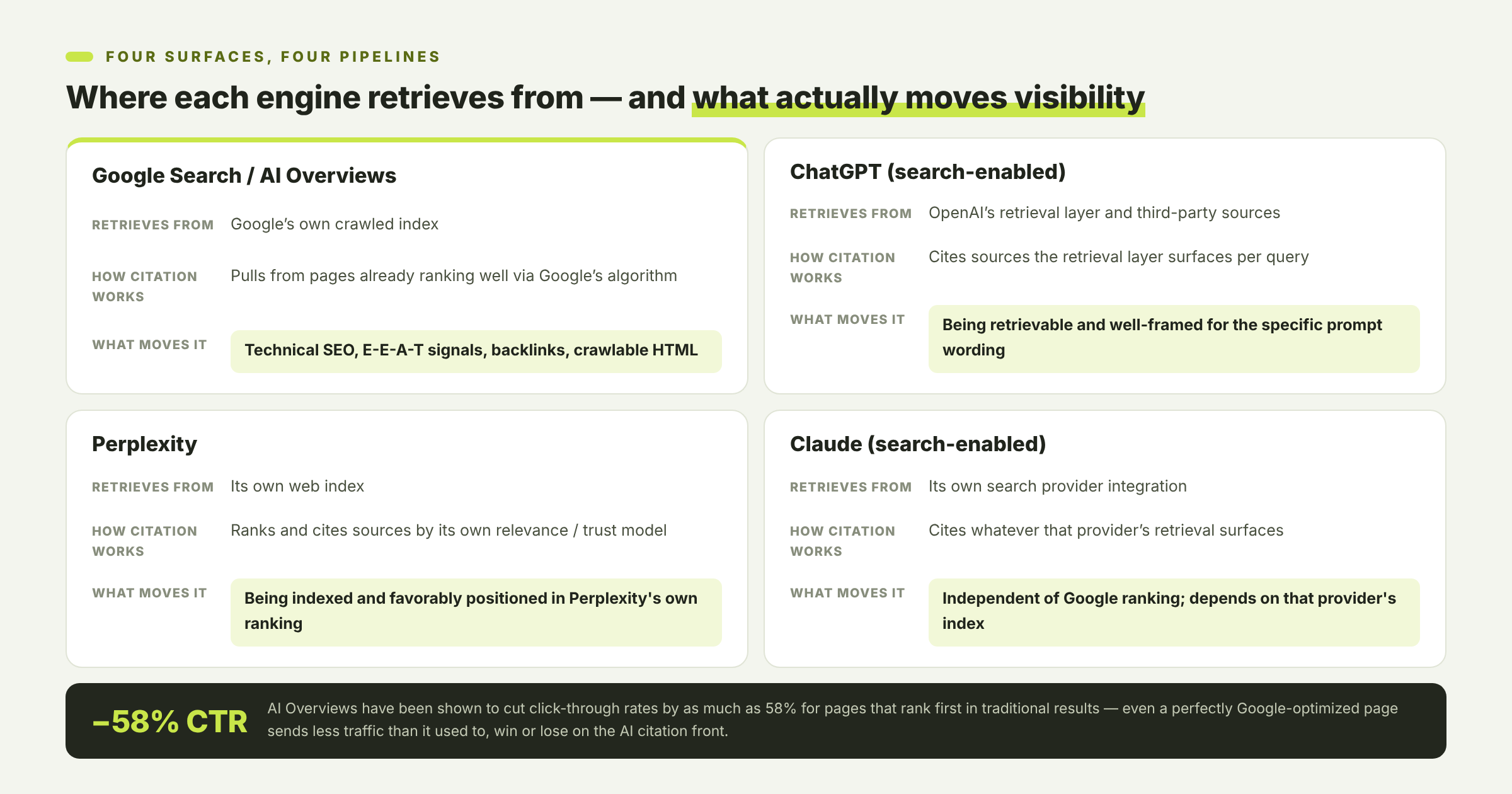
| Surface | What it retrieves from | How citation works | What actually moves visibility |
|---|---|---|---|
| Google Search / AI Overviews | Google's own crawled index | Pulls from pages already ranking well via Google's algorithm | Technical SEO, E-E-A-T signals, backlinks, crawlable HTML |
| ChatGPT (search-enabled) | OpenAI's retrieval layer, third-party sources | Cites sources the retrieval layer surfaces per query | Being retrievable and well-framed for the specific prompt wording |
| Perplexity | Its own web index | Ranks and cites sources by its own relevance/trust model | Being indexed and favorably positioned in Perplexity's own ranking |
| Claude (search-enabled) | Its own search provider integration | Cites whatever that provider's retrieval surfaces | Independent of Google ranking; depends on that provider's index |
How do you measure whether ChatGPT and Perplexity actually recommend your brand?
You measure it the same way you'd measure a salesperson's performance: not by whether they said your company's name, but by whether they put you forward as the answer. The distinction that matters is between a brand being mentioned and a brand being recommended. If someone asks ChatGPT "what's a good project management tool for a 10-person agency," an answer that lists your product among six others in passing is a mention. An answer that opens with your product as the suggested pick is a recommendation. Treating those as the same event in a tracking spreadsheet is the single biggest reason teams misjudge their AI visibility.
The practical method is prompt-level tracking across engines. Build a representative list of the actual questions a buyer would ask (not your own brand name, but category-level questions) and run them against each AI engine on a regular cadence. Record three things per prompt per engine: whether your brand appeared at all (mention rate), whether it was cited with a link or clear attribution (citation rate), and whether the framing was positive, neutral, or negative (sentiment). Layer in which competitors showed up in the same answer, and you get a share-of-voice number for that query set.
This is the gap a dedicated tool closes that SEO reporting never addressed. Citadex tracks each prompt's answer across engines and tags whether a mention counts as a true recommendation versus a passing reference. It stores the full original answer text so you can see how the wording shifted over time, and shows which sources the AI actually cited when it answered, including pages where a competitor was cited and you weren't. It also fires alerts automatically based on built-in signals: when a competitor gets named in a slot your brand used to occupy, when coverage for a prompt drops or declines, or when a prompt that used to mention you stops mentioning you entirely. None of that comes from a Search Console export, because Search Console only reports on Google's surfaces.
A decision framework: when is SEO enough, and when do you need a dedicated GEO tool?
Run this as a short audit before you decide:
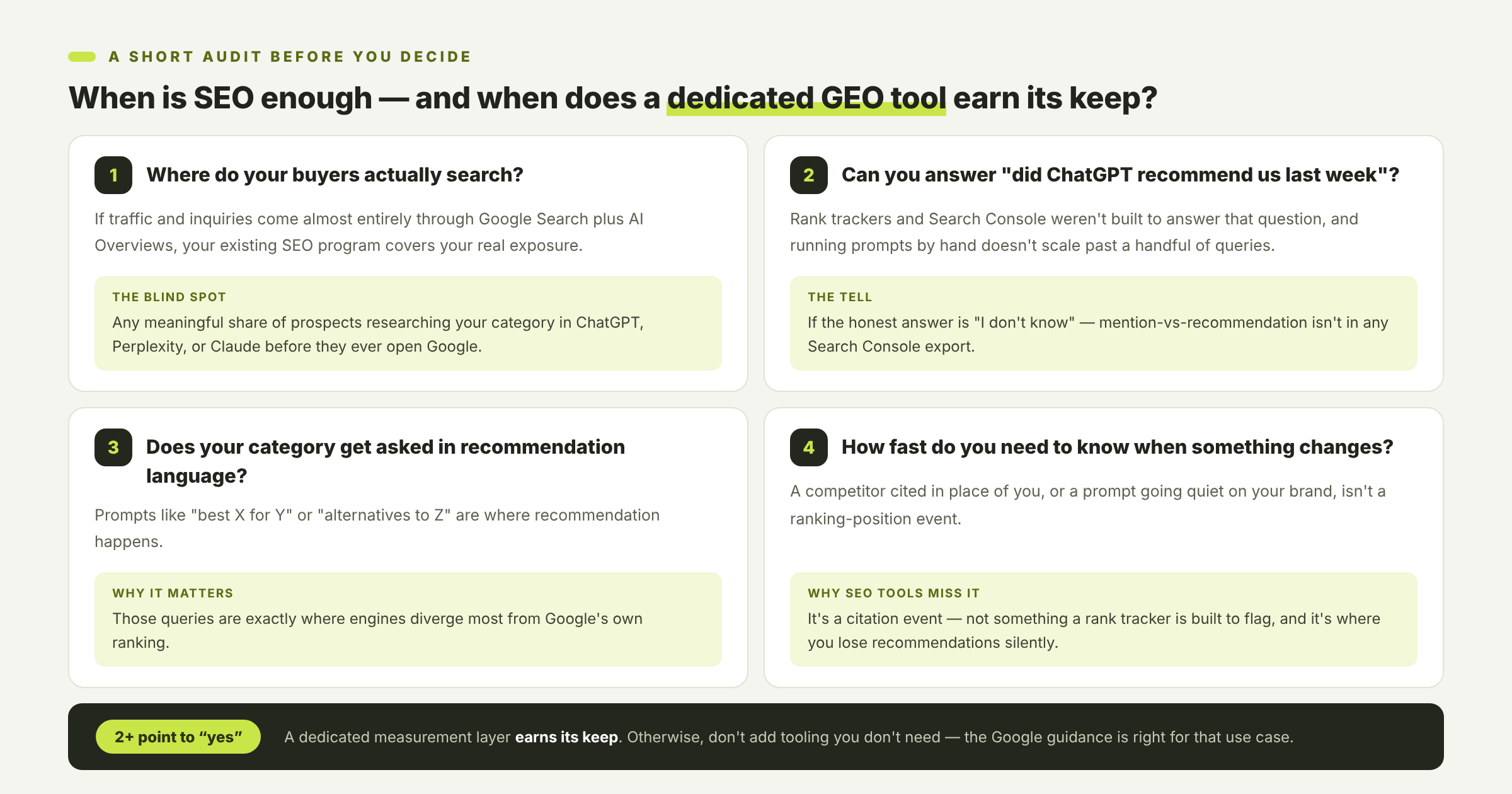
- Where do your buyers actually search? If your traffic and inquiries come almost entirely through Google (Search plus AI Overviews), your existing SEO program plus Google's own AI guidance covers your real exposure. If any meaningful share of prospects use ChatGPT, Perplexity, Claude, or voice assistants to research your category before they ever open Google, SEO reporting alone has a blind spot.
- Can you currently answer "did ChatGPT recommend us last week"? If the honest answer is "I don't know," that's the tell. Rank trackers and Search Console weren't built to answer that question, and manually running prompts by hand doesn't scale past a handful of queries before it becomes unreliable.
- Does your category get asked about in comparison or recommendation language? Prompts like "best X for Y" or "alternatives to Z" are where recommendation happens. Those queries are exactly where engines diverge most from Google's own ranking.
- How fast do you need to know when something changes? A competitor getting cited in place of you, or a prompt that used to surface your brand going quiet, is a change SEO tools don't flag because it isn't a ranking-position event; it's a citation event.
If two or more of those point toward "yes, this matters," a dedicated measurement layer earns its keep. Otherwise, don't add tooling you don't need; the Google guidance is right for that use case.
Worked example: tracking 20 prompts across three engines
Say you sell project management software. You build a list of 20 realistic buyer prompts like "best project management tool for marketing agencies" and "alternatives to [a competitor] for remote teams." You run that list weekly against Google AI Overviews, ChatGPT, and Perplexity.
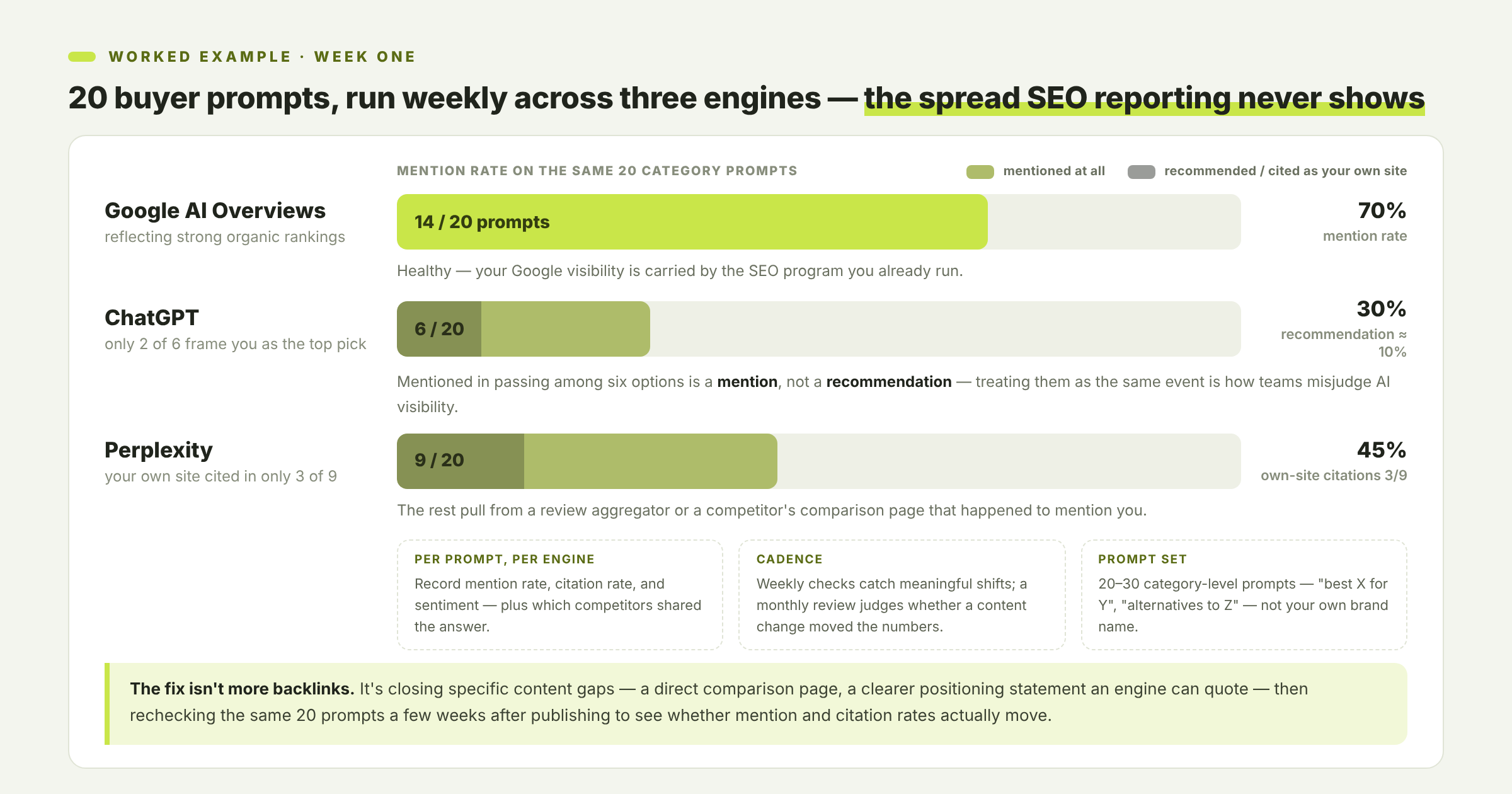
In week one, Google AI Overviews mentions your brand in 14 of 20 prompts (70% mention rate), reflecting your strong organic rankings. ChatGPT mentions you in 6 of 20 (30%), and of those 6, only 2 frame you as the top pick rather than one of several options. Your recommendation rate on ChatGPT is closer to 10%. Perplexity mentions you in 9 of 20 (45%) but cites your actual site as a source in only 3 of those 9; the rest pull from a review aggregator or a competitor's comparison page that happened to mention you.
That spread tells you something SEO performance alone never would: your Google visibility is healthy, but your presence inside generative answers on two other major engines is thin. Where you do appear, you're often cited through someone else's content rather than your own. The fix isn't more backlinks. It's closing specific content gaps (a direct comparison page, a clearer positioning statement an engine can quote) and rechecking those same 20 prompts a few weeks after publishing to see whether the mention and citation rates actually move.
What mistakes do teams make after reading "GEO is just SEO"?
The most common mistake is treating the guidance as license to stop watching anything beyond Google rankings, when the guidance was only ever about Google's own pipeline. A second mistake is the inverse: panicking and investing heavily in llms.txt files and AI-specific schema under the assumption that every engine reads those signals the same way. There's no universal standard for how third-party engines weight them. A third mistake is measuring AI visibility with a single number, "we got mentioned", instead of separating mention from recommendation and citation. This produces a misleadingly rosy picture when most appearances are passing references buried in a list of six competitors. A fourth mistake is checking only brand-name prompts like "what is [your company]" instead of category prompts a real buyer would type. Brand searches tell you almost nothing about whether an engine would recommend you to someone who's never heard of you.
Frequently Asked Questions
Q: If Google's guidance is right for Google, should I stop doing any GEO-specific work at all?
A: No. Stop GEO-specific tactics aimed purely at Google, like llms.txt files intended to influence AI Overviews, since Google's own crawler ignores them. Keep doing GEO work aimed at other engines, because ChatGPT, Perplexity, and Claude retrieve and cite sources through separate systems that Google's guidance doesn't address at all.
Q: Does good technical SEO automatically transfer to visibility in ChatGPT or Perplexity?
A: Partially, but not automatically. Clean, crawlable, well-structured content helps any retrieval system find and understand your pages. But each engine's own ranking and citation logic is independent of Google's, so strong Google rankings don't guarantee a mention or citation in a ChatGPT or Perplexity answer.
Q: How often should I re-check my AI visibility numbers?
A: Weekly checks on your core prompt set catch meaningful shifts without producing noise from day-to-day answer variation. A monthly review is enough to judge whether a content change actually moved mention or citation rates.
Q: Is it worth tracking prompts in languages other than English?
A: Yes if your buyers search in other languages. An AI engine's answer to a German-language prompt can cite entirely different sources than its answer to the English equivalent for the same question. Track prompts in the languages your actual target markets use rather than assuming one language set represents global visibility.
Q: What's a realistic starting point for how many prompts to track?
A: Around 20 to 30 category-level prompts covering your main use cases and the "best X" and "alternatives to Y" phrasings buyers actually type is enough to spot patterns without becoming unmanageable to review by hand.