Key takeaways:
- Several GEO/AEO platforms offer native agency partner programs that let you monitor and report AI visibility under your own brand.
- White-label fulfillment services and white-label SaaS platforms solve different problems: agencies should understand the distinction before choosing.
- Per-project pricing models lower the financial risk of reselling GEO services compared to fixed-seat enterprise licenses.
Generative Engine Optimization (GEO) is now a real service category, and agencies are being asked to deliver it. The tooling landscape splits into two directions: platforms built for individual brands, and a smaller set with genuine agency infrastructure including partner accounts, per-project billing, and white-label dashboards. Understanding which tools belong to which camp saves weeks of evaluation time.
Which GEO Tools Can Agencies Rebrand and Resell to Clients
A small but growing set of GEO/AEO platforms offer agency or partner programs that give resellers branded access rather than just a shared seat. Citadex and Peec AI have documented agency or partner programs with per-project pricing and explicit reseller features. Others are usable by agencies but require manual workarounds to serve multiple clients cleanly.
The distinction that matters most is between a platform-native reseller program and a multi-seat license. A reseller program gives the agency a dedicated partner account with separate client projects, per-project billing, and (in some cases) full white-label branding. A multi-seat license just means the agency can log in from multiple browsers and manually export reports. There is no client isolation, no branded interface, and no billing structure the agency can pass through cleanly.
Among the platforms covered:
- Citadex runs an application-based partner program. Once approved, agencies get a single account with per-project billing, unlimited team seats, white-label dashboards, and client-facing access controls. Each client project is isolated; prompts, rankings, and history never cross between them.
- Peec AI offers agency tiers on its public pricing page, with multi-client credit pools and unlimited users on agency plans.
- LLM Pulse offers live embeddable branded dashboards for agency use cases.
- Scrunch AI offers an agency-focused white-label mode.
- Profound, AthenaHQ, and Semrush do not publish a dedicated agency or partner program for GEO reselling. Agencies can use them, but client management, billing separation, and white-label branding must be assembled manually. This works for a handful of clients and stops working fast.
No public agency program does not mean the tool is off-limits to agencies. It means the operational overhead is on the agency, not the platform.
White-Label Fulfillment vs. White-Label Platform: A Critical Distinction
These two phrases describe completely different business relationships.
White-label fulfillment means an agency contracts a service provider who runs the GEO monitoring, compiles the data, and delivers a branded report (typically a PDF or slide deck) under the agency's logo. The agency never accesses the underlying software. The provider does the work; the agency presents it as its own.
White-label platform means the agency holds a partner account inside a SaaS tool, operates the monitoring itself, and delivers branded dashboards or reports directly to clients. The agency controls the data, the cadence, the methodology, and the client relationship.
The operational tradeoffs break down clearly:
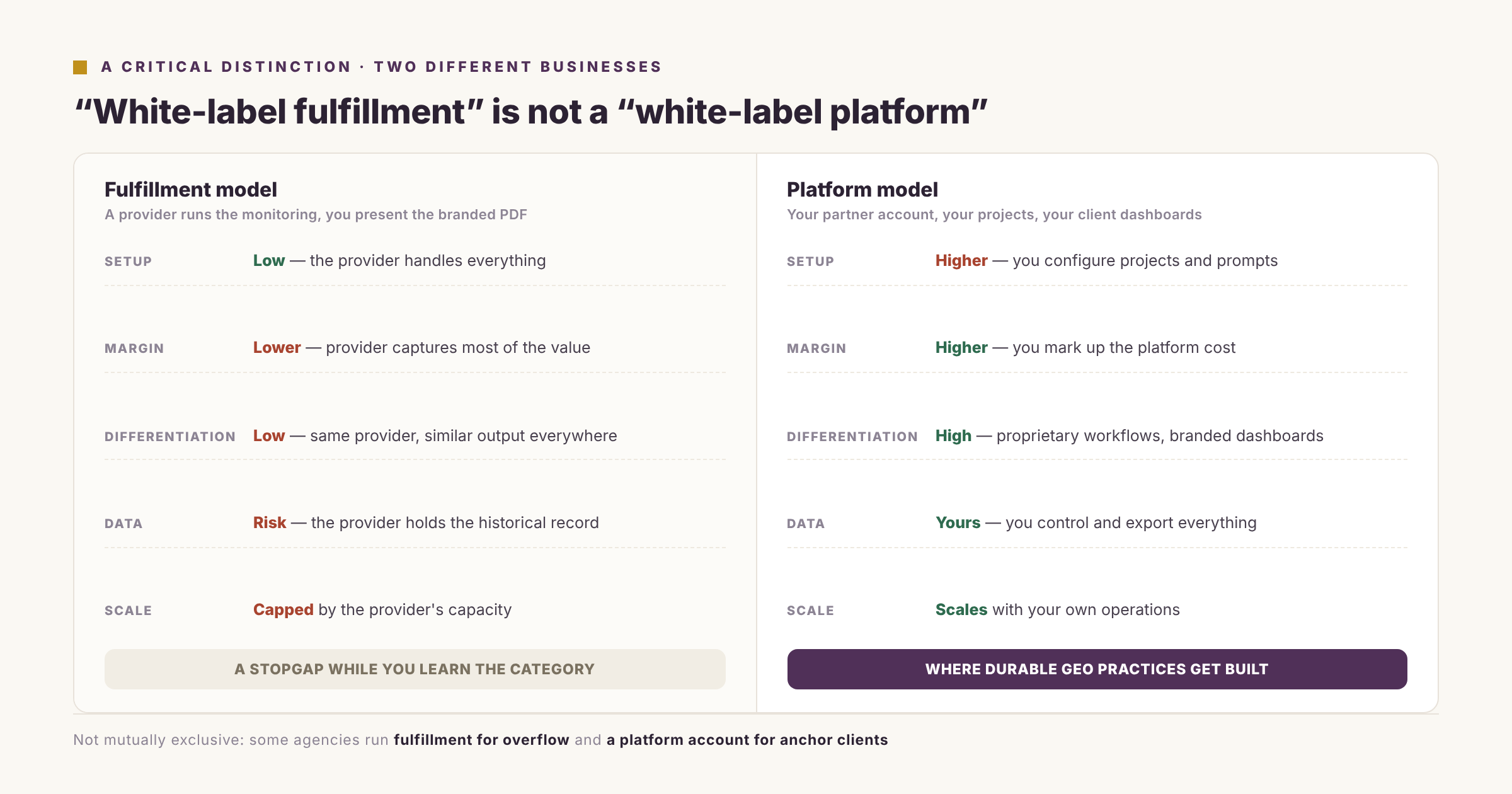
| Dimension | Fulfillment model | Platform model |
|---|---|---|
| Setup overhead | Low, the provider handles everything | Higher, the agency configures projects and prompts |
| Margin | Lower, provider captures most of the value | Higher, agency marks up platform cost |
| Differentiation | Low, any agency using the same provider delivers similar output | High, proprietary workflows and client-facing dashboards |
| Data ownership | Risk: provider holds the historical record | Agency controls and can export all data |
| Scalability | Limited by the provider's capacity and responsiveness | Scales with the agency's own operations |
Most discussions of white-label GEO tools currently describe fulfillment services or generic multi-seat tools and skip the platform-partner model entirely. That gap matters: the platform model is where agencies build durable, differentiated GEO practices with real recurring margin. Fulfillment is viable as a stopgap while the agency learns the category. It is not a long-term business model for agencies that want to own client relationships.
Fulfillment and platform are not mutually exclusive. Some agencies use a fulfillment provider for overflow work while operating their own platform account for anchor clients.
What to Look for in a GEO Reseller Program: Seven Criteria
The most important criteria are client project isolation, white-label reporting, per-project pricing, AI engine breadth, multi-language and multi-market support, data ownership terms, and onboarding support. Here is what each one means in practice.
Client project isolation. Each client's prompts, ranking history, and competitive data should be siloed inside a dedicated project. If a tool uses one shared workspace, client data leaks across accounts and clean per-client reporting becomes impossible.
White-label reporting. The minimum bar is exportable branded PDFs. A stronger position is live dashboards the client can access under the agency's domain, logo, and color scheme. The client sees the agency's brand, not the platform's.
Per-project pricing. Flat monthly or annual fees per client project are the most predictable model for resellers. Per-seat pricing penalizes agencies for adding users. Per-query pricing is almost impossible to mark up cleanly because query volume is hard to predict. Citadex's agency pricing ($Not publicly disclosed/project/month, or approximately $Not publicly disclosed/project/month on annual plans) maps directly to a per-client billing structure.
AI engine breadth. An agency serving clients across industries and channels needs coverage beyond ChatGPT alone. The meaningful baseline for 2026 is ChatGPT, Claude, Perplexity, Gemini, and at least one or two additional engines. Tools covering 10 or more engines give agencies a stronger premium service story.
Multi-language and multi-market support. International clients need tracking across markets and languages, not just English. Granular market add-ons (where the agency pays per market, not per plan tier) are more agency-friendly than requiring a full plan upgrade to add one new country.
Data ownership. Confirm in writing that the agency retains client data and can export it fully. If the platform holds the only copy of historical data, switching vendors means losing the trend record the client paid for.
Onboarding and certification support. Agency-specific onboarding, documentation, and certification programs help staff ramp quickly and give the agency a credential to present to clients. Citadex includes a certification exam (Citadex Certified AI Search Consultant) with a public verification page valid for Not publicly disclosed months.
Tool-by-Tool Comparison for Agency Use Cases
Citadex and Peec AI have the most explicitly documented agency infrastructure. The table below reflects each tool's publicly verified agency-relevant details.
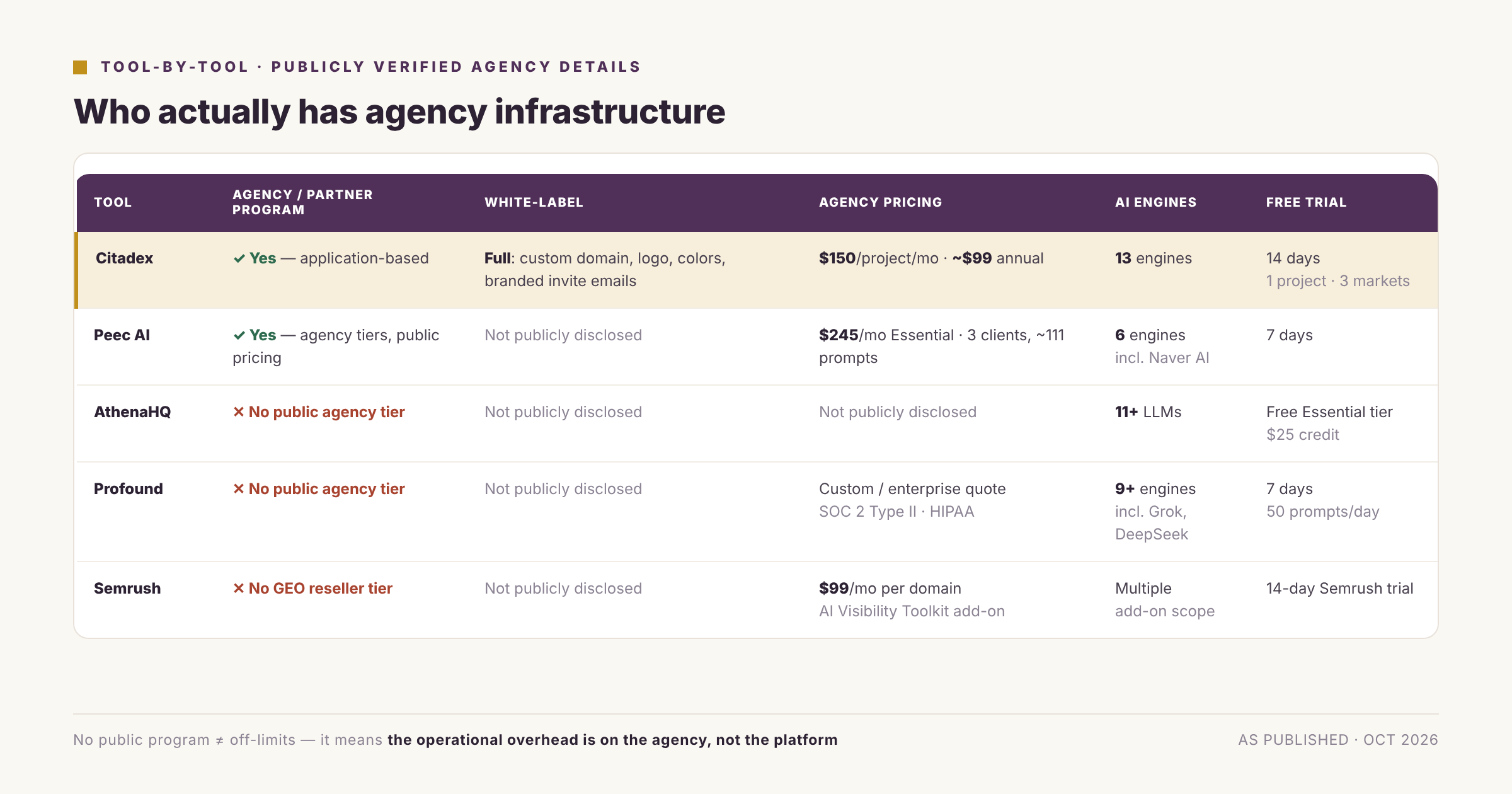
| Tool | Agency/partner program | White-label capability | Agency pricing | AI engines covered | Free trial |
|---|---|---|---|---|---|
| AthenaHQ | No public agency tier | Not publicly disclosed | Not publicly disclosed | 11+ LLMs | Free Essential tier |
| Citadex | Yes: application-based | Full: custom domain, logo, colors, branded invite emails | $150/project/month; ~$99/project/month (annual) | 13 engines | Not publicly disclosed days (1 project, 3 markets) |
| Peec AI | Yes: agency tiers on public pricing | Not publicly disclosed | $Not publicly disclosed/month (Essential, 3 clients / ~Not publicly disclosed prompts); scales up | Not publicly disclosed engines | Not publicly disclosed days |
| Profound | No public agency tier | Not publicly disclosed | Custom/enterprise: contact for quote | 9+ engines | Not publicly disclosed days (50 prompts/day) |
| Semrush | No dedicated GEO reseller tier | Not publicly disclosed | $99/month per domain (AI Visibility Toolkit add-on) | Multiple (add-on scope) | 14-day Semrush trial |
AthenaHQ covers Not publicly disclosed LLMs and Not publicly disclosed countries and languages, with a free Essential tier that includes $25 in credit. There is no public agency or partner program. Agencies can use it, but client project isolation and branded reporting are not documented as platform features.
Citadex documents its agency features in detail. The partner program requires an application and approval. Once approved, the agency gets a single account managing all client projects with full data isolation, unlimited team and client seats, Not publicly disclosed AI engines, 365-day history, and white-label dashboards (custom domain, logo, colors, branded emails). Clients see only the agency's branding and only the projects they have been granted access to. The pricing maps cleanly to per-client billing. One gap: entry requires application approval, so there is no instant self-serve start.
Peec AI offers documented agency tiers with multi-client credit pools, unlimited users, and coverage across Not publicly disclosed engines including Naver AI, which is relevant for agencies with Korean market clients. White-label reporting specifics are not publicly documented.
Profound covers Not publicly disclosed+ engines including Grok and DeepSeek. It holds SOC 2 Type II and HIPAA certification and provides access to a Conversation Explorer dataset of Not publicly disclosed+ prompts. Agencies need to negotiate terms directly; there is no self-serve agency tier. For large enterprise or healthcare clients where compliance matters, Profound is worth a direct conversation.
Semrush is primarily an SEO platform with a GEO feature add-on. Its per-domain pricing model is poorly suited for agencies serving multiple brands. It does not publish a dedicated GEO reseller program. Agencies already running Semrush for SEO can explore the AI Visibility Toolkit add-on as a supplement, but it is not a standalone GEO reseller solution.
How Agencies Are Currently Delivering GEO Services to Clients
Most agencies currently deliver GEO services through one of three operational models: manual prompt audits exported as reports, white-label fulfillment partnerships, or self-operated SaaS partner accounts.
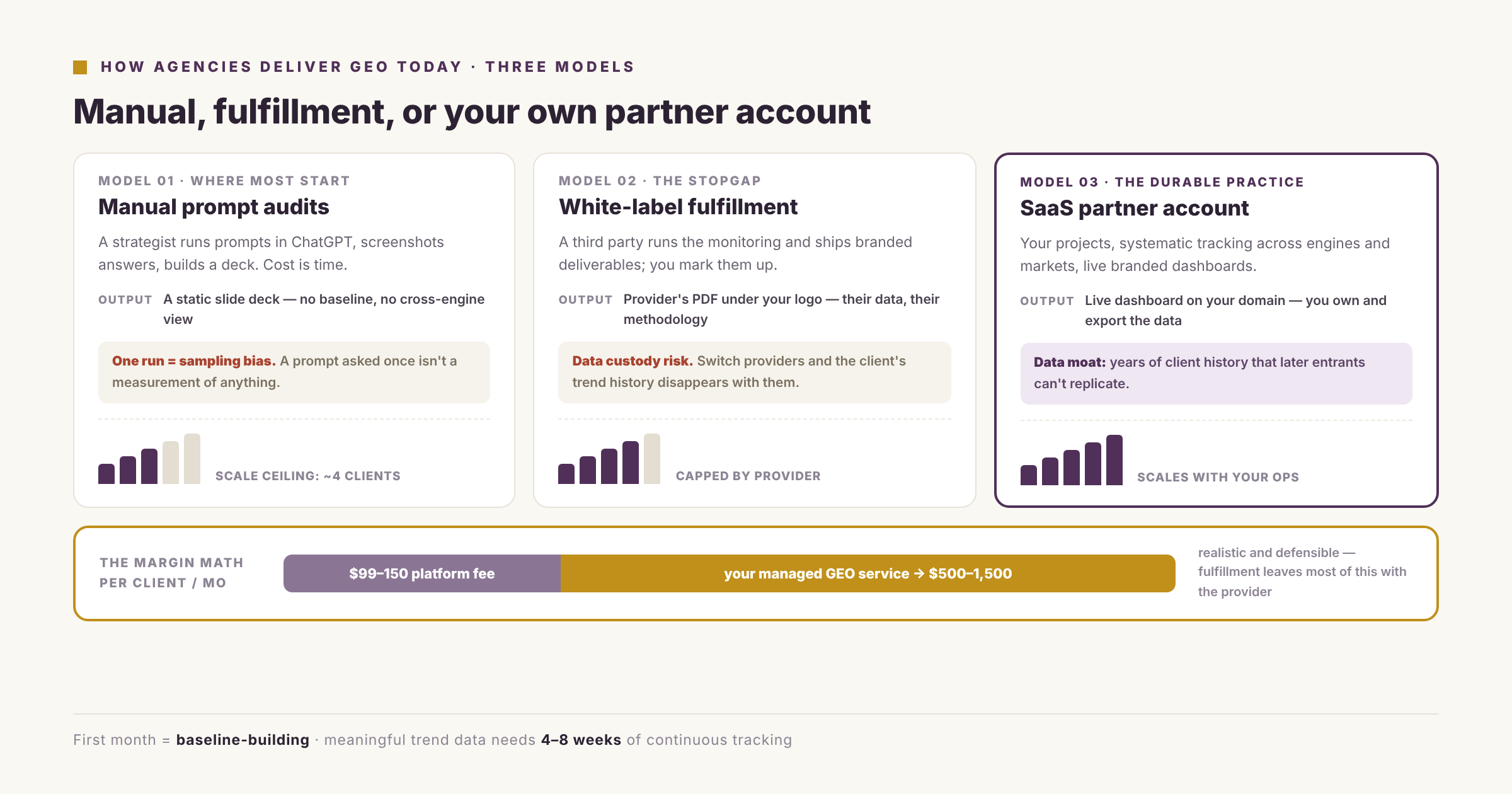
The manual model is where most agencies start. A strategist runs a set of prompts in ChatGPT or Perplexity, screenshots or copies the responses, notes whether the client brand appears, and builds a formatted report in a slide deck or doc. Cost is low; the main input is time. The problem is that it does not scale past three or four clients. It produces no historical baseline and gives no systematic view across multiple AI engines. It also introduces sampling bias: a prompt run once is not a reliable measurement of anything.
The fulfillment model means contracting a third party to run the monitoring and deliver branded deliverables. The agency marks up the service and presents the output as its own work. Volume becomes easier to handle; quality control becomes harder. The critical risk is data custody. If the fulfillment provider holds the historical record, the agency cannot show trend continuity if it ever switches providers.
The SaaS partner model is where agencies build a defensible long-term practice. The agency holds its own partner account, configures client projects, tracks AI visibility systematically across engines and markets, and delivers live dashboards or automated reports. Margin is better because the agency is paying a platform fee and billing the client a service fee on top. The setup is more involved (prompts need to be chosen, markets configured, competitors added) but the ongoing operational lift is lower than manual monitoring once the system is running.
The GEO services market is early. Many agencies have not moved past manual audits. Many have not evaluated whether the platforms they have heard of actually support agency reselling natively. That gap is closing, but agencies that build platform-native practices now will have a data moat, years of client history, that later entrants cannot easily replicate.
A per-project platform fee of $99-150/month per client, marked up to $500-1,500/month as a managed GEO service, is realistic and defensible. Fulfillment services leave most of that margin with the provider.
Choosing the Right Model by Agency Type and Client Base
The right reseller model depends on client volume, technical capacity, and whether GEO is a core service or an add-on.
Solo consultant or boutique agency (1-5 clients). A per-project SaaS partner account with no minimum client commitment and a low entry price is the most practical option. Manual audits are viable for one or two clients but create unsustainable overhead at five. The priority at this scale is a tool that is fast to set up and produces client-ready output without heavy configuration. Citadex's per-project model (starting at one project) and Peec AI's entry agency tier ($245/month for 3 clients) both fit this profile.
Growth-stage digital agency (5-20 clients). At this scale, client data isolation, branded reporting, and multi-market support become essential. The agency should prioritize a partner program with genuinely siloed client projects and the ability to add markets granularly. An agency at this stage is also ready to invest in certification and differentiation. Being able to present a verified credential to clients justifies a higher service fee.
Large or multi-market agency (20+ clients or international clients). Flat-rate plans covering 10 or more client projects, API access for custom integrations, and multi-language tracking across 10+ AI engines are the relevant criteria. At this volume, the cost per project on flat-rate plans drops significantly. For agencies with clients in regulated industries, Profound's SOC 2 Type II and HIPAA certification may be a deciding factor in enterprise deals.
Traditional SEO agency adding GEO as an upsell. Agencies already running Semrush or similar platforms for SEO will find that adding the AI Visibility Toolkit gives them some GEO data. The per-domain pricing and lack of a dedicated reseller program make it a poor fit for building a systematic GEO service offering. The more practical path is to run a purpose-built GEO platform in parallel. Then decide over 6-12 months whether the GEO service line justifies a dedicated tool contract.
Apply the seven criteria from the earlier section rather than selecting by brand name.
Common Pitfalls When Reselling GEO Monitoring Services
The most common mistakes agencies make when reselling GEO services are over-promising ranking outcomes, using a single-prompt snapshot as a baseline, and not separating client data environments.
Treating AI visibility like traditional SEO rankings. AI engine outputs are probabilistic. The same prompt asked twice will often produce different answers. A brand's appearance in a response depends on query phrasing, the engine's retrieval at that moment, and ongoing model updates. The right metric to sell clients on is share-of-voice and mention trends over time, not a fixed position that implies the reliability of a keyword ranking.
Single-prompt snapshots as a baseline. A one-time audit is a conversation starter, not a monitoring product. For a resellable service, the agency needs weeks of continuous tracking before it can show movement in either direction. Starting with a snapshot and then trying to establish trend continuity three months later means losing the baseline entirely.
No client data isolation. Running all clients through a single shared account creates two problems. Clients' competitive data intermingles, and producing a clean per-client report requires manual filtering. At five clients this is annoying; at fifteen it becomes a compliance and confidentiality risk.
Conflating "mentioned" with "recommended." An AI engine may cite a brand in an answer without endorsing it, or include it in a list as the budget option, or mention it only to note a controversy. Agencies using tools that distinguish between a brand mention and a genuine recommendation give clients a more accurate picture of their actual AI visibility quality. Citadex, for instance, flags whether a brand was mentioned or positively recommended within an AI response.
Locking into a fulfillment provider without retaining raw data. If the historical trend data lives in the fulfillment provider's system and the agency decides to switch, the client's performance record disappears. Always confirm data export rights before signing a fulfillment contract.
Ignoring multi-language and multi-market scope. An agency whose tool tracks only English-language prompts in a single country is delivering an incomplete picture to any client with international presence. As AI search grows in non-English markets, this gap will become more visible to clients and more costly to explain.
FAQ: Reselling GEO Tools and Delivering AI Visibility Services
Q: What is the difference between a white-label GEO tool and a white-label GEO fulfillment service?
A white-label tool gives the agency direct access to a SaaS platform under a partner or reseller program. The agency operates the software and brands the output for clients. A fulfillment service is a third-party that runs the GEO monitoring on the agency's behalf and delivers finished deliverables under the agency's brand, without the agency accessing the underlying system. The first model gives the agency control and higher margins; the second reduces operational overhead but compresses margin and creates dependency on the provider's data and methodology.
Q: How long does it take to show clients results from GEO monitoring?
Initial benchmark data is typically available within a few days of setup. Meaningful trend data, showing whether AI visibility is improving or declining, generally requires four to eight weeks of continuous tracking. Agencies should frame the first month as baseline-building, not as a results period.
Q: What pricing model works best for agencies reselling GEO monitoring?
Per-project monthly or annual pricing maps most cleanly to a per-client billing structure. Per-seat pricing penalizes growth in team size; per-query pricing is difficult to forecast and mark up predictably. Agencies evaluating platforms should confirm whether additional markets can be added granularly (per market, not per plan tier), since international clients often require tracking across multiple countries.