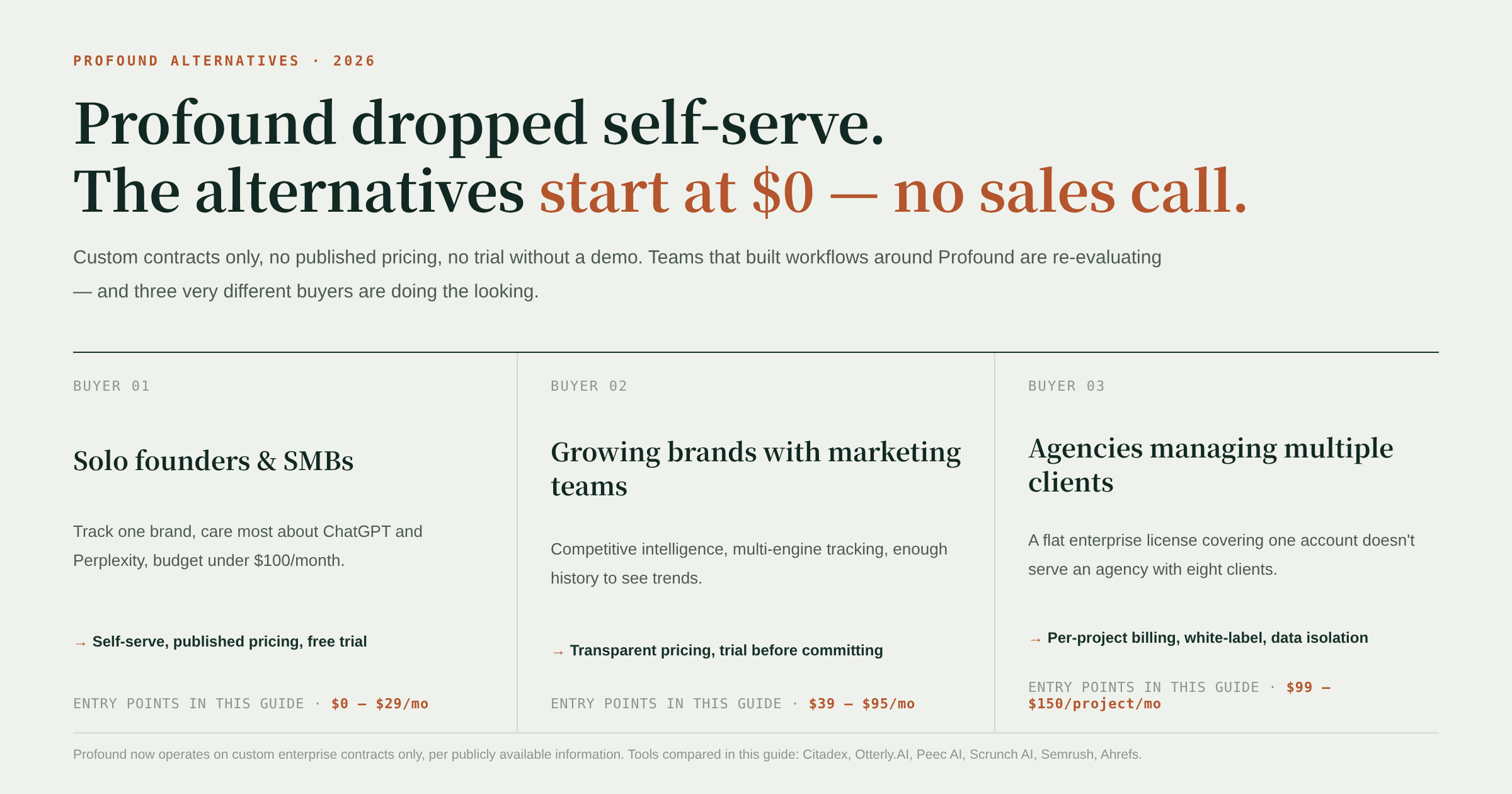
Key takeaways:
- Profound no longer offers self-serve plans, making it inaccessible to SMBs and solo founders without a sales conversation.
- Several AEO platforms publish transparent pricing starting under $100/month with no demo required to get started.
- Agencies managing multiple clients need per-project billing, white-label support, and isolated client data: features that vary widely across tools.
- Agency managing multiple clients. For agencies with defined client rosters, Citadex is built for this case.
The market for AI engine optimization (AEO) tools has shifted noticeably in 2026. Profound's move away from self-serve access is one of the clearest catalysts. Teams that built early workflows around Profound's platform are now evaluating alternatives, and the options range from lightweight self-serve tools under $50/month to full agency platforms with white-label reporting and per-client project isolation. This article covers seven tools across that spectrum: Profound, Peec AI, Otterly.AI, Scrunch AI, Citadex, Semrush, and Ahrefs.
Why Teams Are Looking for Profound Alternatives in 2026
Profound discontinued its self-serve plans and now operates exclusively on custom enterprise contracts. No published pricing, no trial without a sales call, and minimum contract commitments put the platform out of reach for most SMBs, solo founders, and independent agencies. For teams that need to start tracking AI visibility this week, that friction blocks adoption.
Before the change, Profound was a respected early entrant in AI search monitoring, focused on enterprise-grade visibility into how large language models answered questions about brands. That positioning made sense for Fortune 500 teams with procurement cycles and dedicated vendor budgets. A 10-person SaaS company trying to understand whether it shows up when someone asks ChatGPT to recommend a project management tool faces a different calculus.
Three buyer profiles emerge from this gap.
Solo founders and SMBs need self-serve access with published pricing. They typically track one brand, care most about ChatGPT and Perplexity coverage, and want to get started without a sales call. Budget usually stays under $100/month.
Growing brands with marketing teams need competitive intelligence, multi-engine tracking, and enough historical data to identify trends. They can spend more but still expect transparent pricing and a trial before committing.
Agencies managing multiple clients have fundamentally different requirements: per-client project isolation, white-label reporting, and billing that scales per project rather than per seat. A flat enterprise license that covers one account doesn't serve an agency with eight clients.
What to Look for in a Profound Alternative: Evaluation Criteria
The right alternative depends on five criteria, weighted differently by buyer segment.
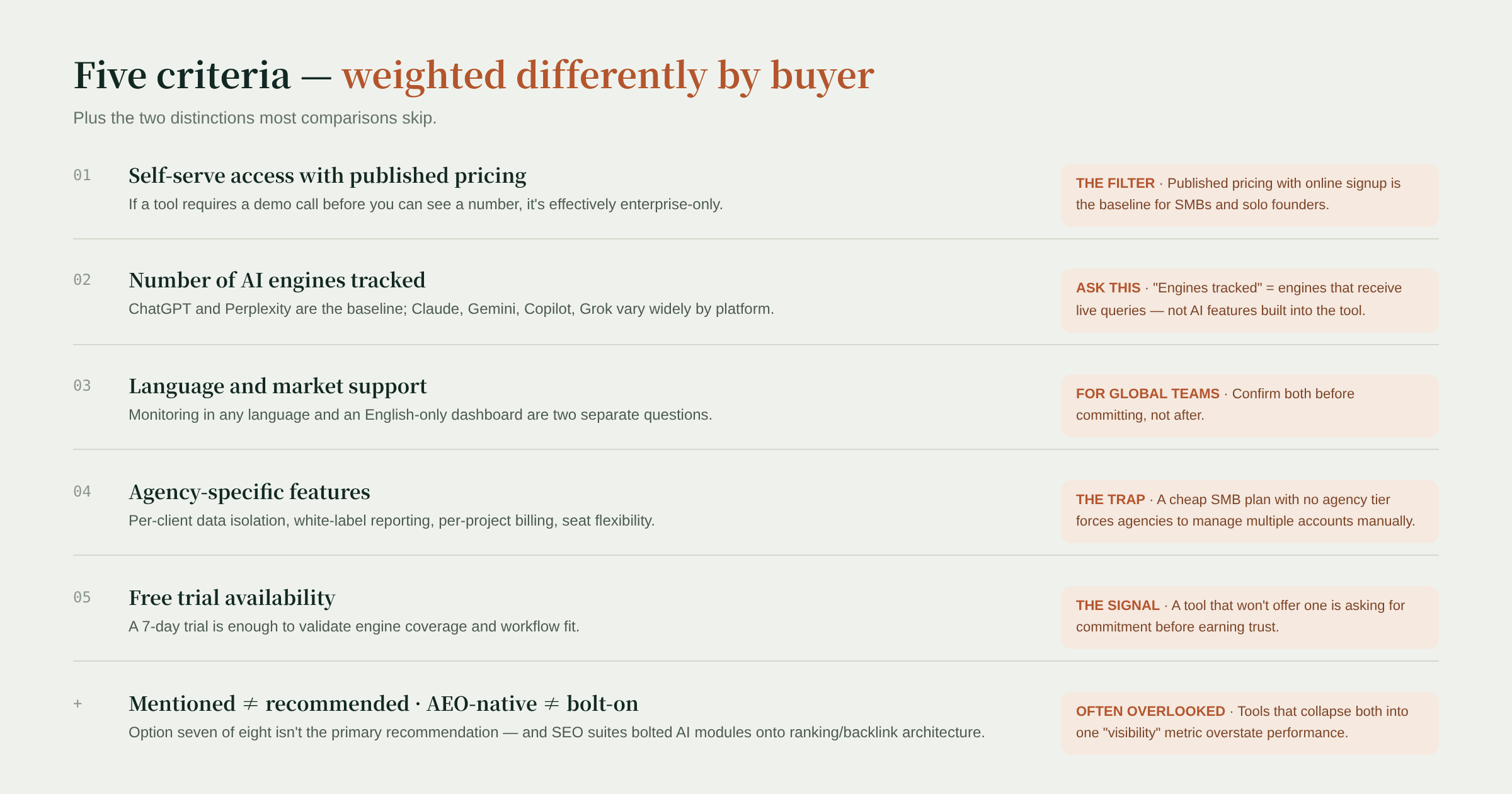
Self-serve access with published pricing is the first filter. If a tool requires a demo call before you can see a number, it's effectively enterprise-only. For SMBs and solo founders, published pricing with online signup is a baseline requirement.
Number of AI engines tracked determines coverage. ChatGPT and Perplexity are the near-universal baseline. Claude, Gemini, Copilot, Grok, and vertical AI engines vary significantly across platforms. More engines mean more complete visibility, but they also affect cost. It's worth knowing which engines your actual audience uses before optimizing for engine count alone.
One distinction: "AI engines tracked" means the tool actively sends prompts to those engines and records what they answer. That's different from "AI-powered features built into the tool," which might include AI-generated content recommendations or automated reporting. When evaluating engine coverage, ask specifically which engines receive live queries.
Language and market support is critical for non-English brands and global teams. A tool that monitors in any language looks different from one whose dashboard and setup workflow is English-only. These are two separate questions.
Agency-specific features cover per-client project isolation (one client's data should not be visible to another), white-label reporting (clients see the agency's brand, not the tool's), per-project billing, and seat flexibility. A tool with a cheap SMB plan but no agency tier forces agencies to either overpay or manage multiple accounts manually.
Free trial availability signals confidence and reduces switching risk. A 7-day trial is enough to validate engine coverage and workflow fit. A tool that won't offer one is asking for a commitment before it has earned trust.
One criterion often overlooked: whether the tool distinguishes between a brand being mentioned in an AI answer versus being recommended as a top choice. A brand can appear in a list of ten options without being the AI's primary recommendation. Tools that collapse both into a single "visibility" metric can overstate how well a brand is actually performing in AI search.
Finally, consider whether the tool is purpose-built for AEO. Semrush and Ahrefs built their platforms around keyword rankings, backlinks, and crawl data. Their AI visibility modules are genuine additions, but the underlying architecture wasn't designed for AEO. For teams already living in those platforms, the integration is convenient. For teams starting fresh, an AEO-native tool will typically offer deeper AI engine coverage and more granular prompt-level analytics.
Head-to-Head Comparison Table
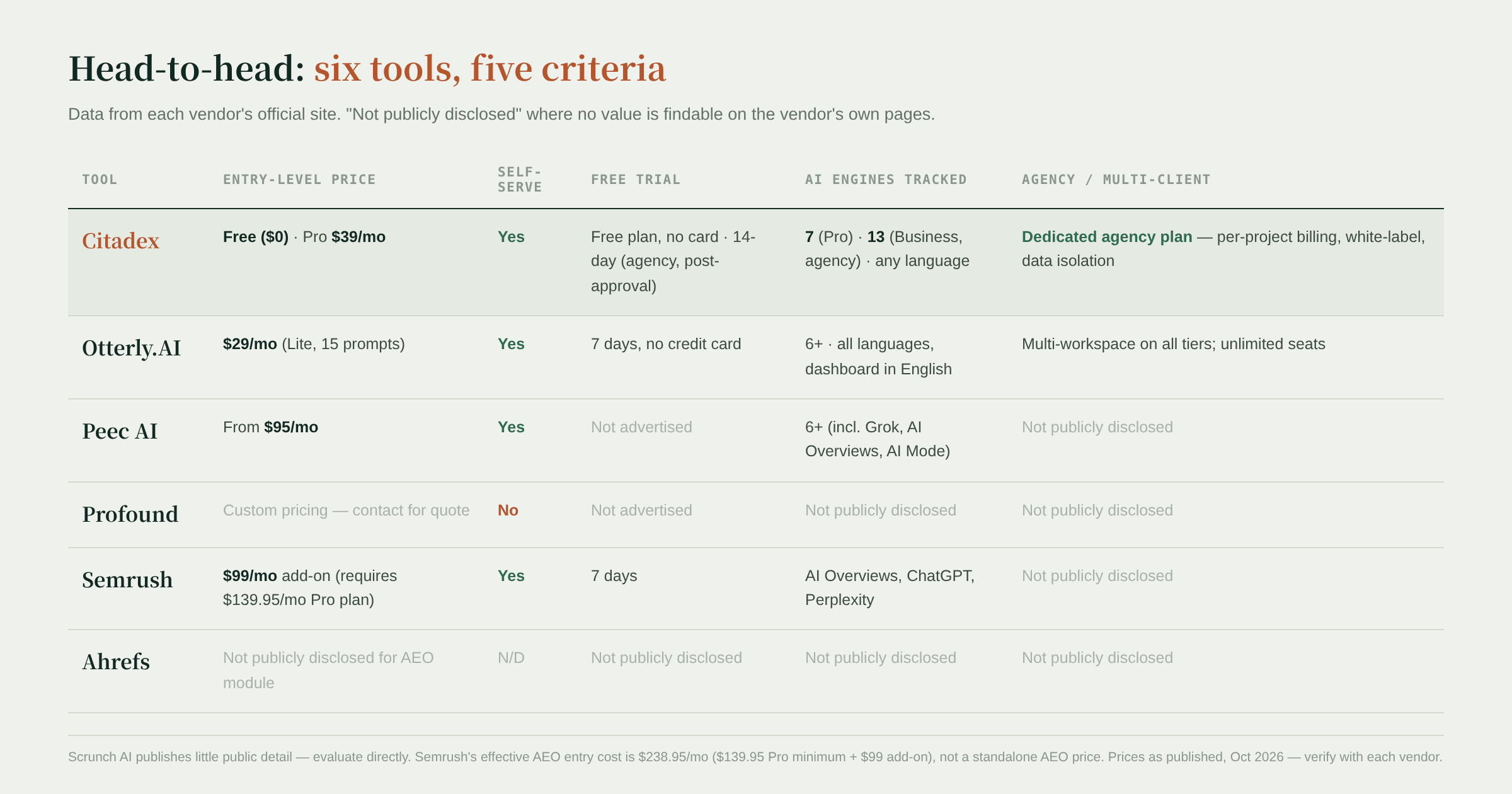
Data sourced from each vendor's official site. "Not publicly disclosed" is used where a specific value was not findable on the vendor's own pages.
| Tool | Entry-Level Price | Self-Serve | Free Trial | AI Engines Tracked | Languages | Agency / Multi-Client Support | Best Fit |
|---|---|---|---|---|---|---|---|
| Citadex | Free ($0); Pro $39/mo | Yes | Free plan (500 credits, no card); 14-day (agency, post-approval) | 7 (Pro); 13 (Business, agency) | Any language for monitoring | Yes: dedicated agency plan with per-project billing, white-label, data isolation | Agencies and brands needing broad AI-engine coverage |
| Otterly.AI | $29/mo (Lite, 15 prompts) | Yes | 7 days, no credit card | 6+ (ChatGPT, Google AI Overviews, Perplexity, Copilot, Claude, Google AI Mode; Gemini as add-on) | All languages for monitoring; dashboard in English | Multi-workspace support on all tiers; unlimited seats | Solo marketers, SMEs, agencies |
| Peec AI | Starting from $95/mo | Yes | Not advertised | 6+ (ChatGPT, Gemini, Perplexity, Copilot, Grok, Google AI Overviews, AI Mode) | Not publicly disclosed | Not publicly disclosed | Mid-market teams |
| Profound | Custom pricing: contact for quote | No | Not advertised | Not publicly disclosed | Not publicly disclosed | Not publicly disclosed | Enterprise brands |
| Semrush | $99/mo add-on (requires $139.95/mo Pro plan minimum) | Yes | 7 days | Google AI Overviews, ChatGPT, Perplexity | Not publicly disclosed for AEO module | Not publicly disclosed | Teams already using Semrush for SEO |
| Ahrefs | Not publicly disclosed for AEO module | Not publicly disclosed | Not publicly disclosed | Not publicly disclosed | Not publicly disclosed | Not publicly disclosed | Teams already using Ahrefs for SEO |
Scrunch AI publish little public detail — evaluate them directly.
Semrush's AEO entry cost reflects the full platform minimum ($139.95/mo Pro + $99/mo AI add-on = $238.95/mo), not a standalone AEO price.
Self-Serve Profound Alternatives Under $100/Month
For teams that want to start tracking AI visibility without a sales conversation, three tools publish pricing and allow signup without contacting sales: Otterly.AI, Peec AI, and Citadex.
Otterly.AI starts at $29/month for its Lite plan, covering 15 prompts and including 6+ AI engines (ChatGPT, Google AI Overviews, Perplexity, Copilot, Claude, and Google AI Mode, with Gemini available as an add-on). No seat limits apply on any tier, and the 7-day trial requires no credit card. For a solo founder tracking one brand's appearance in AI answers across the most common engines, the Lite plan works as a functional starting point. The prompt cap is the main constraint: 15 prompts per month means careful selection of queries that matter most.
Citadex offers a Free plan at $0 and a Pro plan at $39/month (monthly billing). Both are self-serve with no sales call required. The Free plan allows teams to get initial signal without any commitment. Citadex covers 7 AI engines on Pro and 13 on Business. The platform distinguishes between a brand being "mentioned" and being "recommended" in an AI response: a meaningful difference when assessing whether AI visibility translates into actual referral intent. A 7-day free trial is available for brand plans.
Peec AI starts at around $95/month, sitting at the edge of the under-$100 bracket. It covers 6+ AI engines including ChatGPT, Gemini, Perplexity, Copilot, Grok, Google AI Overviews, and AI Mode, with sentiment analysis and competitor benchmarking included. A free trial is not advertised on the vendor's official site, so teams would need to evaluate the platform on its published feature set before committing.
For minimum viable tracking (one brand, one or two AI engines, basic mention tracking) Otterly.AI's Lite plan at $29/month or Citadex's Free plan are the lowest-friction entry points. Peec AI fits better for teams that need competitive benchmarking from the outset and can absorb the higher entry price.
Scrunch AI describes itself as a comprehensive platform for monitoring and optimizing brand presence across AI search platforms, but pricing is not publicly disclosed on the vendor's site. Teams interested in Scrunch AI would need to contact the vendor directly for access terms.
Profound Alternatives for Agencies Managing Multiple Clients
Agencies have requirements that look nothing like a single brand's. The core needs are one account that manages all clients, each client's data fully isolated from the others, billing that scales per project rather than per seat, and reporting that carries the agency's brand rather than the tool's.
Among the tools in this comparison, Citadex has a dedicated agency plan designed around exactly that structure. The plan is not self-serve in the traditional sense: agencies apply and go through an approval process before the account opens. After approval, there is a 14-day trial that includes one project, up to three markets, and a credit allocation for monitoring. Billing runs at $150/project/month (monthly) or $1,188/project/year (approximately $99/project/month on annual). Each project maps to one client brand, with prompts, competitive intelligence, and historical data fully isolated between projects. The plan includes unlimited team seats, unlimited prompts, 13 AI engines, 365 days of historical data, and full white-label capability: clients see the agency's brand, logo, colors, and custom domain. The agency can also control which feature modules each client can access, and client accounts show no pricing or billing visibility.
For the other tools in this comparison, agency-specific billing and white-label features are either not publicly disclosed or not explicitly offered as a separate tier. Otterly.AI supports multi-workspace management and unlimited seats on all plans, which gives agencies some operational flexibility, but whether this constitutes a formal agency billing structure with per-client project isolation is not stated on the official site. Peec AI's official site does not publicly disclose agency-specific pricing or white-label capabilities. Profound, now enterprise-only, would require a direct sales conversation to determine agency terms.
White-label matters in agency relationships because clients paying a retainer expect to see deliverables branded by the agency, not a third-party SaaS vendor's logo. When a client sees an unfamiliar tool's interface, it raises questions about what the agency actually built. It also creates risk if the agency switches vendors.
Data isolation is equally important. An agency managing a B2B software client and a consumer goods client should never have one client's competitive intelligence visible in another client's dashboard: both for confidentiality and to prevent muddled reporting.
On cost-per-client economics: per-project billing models like Citadex's scale linearly with client count. At a small client count (two to three clients), the monthly cost per client is straightforward to calculate. At higher client counts, the per-project fee can exceed the cost of a flat enterprise license from a single-seat platform, but the flat license typically doesn't offer per-client data isolation, which means agencies would need to manage segregation manually. The crossover point depends on client count and what the enterprise license includes, so agencies should model both scenarios against their actual roster before committing.
Tool-by-Tool Breakdown: Strengths, Weaknesses, and Fit
Ahrefs is a mature SEO platform with strong backlink analysis, keyword research, and site audit capabilities. Its AI visibility features are a relatively recent addition to a platform built for conventional search. Teams already using Ahrefs for SEO benefit from keeping data in one place. The limitation is that AEO is not the platform's core design, so coverage of AI engines beyond the major ones and prompt-level analytics depth may lag behind AEO-native tools. Specific AI engine coverage and pricing for its AEO module are not publicly disclosed, making direct comparison difficult.
Citadex covers 13 AI engines and tracks mentions at the prompt level, with a distinction between a brand being mentioned and being recommended: a signal that most tools collapse into a single metric. The agency plan includes full white-label, per-project data isolation, and unlimited prompts. An AI marketing agent feature allows teams to run multi-step tasks (generating reports, adding prompts, retesting pages after edits) from a single instruction. One practical gap: the agency plan requires an application and approval process rather than immediate self-serve signup, adding a few days of lead time before an agency can start a trial.
Otterly.AI offers the lowest published entry price at $29/month, with a 7-day trial requiring no credit card. Coverage spans 6+ AI engines, and all tiers include unlimited seats and multi-workspace support. The main constraint at entry tier is the prompt cap of 15/month: sufficient for a focused brand but limiting for teams that want to track a broad keyword universe. Content optimization for up to 5,000 articles/month is included, which adds value beyond pure monitoring.
Peec AI covers 6+ AI engines and includes sentiment analysis and competitor benchmarking, giving mid-market teams analytical depth beyond raw mention counts. Pricing starts at approximately $95/month. The absence of a publicly advertised free trial makes evaluation before committing harder, and language support details are not disclosed on the official site: a gap for teams serving non-English markets.
Profound was an early leader in AI visibility for enterprise brands, with a focus on large-scale deployment suited to teams with complex monitoring needs. The removal of self-serve plans is a concrete gap: there is no published pricing, no trial without a sales conversation, and no accessible entry tier for smaller teams. For enterprise buyers with procurement processes, Profound may still be a reasonable candidate. For everyone else, it is effectively off the table.
Scrunch AI describes itself as a platform for monitoring, analyzing, and optimizing brand presence across AI search platforms. Beyond that characterization from the G2 comparison database, specific details on engine coverage, pricing, languages, and agency capabilities are not publicly disclosed, making it difficult to evaluate on comparable terms.
Semrush added AI visibility tracking as a module within its established SEO platform. The AEO add-on covers Google AI Overviews, ChatGPT, and Perplexity, and the 7-day trial lets teams test the feature. The effective entry cost of $238.95/month (platform minimum plus add-on) means teams are paying for substantial keyword, backlink, and audit capabilities alongside the AI visibility feature. For teams already on Semrush, the incremental cost of the add-on is the relevant figure. For teams starting fresh, paying for an entire SEO suite to access AI monitoring is a harder economic argument.
How to Choose: A Decision Framework by Scenario
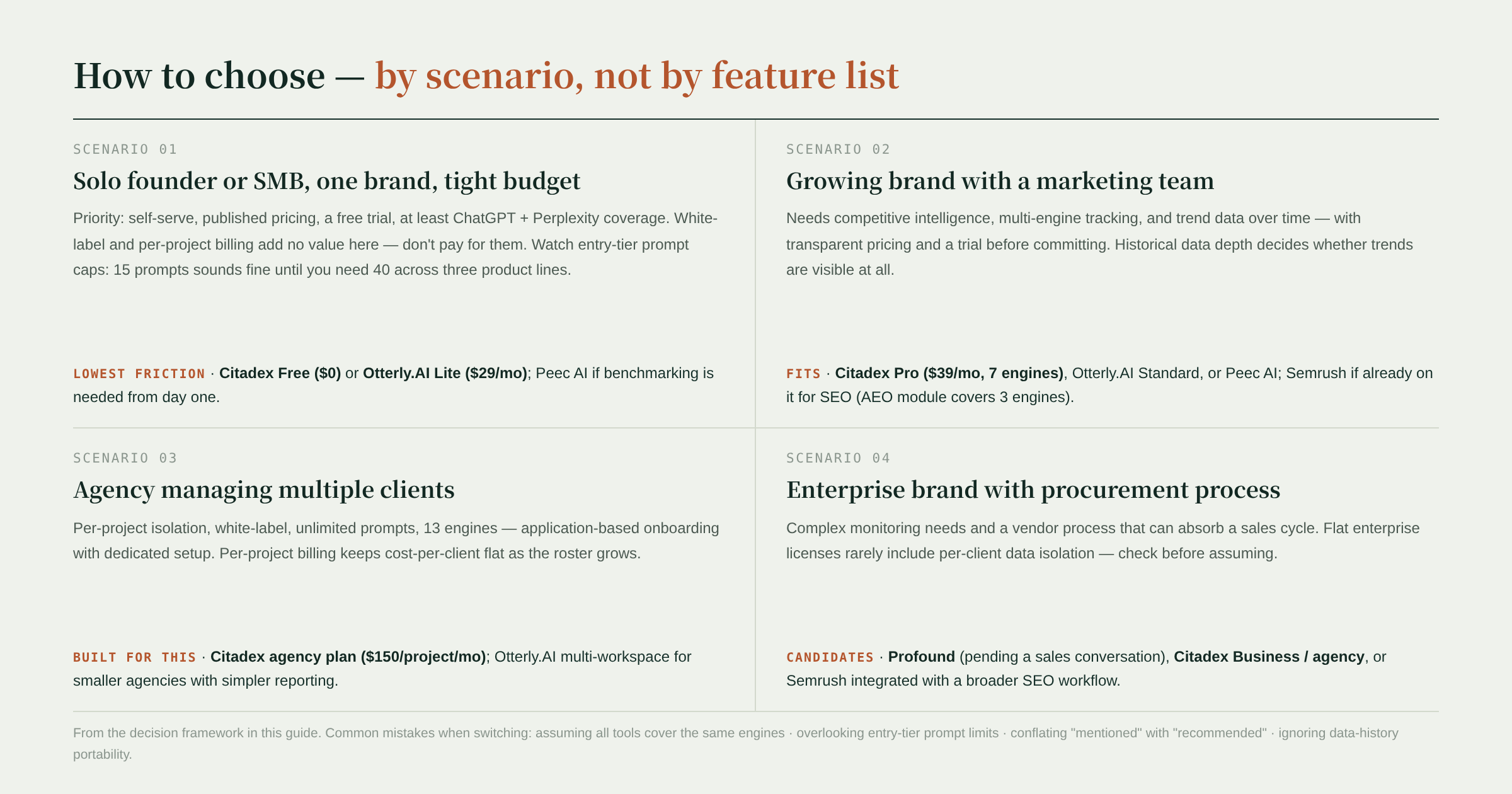
Solo founder or SMB tracking one brand, tight budget. The priority is self-serve access, published pricing, a free trial, and at least ChatGPT and Perplexity coverage. Otterly.AI's Lite plan at $29/month or Citadex's Free plan are the lowest-friction entry points. Peec AI works if the team needs competitive benchmarking from the outset and can absorb the higher entry price. White-label and per-project billing add no value in this scenario.
Growing brand with a marketing team. This buyer needs competitive intelligence, multi-engine tracking, and trend data over time. Citadex's Pro plan at $39/month covers 7 AI engines (13 on Business) and stores historical data. Otterly.AI's Standard plan (100 prompts) or Peec AI both serve this segment. Semrush is worth considering if the team is already using it for SEO and wants consolidated reporting, understanding that the AEO module covers only three engines.
Agency managing multiple clients. For agencies with defined client rosters, Citadex is built for this case. The agency plan includes per-project isolation, white-label, unlimited prompts, 13 AI engines, and the application-based onboarding ensures dedicated setup. Otterly.AI's multi-workspace structure provides some operational flexibility and may suit smaller agencies with simpler reporting needs. Profound is not a practical option without enterprise budget and a sales process.
Enterprise brand, complex monitoring needs, existing procurement process. Profound's enterprise positioning may still be relevant pending a sales conversation. Citadex's Business plan or agency plan can also serve enterprise teams depending on internal structure. Semrush fits enterprises that want AI visibility integrated with a broader SEO workflow.
Common Mistakes When Switching from Profound to a New Tool
The most common mistake is choosing a replacement based on entry price alone without verifying which AI engines are actually tracked at that price point.
Assuming all tools cover the same engines. ChatGPT and Perplexity appear across nearly every platform in this comparison. Claude, Gemini, Grok, and others vary significantly. Before migrating, list the engines your audience actually uses and confirm each candidate tool covers them at the plan you intend to buy.
Overlooking prompt limits at entry tiers. A $29/month plan with 15 prompts per month sounds accessible until the team realizes they need to track 40 queries across three product lines. Calculate the actual prompt volume needed before selecting a tier, and check whether upgrading to the next tier is straightforward.
Conflating "mentioned" with "recommended." A brand that appears in an AI answer as option seven out of eight is technically visible, but that's not the same signal as appearing as the primary recommendation. Verify that the tool you're evaluating makes this distinction explicitly, and check how its reporting surfaces it.
Ignoring data history portability. When switching tools, historical prompt data typically does not transfer. The new platform starts fresh on day one. Plan for a parallel-run period (running both tools simultaneously for a few weeks) if trend continuity matters for stakeholder reporting.
Underestimating the time to meaningful trend data. Tracking data begins immediately after setup, but a single week of data points doesn't reveal a trend. Allow enough time before drawing conclusions or making optimization decisions based on the new platform's output.
Frequently Asked Questions: Profound Alternatives
Q: Did Profound remove self-serve plans entirely?
Based on publicly available information, Profound now operates on custom pricing with no self-serve signup and no published pricing on its official site. Teams interested in Profound need to initiate a sales conversation to receive terms.
Q: What is the cheapest self-serve AEO tool available right now?
Among the tools in this comparison with published pricing and online signup, Citadex offers a Free plan at $0 and a Pro plan at $39/month. Otterly.AI's entry point is $29/month. Peec AI starts at approximately $95/month.
Q: Can I track my brand in ChatGPT without paying for a tool?
Manual querying is possible: anyone with a ChatGPT account can ask questions and note whether their brand appears. The limitation is that manual checks are not systematic, don't store history, and can't surface trends across hundreds of prompts over weeks. Paid tools automate the prompt cycle, store full response history, and flag changes over time, which manual checking cannot replicate at scale.
Q: How many AI engines do I actually need to track?
For English-language brands, ChatGPT and Perplexity are the starting point, as they account for a large share of AI-referred traffic. Claude, Gemini, Copilot, and Grok add coverage and are worth including if budget allows and if the target audience uses those platforms. Prioritize by where the audience actually spends time rather than by engine count as a metric in itself.
Q: Are AEO tools different from SEO tools like Semrush or Ahrefs?
Yes, in design and scope. AEO-native tools are built specifically to send prompts to AI engines and record how those engines respond: tracking brand mentions, rankings within answers, citation sources, and sentiment. SEO platforms like Semrush and Ahrefs added AI visibility modules to platforms designed for keyword ranking, backlink analysis, and site crawl data. The integration can be convenient for teams already using those platforms, but the depth of AI engine coverage and prompt-level analytics in a purpose-built AEO tool typically exceeds what a bolt-on module provides.
Q: How long does it take to see results after switching AEO tools?
Tracking data begins on day one. Identifying meaningful patterns in how AI engines respond to prompts about a brand, and whether optimization work is having any effect, generally requires consistent monitoring over several weeks before trends become statistically stable enough to act on. Treat the first few weeks as a baseline-building period rather than a performance assessment.
Q: Do these tools work for non-English brands?
Language support varies across the comparison set. Otterly.AI and Citadex both support monitoring in any language, meaning prompts and AI responses can be tracked in languages other than English. Peec AI's language support is not publicly disclosed on the official site. For non-English markets, language support should be confirmed directly with the vendor before committing to a plan.