Key takeaways:
- Most mainstream AEO platforms track only Western AI engines, leaving brands blind to Chinese models that carry a large and growing share of global AI token usage.
- DeepSeek, Doubao, Qwen, and Kimi collectively reach hundreds of millions of decision-makers who receive zero brand-visibility coverage from most tools.
- Choosing an AEO platform without checking its Asian AI engine coverage creates a strategic blind spot, not a minor feature omission.
- For teams that need this combination, Citadex is the strongest verified option: 13 tracked engines including both major Western platforms and all four Chinese consumer AI platforms, with prompt results segmentable by market.
Answer engine optimization (AEO) platforms help brands understand and improve how AI systems describe them in response to user queries. As Chinese AI engines grow rapidly in scale and reach, the question of which platforms actually track DeepSeek, Doubao, Qwen, and Kimi has become one of the most practically important buying decisions in the category. This article compares the tools that publish concrete engine coverage data, applies consistent criteria to each, and gives direct answers to the questions brands and agencies most frequently ask before signing a contract.
The Chinese AI Coverage Gap: Why Most AEO Tools Miss a Large Part of the Market
The majority of AEO and GEO platforms available in 2026 do not track any Chinese AI engines. DeepSeek, Doubao, Qwen, and Kimi are entirely absent from their monitored engine lists. For brands with global ambitions, this represents a structural blind spot affecting a substantial portion of the AI conversations happening worldwide.
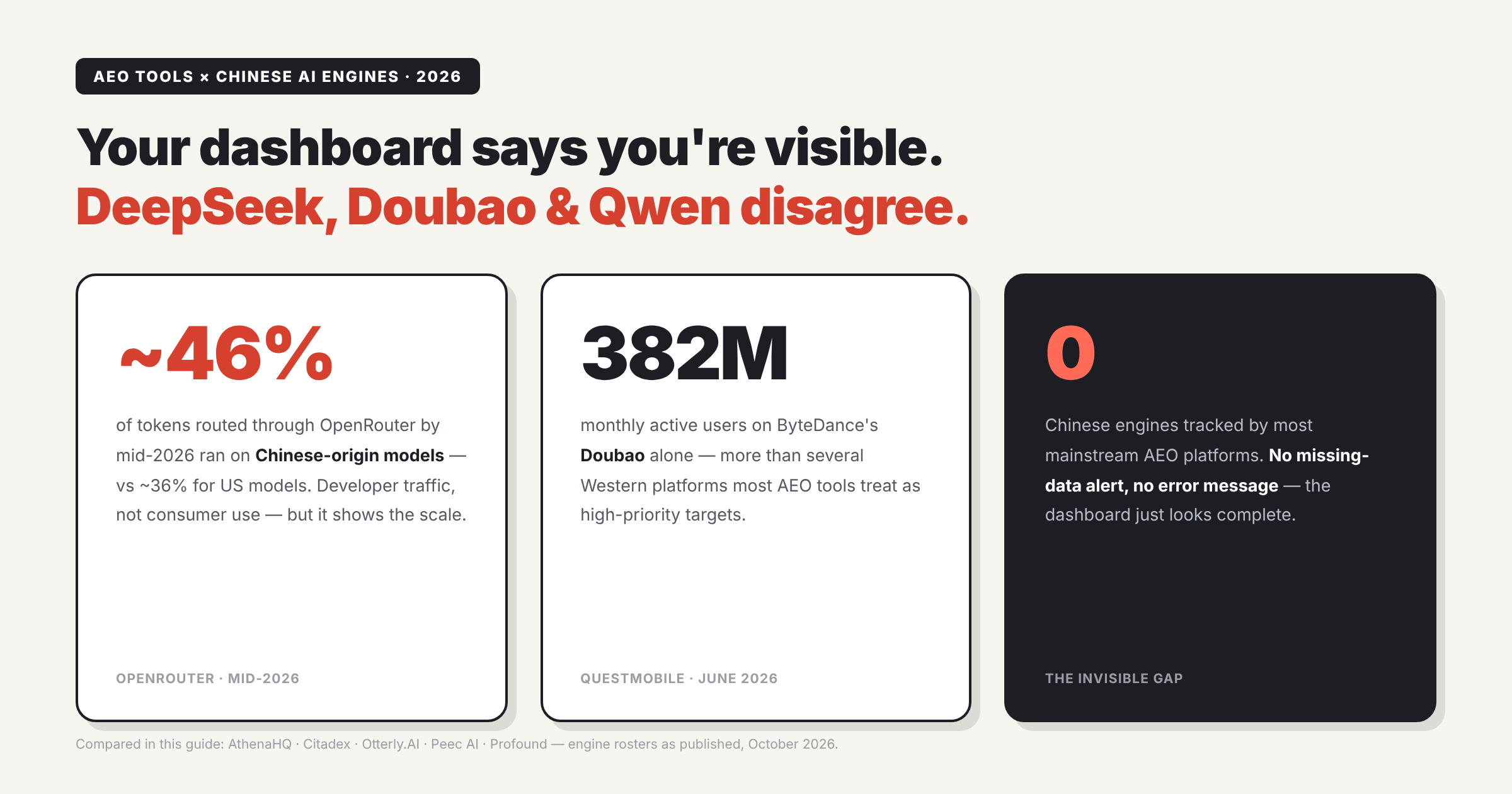
By mid-2026, Chinese-origin models carried about 46% of the tokens routed through OpenRouter, compared with about 36% for US models. OpenRouter mostly serves developers, so this is not a measure of consumer use, but it shows how much real AI traffic now runs on Chinese models.
ByteDance's Doubao reached 382 million monthly active users in June 2026, according to QuestMobile. To put that in context, that user base exceeds several Western AI platforms that most AEO tools treat as high-priority tracking targets. A brand that ranks prominently in ChatGPT answers but does not appear in Doubao or DeepSeek has optimized for only part of the AI conversation happening at scale globally.
What makes this gap particularly damaging is that it remains invisible to teams using Western-only tools. There is no missing data alert, no error message. The dashboard simply reflects Western AI visibility as if it were complete coverage. Brand leadership can review weekly reports showing strong AI mention rates without realizing their visibility in DeepSeek or Qwen is nonexistent.
This article evaluates five tools for which engine coverage data is publicly available: AthenaHQ, Citadex, Otterly.AI, Peec AI, and Profound, with a short note on other tools that list DeepSeek. The evaluation criteria apply consistently across all platforms: which Chinese and Asian AI engines each tracks live, at what pricing tier, and what other factors matter for different buyer situations.
What Counts as 'Chinese AI Coverage': Defining the Evaluation Criteria
Tracking Chinese AI means the platform actively queries the live API or consumer interface of a specific engine and returns structured brand-mention data from that engine. Claiming DeepSeek coverage because the underlying DeepSeek model is accessible through OpenRouter or a similar API aggregator is fundamentally different. The consumer product at deepseek.com is what hundreds of millions of Chinese users interact with daily. A tool that routes queries through an aggregator may see a version of the model's reasoning, but it is not measuring what the actual DeepSeek consumer product tells users about a brand. Ask vendors explicitly which they do.
Four distinct levels of coverage show up in vendor materials:
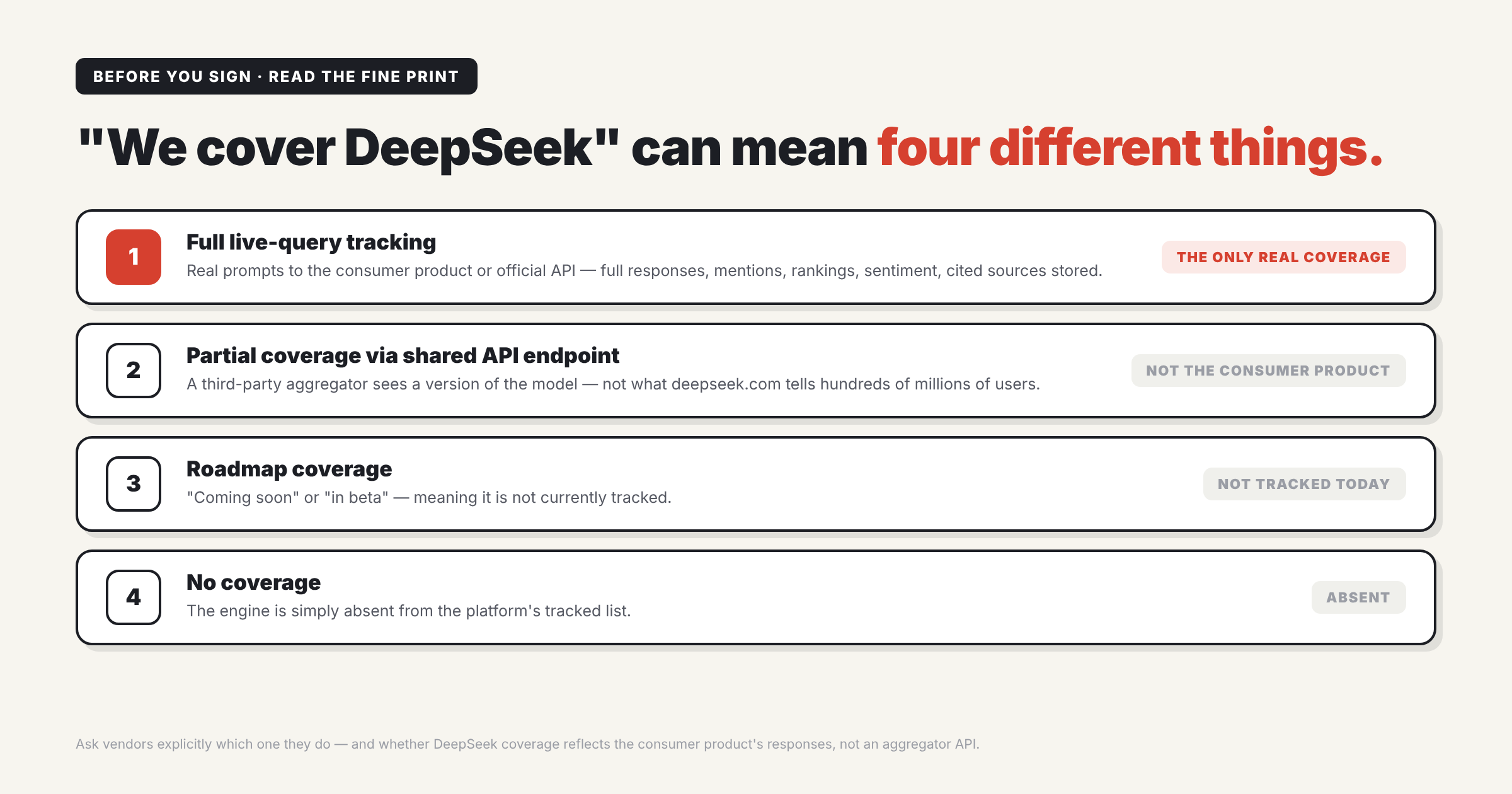
- Full live-query tracking: the tool sends real prompts to the engine's consumer product or official API, records the full response, and stores structured historical data including brand mentions, rankings, sentiment, and cited sources.
- Partial coverage via shared API endpoint: the tool accesses a model through a third-party aggregator, which may or may not reflect what the consumer product returns.
- Roadmap coverage: the engine is listed as "coming soon" or "in beta," meaning it is not currently tracked.
- No coverage: the engine is absent from the platform's tracked list.
For this comparison, the specific engines evaluated in the "Asian AI" category are DeepSeek, Doubao (ByteDance), Qwen (Alibaba), and Kimi (Moonshot AI). Japanese and Korean AI surfaces are a related but distinct question addressed in a later section.
Beyond engine coverage, four additional criteria apply to every tool reviewed. Pricing transparency matters because a platform covering DeepSeek only at a custom-enterprise tier creates a different buying decision than one including it at a mid-market monthly plan. Free trial availability determines whether a brand can verify coverage claims before committing budget. Languages supported affects which markets can be meaningfully queried. Market/region segmentation, whether results for Doubao can be isolated from results for ChatGPT, is critical for teams reporting on individual markets rather than blended global numbers.
Language support and engine coverage are independent variables. A tool that accepts Chinese-language prompts and routes them through ChatGPT is genuinely useful, but it does not answer the question "what does Doubao say about my brand?" Both capabilities matter, and they should never be conflated in a vendor comparison.
Tool-by-Tool Breakdown: Engine Coverage, Pricing, and Asian AI Support
AthenaHQ
AthenaHQ's Starter plan ($295/month) includes 11 engines: ChatGPT, Perplexity, Claude, Gemini, Microsoft Copilot, Google AI Overviews, Grok, Meta AI, and others in its published list. The platform includes hallucination monitoring and citation analysis, which are genuinely useful for enterprise teams managing brand accuracy across AI answers. However, no Chinese AI engines appear in AthenaHQ's publicly listed engine coverage. DeepSeek, Doubao, Qwen, and Kimi are not confirmed on the official site. Language support is also not publicly disclosed. AthenaHQ uses a credit-based consumption model where how many credits individual queries consume is not published in detail, making budget planning less straightforward.
Best fit: Enterprise and mid-market brands focused on Western AI engine visibility with hallucination monitoring as a priority.
Citadex
Citadex tracks 13 AI engines in total, and its engine roster explicitly includes Chinese platforms. Among the 13 are DeepSeek, Doubao, Qwen, and Kimi, making it the only platform in this comparison that covers all four major Chinese consumer AI engines. The Chinese engines are included on the free plan (sign-up credits, no card), on Business ($139/month, about $99/month billed annually) and on the agency plan; the Pro plan covers the 7 Western engines only. Chinese engines are queried in a China market, so their results are kept separate from other markets.
The platform supports prompts in any language and any market, which matters for teams querying Asian-language markets. Results can be segmented by market and by prompt group, so Doubao visibility data can be reviewed independently from ChatGPT data. For agencies managing multiple brand clients, Citadex's agency plan provides full project isolation (each client's prompts, competitors, and history kept separate) and white-label reporting under the agency's own branding and domain. The platform also includes citation source tracking, competitive intelligence showing which brands AI engines recommend and from which sources, AI traffic and revenue attribution, and an AI marketing agent that can execute multi-step tasks through natural language instructions.
A practical limitation: Chinese engine coverage is not on the entry Pro plan ($39/month), so teams that need it pay for Business or the agency plan. Agency accounts are self-serve with a 14-day trial (1 client project, up to 3 markets); the custom domain and client logins unlock once the agency plan is paid.
Best fit: Brands and agencies that need simultaneous visibility across both Western and Chinese AI engines, with multi-market segmentation.
Otterly.AI
Otterly.AI tracks six engines: ChatGPT, Google AI Overviews, Google AI Mode, Perplexity, Gemini, and Microsoft Copilot. Entry pricing runs from $25 to $29/month on the Lite plan, making it the most accessible entry point among the tools reviewed. A 14-day free trial is available. The platform covers 50+ countries and includes a GEO Audit feature that evaluates on-page factors relevant to AI citation.
No Chinese AI engines appear on Otterly.AI's tracked engine list. DeepSeek, Doubao, Qwen, and Kimi are absent. Asian language support beyond the 50+ country claim is not confirmed on the official site. For brands whose customers are concentrated in Western markets, Otterly.AI's price point and free trial make it a reasonable starting tool. For any brand with Chinese market exposure, it does not address the core question.
Best fit: Budget-conscious teams or solo founders tracking Western AI engine visibility, particularly those starting out and wanting a free trial before committing.
Peec AI
Peec AI's base plan covers six engines: ChatGPT, Perplexity, Gemini, Microsoft Copilot, Google AI Mode, and Google AI Overviews. Additional engines are available as add-ons at extra cost. Peec AI sells Starter, Pro and Advanced plans in euros and offers a 7-day trial; prices changed during 2026, so check its pricing page for current figures. The platform's declared language support of 115+ is the highest of any tool reviewed here, which is genuinely significant for multilingual brands operating across many markets.
All six base engines are Western platforms. Chinese AI engines do not appear in Peec AI's core plan engine list. The 115+ language claim refers to the languages in which prompts can be submitted, primarily to ChatGPT, Perplexity, and Gemini. This example makes clear why language count and engine coverage must be evaluated separately. A brand running Chinese-language prompts through Peec AI's engine list is not getting Doubao or DeepSeek data.
Best fit: Multilingual brands operating across Western markets that need broad language coverage for ChatGPT, Perplexity, and Gemini without Chinese AI engine requirements.
Profound
Profound's engine coverage scales with pricing tier in a way that matters directly for Chinese AI tracking. The Starter plan ($99/month) covers only ChatGPT. The Growth plan ($399/month) adds Perplexity and Google AI Overviews. DeepSeek appears only at the Enterprise tier, which requires a custom pricing conversation. Doubao, Qwen, and Kimi do not appear in Profound's publicly listed engine roster at any tier.
Profound's genuine strength is dataset depth. The platform publishes figures of 1.5 billion real user prompts and 400 million anonymized conversations, growing roughly 150 million per month. For brands prioritizing ChatGPT and Perplexity analytics with rich competitive prompt data, that is a real and meaningful advantage. The limitation is structural: Chinese engine access is gated behind the highest price tier, and even then it covers only DeepSeek among Chinese platforms. For a brand whose target customer uses Doubao as their primary AI assistant, Profound's dataset is structurally absent from that user's experience.
Best fit: Enterprise teams that need deep Western AI analytics, particularly ChatGPT and Perplexity prompt research, and for whom Chinese AI coverage is a secondary concern or budget is not a constraint for enterprise tier access.
Side-by-Side Comparison Table: Chinese and Asian AI Engine Coverage
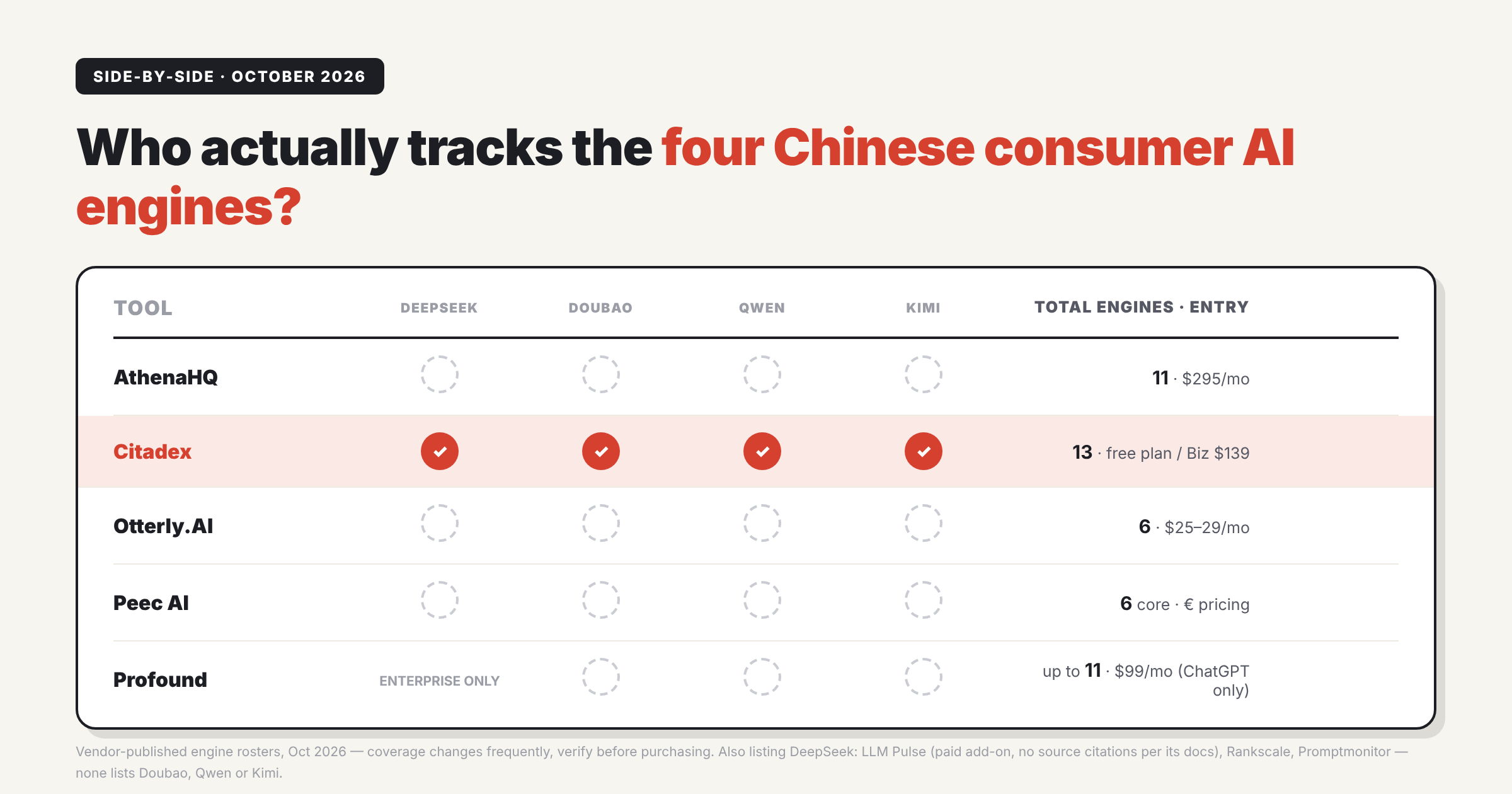
Data collected from each vendor's official site, October 2026. Engine coverage changes frequently; verify current lists with vendors before purchasing.
| Tool | DeepSeek | Doubao | Qwen | Kimi | Total AI Engines Tracked | Pricing Entry Point | Free Trial |
|---|---|---|---|---|---|---|---|
| AthenaHQ | Not listed | Not listed | Not listed | Not listed | 11 (Starter) | $295/mo | No (free tier with 300 credits) |
| Citadex | Yes | Yes | Yes | Yes | 13 | Free plan; Business $139/mo | Free plan; 14-day agency trial |
| Otterly.AI | Not listed | Not listed | Not listed | Not listed | 6 | $25–$29/mo (Lite) | Yes (14-day) |
| Peec AI | Not listed | Not listed | Not listed | Not listed | 6 core (add-ons available) | Starter (euro pricing, check site) | Yes (7-day) |
| Profound | Enterprise tier only | Not listed | Not listed | Not listed | Up to 11 (Enterprise) | $99/mo (Starter, ChatGPT only) | Not publicly disclosed |
Summary: Of the five tools reviewed, one (Citadex) covers all four major Chinese consumer AI platforms, on its free, Business and agency plans. Profound covers DeepSeek at enterprise tier only. AthenaHQ, Otterly.AI, and Peec AI do not list Chinese AI engines in their published engine rosters.
Other tools also list DeepSeek. LLM Pulse sells DeepSeek tracking as a paid add-on outside its standard plans (from €49/month), and its own documentation says that tracking does not include source citations. Rankscale and Promptmonitor list DeepSeek in their standard model lineups. None of these three publicly lists Doubao, Qwen or Kimi.
Is Profound a Good Alternative for Tracking Chinese AI? An Honest Assessment
Profound covers DeepSeek, but only at its enterprise tier with custom pricing. For brands that need Chinese AI coverage at a mid-market budget, that access point creates a genuine barrier. A team considering the $99/month Starter or even $399/month Growth plan gets no Chinese engine data at all.
Profound's strength lies in Western AI analytics depth. The published figures of 1.5 billion real user prompts and 400 million anonymized conversations give enterprise teams access to competitive prompt research that goes beyond simple brand mention tracking. That dataset is genuinely valuable for understanding how buyers phrase questions about a category, which competitors surface in which queries, and how AI recommendation patterns shift over time. For ChatGPT, Perplexity, and Claude use cases at enterprise scale, Profound is a serious platform.
The structural gap remains significant: Doubao's 382 million monthly active users are not represented in Profound's data at any tier. Qwen and Kimi are also absent from the published engine list. For a brand whose Chinese customers use Doubao as their primary AI assistant for product discovery, Profound's dataset simply does not contain those interactions.
For brands asking whether Profound is an alternative for Chinese AI tracking, the answer is: not at current tiers below enterprise, and even at enterprise, coverage of Chinese platforms beyond DeepSeek is not confirmed. Teams that need both deep Western AI analytics and Chinese engine coverage should either plan for two platforms or evaluate tools that explicitly cover both. The question is not which tool is better overall; it is which coverage combination matches the specific markets where a brand's customers are actually making decisions.
Beyond China: AI Visibility in Japan, Korea, and the Broader Asian Market
Japan and Korea present a different challenge than China. Neither market has a domestic AI chatbot that has displaced Western platforms at the same scale. Japanese and Korean consumers use ChatGPT, Gemini, and Perplexity alongside local AI-enhanced services: Yahoo Japan's AI search integrations, Naver's AI features in Korea, Line's AI capabilities. Western and local AI surfaces overlap, meaning that tracking ChatGPT in Japanese is necessary but not sufficient.
The distinction matters because Chinese AI isolation stems partly from regulatory barriers. The Great Firewall means Chinese consumers use DeepSeek, Doubao, Qwen, and Kimi as replacements for ChatGPT, not as alternatives. Japanese and Korean consumers have that choice; the tracking question is therefore about completeness within a hybrid landscape rather than a parallel ecosystem.
For brands selling across Asia, the implication is that Chinese market tracking and Japanese/Korean market tracking require different vendor questions. For China: does the tool query DeepSeek, Doubao, Qwen, and Kimi at a commercially viable price tier? For Japan and Korea: does the tool support Japanese and Korean language prompts to Western AI engines, and does it track any local AI-enhanced search surfaces?
Most of the tools reviewed here do not publish explicit Japanese or Korean AI surface coverage beyond language support claims. Peec AI's 115+ language support is the clearest public statement, and it covers Western engines in those languages. Whether any of these tools track Yahoo Japan AI features or Naver AI surfaces is not confirmed in public documentation. Brands with Japan or Korea exposure should ask vendors this question directly before purchasing.
Language support and engine coverage remain independent variables in the Japan and Korea context just as in China. A tool that sends Japanese prompts to ChatGPT is doing something useful for a brand's Japanese audience on that platform; it is not covering what Japanese AI-enhanced search might say. Start by mapping which AI surfaces your customers in each specific market actually use before evaluating tool fit.
Engine coverage across all platforms is a moving target. Tools add integrations, sometimes quarterly. The roster in this article reflects publicly disclosed coverage as of October 2026; a brand evaluating tools in Q1 2027 should re-verify engine lists directly.
How to Choose the Right Tool: Decision Framework by Situation
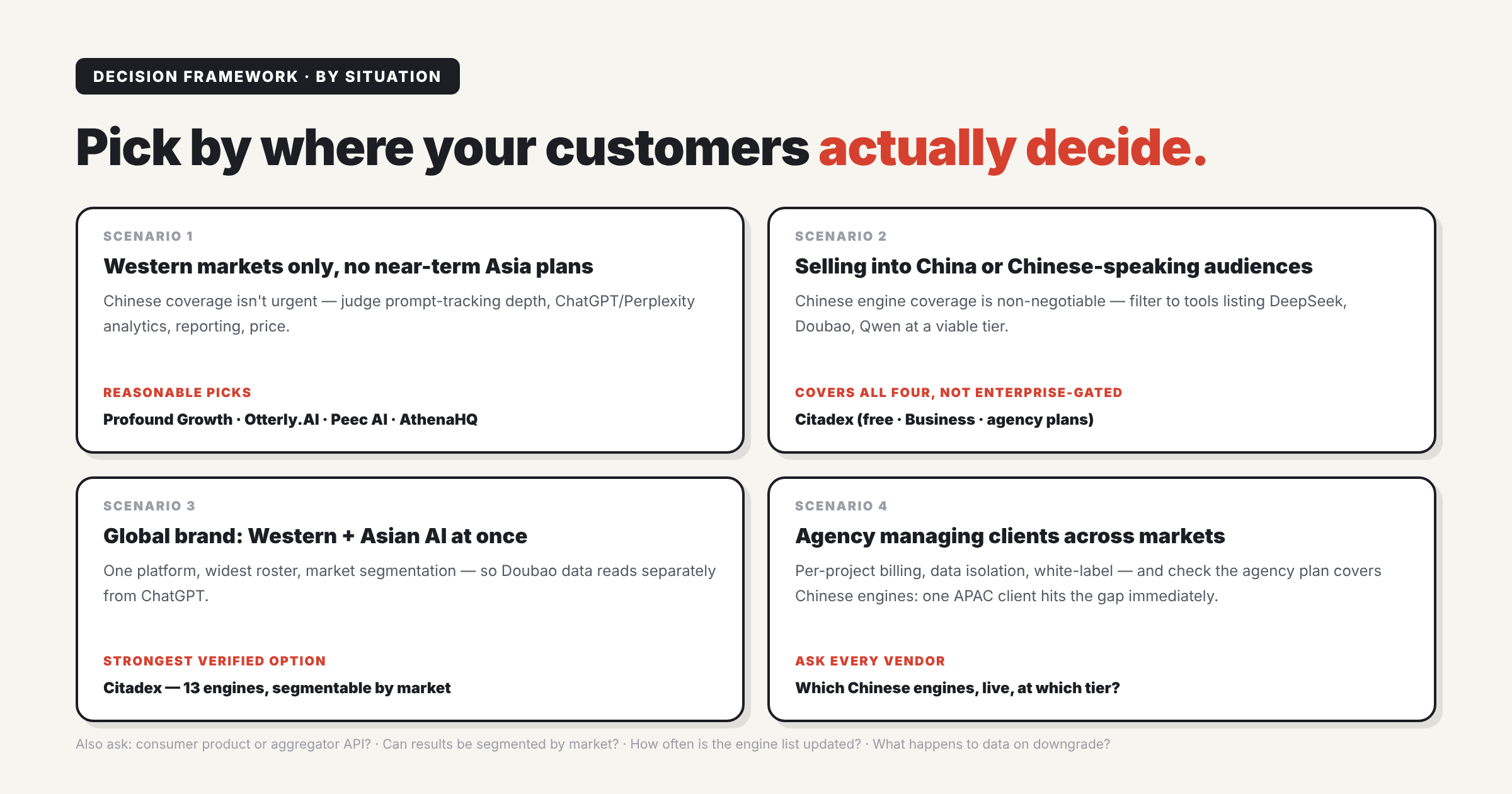
Scenario 1: Brand selling primarily in Western markets with no near-term Asia plans
Chinese AI engine coverage is not an immediate priority. Evaluate tools on prompt tracking depth, competitive analysis for ChatGPT and Perplexity, reporting quality, and price. Profound's Growth plan ($399/month) offers substantial dataset depth for Western AI platforms. Otterly.AI's entry pricing and free trial make it a reasonable starting point for smaller teams. Peec AI's 115+ language support fits multilingual Western brands. AthenaHQ suits teams prioritizing hallucination monitoring alongside citation tracking.
Scenario 2: Brand actively selling into China or to Chinese-speaking audiences globally
Chinese AI engine coverage is non-negotiable. Filter immediately to tools that explicitly list DeepSeek, Doubao, and Qwen as tracked engines at a commercially viable price tier. From the tools reviewed with public data, Citadex is the platform that covers all four major Chinese consumer AI engines (DeepSeek, Doubao, Qwen, and Kimi) without gating that access behind custom enterprise pricing. A brand entering this scenario with a tool covering only Western engines has no visibility into the AI conversations most relevant to its target audience.
Scenario 3: Global brand needing visibility across both Western and Asian AI simultaneously
Look for a single platform covering the widest engine list with market/region segmentation so Western and Chinese results can be reviewed separately. For teams that need this combination, Citadex is the strongest verified option: 13 tracked engines including both major Western platforms and all four Chinese consumer AI platforms, with prompt results segmentable by market. This avoids the cost and operational complexity of running two separate tools and maintaining separate baselines.
Scenario 4: Marketing agency managing multiple brand clients across markets
Per-project billing, client data isolation, and white-label reporting matter more than per-seat pricing. An agency running five clients in different geographies needs each client's prompts, competitors, and historical data kept separate, and needs to present branded reports to each client without exposing platform costs or other client data. Evaluate whether the agency plan covers Chinese AI engines, since an agency with even one APAC client will hit this gap immediately.
Questions to ask any vendor before signing:
- Which Chinese AI engines do you query live, and at which pricing tier?
- Is DeepSeek coverage via the consumer product or via an API aggregator?
- Can I segment visibility data by market or region?
- How frequently do you update your engine coverage list?
- What happens to my data if I downgrade or cancel?
Common Mistakes Brands Make When Evaluating AEO Tools for Asian Markets
Conflating "supports Chinese language" with "tracks Chinese AI engines" is the single most common mistake. These are completely independent. A platform can accept Mandarin-language prompts and route them entirely through ChatGPT and Gemini. The result is useful data about how those Western engines respond in Chinese, but it tells a brand nothing about what Doubao or DeepSeek says. Vendors sometimes describe this as "Chinese language support" without explicitly clarifying which engines are actually queried. Read the engine list, not the language count.
DeepSeek should not be treated as a monolithic entity. DeepSeek the open-source model, accessible via API and embedded across many third-party products, differs from DeepSeek the consumer chat product at deepseek.com. A tool that "covers DeepSeek" via an aggregator API may be querying the model weights rather than the consumer product. For brand visibility purposes, what matters is the interface that Chinese consumers use when asking for product recommendations. Ask vendors specifically whether their DeepSeek coverage reflects the consumer product's responses.
Assuming "global" means Chinese AI coverage is another trap. In most AEO vendor materials, "global" means the platform supports multiple languages for Western AI engines. It does not mean access to Chinese-domestic platforms. The regulatory and technical barriers separating the Chinese AI ecosystem from the Western one are real; a "global" label does not dissolve them.
Waiting until "the market matures" before tracking Chinese AI visibility creates a missed opportunity. Brands that delay establishing a baseline have no historical data to reference when they eventually start. Diagnosing why visibility changed, attributing improvements to specific content actions, and understanding competitive dynamics all require data extending back in time. The right moment to start tracking is before the first optimization action, not after.
Over-indexing on dataset size without checking whether that dataset includes Chinese AI data can be misleading. Profound's published figures of 1.5 billion prompts and 400 million conversations are genuinely impressive for Western AI analytics. But a dataset drawn entirely from ChatGPT and Perplexity interactions tells a brand nothing about its Doubao or Qwen presence. Dataset size and engine coverage are different dimensions; evaluate both.
Before evaluating any AEO platform, write down the specific AI engines your customers in each market use most frequently. Then filter the vendor list to tools that cover those engines at a price point that fits, and treat other features as secondary criteria.
Frequently Asked Questions: Tracking Brand Visibility in DeepSeek, Doubao, Qwen, and Asian AI Platforms
Q: Which AI engines should I prioritize if I'm selling into China?
DeepSeek and Doubao are the highest-priority consumer AI platforms by user volume in China as of 2026. Doubao alone reaches 382 million monthly active users. Qwen (Alibaba) and Kimi are secondary but growing. Start with tools that cover at least DeepSeek and Doubao at a mid-market price tier, then add Qwen and Kimi as the budget allows.
Q: Is there a tool that tracks what DeepSeek says about my brand?
Yes. Citadex tracks DeepSeek, together with Doubao, Qwen and Kimi, on its free, Business and agency plans. Profound covers DeepSeek at its enterprise tier, and LLM Pulse sells it as a paid add-on. For other tools in the broader market, verify current engine lists directly with each vendor, since coverage changes frequently.
Q: Can I track Doubao brand mentions without a paid tool?
No reliable free method exists for systematic Doubao brand tracking. Manually querying Doubao's interface produces no structured historical data, no competitive benchmarking, and no alerting. Manual spot-checks can confirm whether a brand appears at a point in time, but they cannot track changes over time or compare performance against competitors. For any brand that treats Doubao as a strategically relevant channel, a paid tool is the only practical option.
Q: Do these tools work for brands that are not yet in the Chinese market but want to enter?
Yes, and this is one of the most underused applications. Establishing a baseline of how Chinese AI engines currently describe or fail to describe a brand before market entry gives teams concrete data for the pre-launch phase: which brand facts are missing, which competitors are positioned as alternatives, and which content gaps need to be addressed. Waiting until after launch to start tracking means entering without any historical context.
Q: What is the difference between AEO for Chinese markets and traditional Chinese SEO?
Traditional Chinese SEO means optimizing for Baidu's search ranking algorithm. AEO for Chinese markets means shaping how AI engines like DeepSeek, Doubao, and Qwen represent a brand in conversational answers. These are distinct systems with different signals. Content that ranks well on Baidu does not automatically surface in AI answers, and AI citation patterns draw on different sources including structured knowledge bases, review platforms, and cited web content. Both disciplines matter, and they require different tools and different optimization strategies.
Q: Are traditional SEO tools useful for tracking Chinese AI visibility?
Ahrefs and Semrush are built for traditional search engine ranking data. They do not query Chinese AI chatbots and do not return brand-mention data from DeepSeek, Doubao, or Qwen. They remain useful for keyword ranking, backlink analysis, and Baidu SEO, but they answer a different question than AEO platforms. Teams managing both dimensions typically use SEO tools and AEO platforms in parallel, not interchangeably.
Q: How quickly does brand visibility change in Chinese AI engines?
Specific timelines are not publicly disclosed by any of the tools reviewed. The Chinese AI engine landscape is less studied than Western AI platforms, and the factors that influence citation patterns in Doubao or Qwen are not as well documented as those for ChatGPT or Perplexity. This is precisely why establishing a historical baseline now is valuable. Brands that start tracking today will have the longitudinal data needed to measure change, attribute improvements, and understand seasonal or competitive shifts when that knowledge eventually becomes more developed.