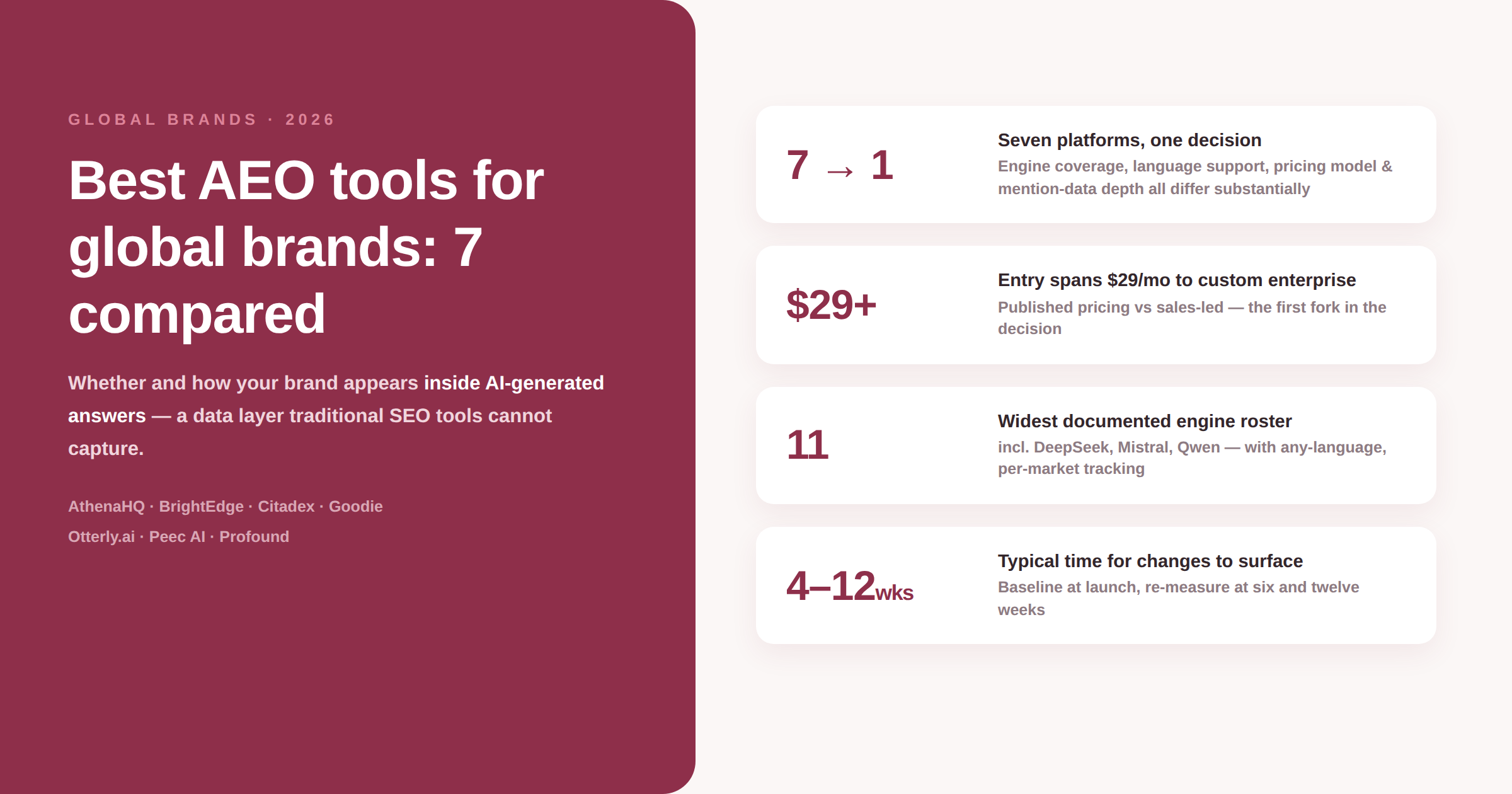
Key takeaways:
- Specialized AEO platforms track product-level brand mentions across ChatGPT, Claude, Gemini, and Perplexity in ways traditional SEO tools cannot.
- Global brands need platforms that support multiple languages and regional AI engines, especially for non-English markets like China, Portugal, and the Philippines — and only a handful of tools cover Chinese-language engines like DeepSeek and Qwen alongside any-language, per-market tracking.
- Choosing the right AEO tool depends on team size, client structure, geographic scope, and the granularity of mention tracking required.
AEO and GEO platforms solve a specific problem: they tell you whether and how your brand appears inside AI-generated answers, a data layer that Google Analytics, Semrush, and Ahrefs do not touch. Seven platforms now compete meaningfully in this space, AthenaHQ, BrightEdge, Citadex, Goodie, Otterly.ai, Peec AI, and Profound, and they differ substantially in engine coverage, language support, pricing model, and the depth of mention data they return. This comparison examines all seven on the same set of criteria, drawn from each vendor's own public-facing product documentation.
What AEO and GEO Tools Actually Do
AEO and GEO platforms monitor and improve how a brand appears inside AI-generated answers, not traditional search result pages. When a buyer asks ChatGPT "what's the best project management tool for remote engineering teams," the answer they receive is generated by the model from sources it can retrieve and cite at that moment, not from a ranked list of pages the way Google's blue-link results work. Tracking whether your brand appears in that answer, where it ranks relative to competitors, whether the model cited a URL pointing to your content, and how the sentiment reads requires infrastructure designed specifically for this task. Conventional rank-tracking tools do not capture any of it.
The core data loop these platforms run is straightforward: a tracked prompt is submitted to an AI engine, the returned answer is parsed, brand mentions are detected and classified, and four metrics are recorded: mention rate (how often the brand appears across queries), rank position within the answer, sentiment, and citation (whether the answer included a source URL pointing to the brand's content). That loop runs across multiple engines simultaneously and, on the stronger platforms, across multiple languages.
AEO vs. GEO. Answer Engine Optimization (AEO) refers specifically to optimizing for inclusion in AI-generated answers, structuring content so AI engines select and cite it. Generative Engine Optimization (GEO) covers the broader content strategy for generative AI surfaces, including how to write, structure, and distribute content that generative models prefer to surface. Most platforms and practitioners use both terms interchangeably, and the tools reviewed here address both.
Traditional SEO platforms are adding AI Overview tracking as bolt-on modules, but these add-ons typically cover one or two engines and report only whether an AI Overview appeared for a keyword, not whether your brand was cited inside it or how you compared to competitors. Dedicated AEO platforms cover eight to twelve engines and return answer-level data: which specific content was cited, what sentiment the answer carried, how mention frequency shifts over time. For teams making a build-vs-buy decision, the difference is meaningful. SEO tool add-ons handle the "did an AI Overview fire" question; AEO platforms handle the "are we inside the answer, and what does it say about us" question.
How This Comparison Was Compiled
Every tool in this piece is evaluated on seven criteria: (1) AI engines covered, number and names; (2) pricing entry point; (3) free trial availability; (4) languages supported; (5) best-fit customer segment; (6) notable strength; (7) notable weakness or gap. All data points come from each tool's official website, public pricing pages, G2 profiles, or Crunchbase. Nothing is inferred or estimated. Where a data point is not publicly available, the table cell reads "Not publicly disclosed." Tools are listed alphabetically throughout..
Side-by-Side Comparison: Seven AEO Platforms
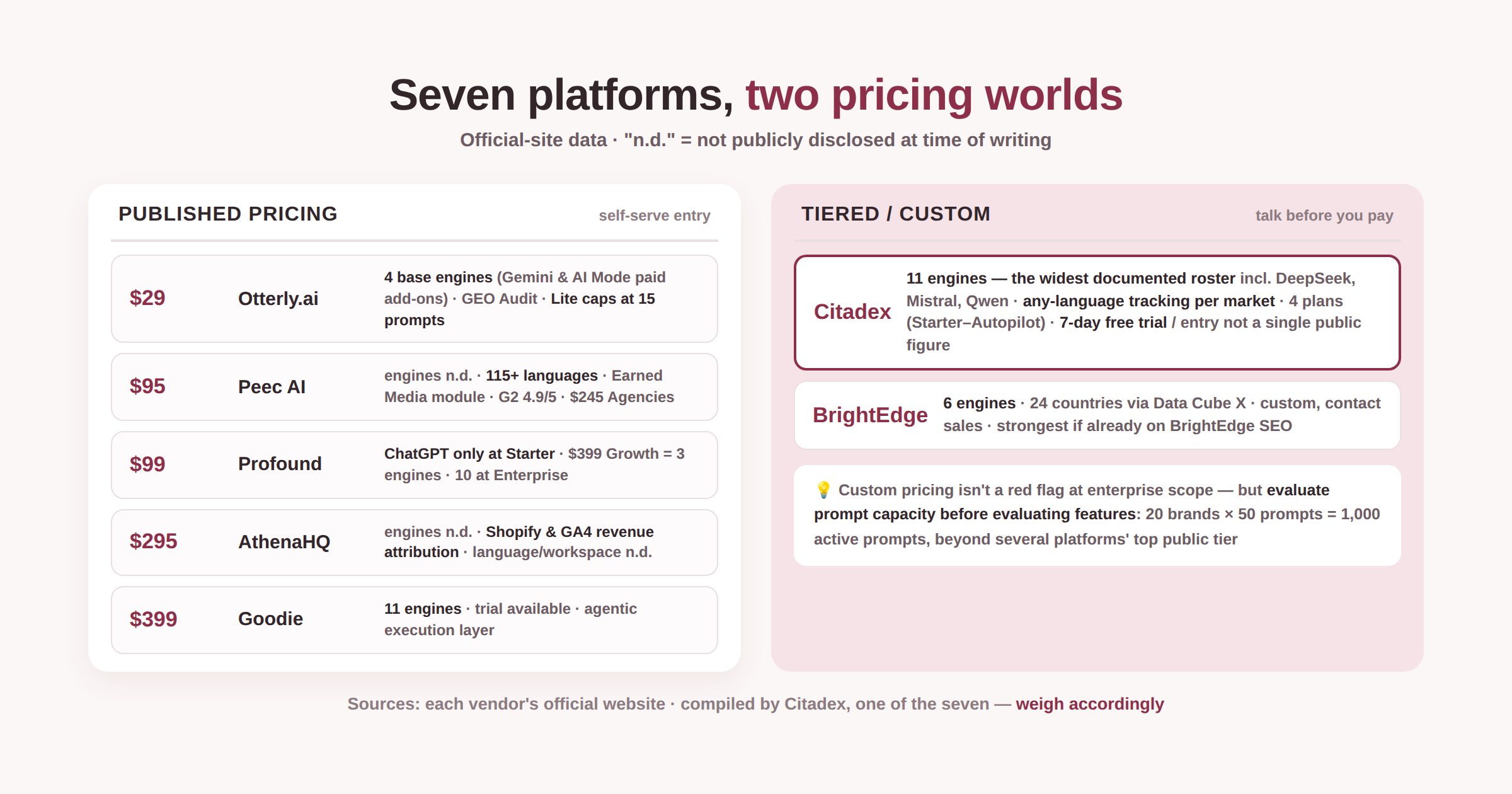
| Tool | AI Engines Covered | Engine Count | Pricing Entry Point | Free Trial | Languages Supported | Best For | Notable Strength | Notable Weakness |
|---|---|---|---|---|---|---|---|---|
| AthenaHQ | Not publicly disclosed | Not publicly disclosed | $295/mo (Self-Serve) | Not publicly disclosed | Not publicly disclosed | Mid-market & DTC brands with revenue attribution needs | Action Center workflow automation; Shopify/GA4 revenue attribution | Language and workspace details not publicly disclosed |
| BrightEdge | ChatGPT, Google AI Overviews, Google Gemini, Perplexity, Claude, Microsoft Copilot | 6 | Custom, contact sales | Not publicly disclosed | 24 countries via Data Cube X | Enterprise teams with existing SEO workflows | Unified SEO + AEO data in one platform; Fortune 100 client base | Enterprise-only pricing; likely over-specified for sub-enterprise teams |
| Citadex | ChatGPT, Claude, Gemini, Perplexity, Copilot, Grok, DeepSeek, Mistral, Qwen, Doubao, Google AI Overviews, and Google AI Mode | 12 | Varies by plan (Starter / Pro / Business / Autopilot) | 7-day free trial | Any language | Global brands and teams requiring widest engine and language coverage | Widest engine roster (12), including DeepSeek, Mistral, Qwen, and Doubao; any-language prompt tracking per market | Entry pricing not listed as a single public figure |
| Goodie | ChatGPT, Gemini, Claude, Perplexity, Google AI Overviews, and 6+ others | 11 | $399/mo (Explorer) | Available | Not publicly disclosed | Brands seeking an all-in-one AEO + content creation platform | Agentic execution layer combining monitoring and content optimization | Language support not publicly disclosed |
| Otterly.ai | ChatGPT, Google AI Overviews, Perplexity, Microsoft Copilot (Gemini, Google AI Mode as paid add-ons) | 4 base | $29/mo (Lite, 15 prompts) | Available | Country-level monitoring with language support | Budget-conscious teams and early-stage brands | Most transparent and affordable public pricing; GEO Audit feature | Lite plan caps at 15 prompts, insufficient for multi-product or multi-market tracking at scale |
| Peec AI | Not publicly disclosed | Not publicly disclosed | $95/mo (Brands), $245/mo (Agencies) | Not publicly disclosed | 115+ languages | Agencies managing multiple brands | Multi-brand workspace; Earned Media module; G2 rating of 4.9/5 | Not publicly disclosed |
| Profound | ChatGPT, Perplexity, Google AI Overviews, Gemini, Copilot, Claude (10 on Enterprise) | Up to 10 | $99/mo (Starter, ChatGPT only); $399/mo (Growth, 3 engines) | Not publicly disclosed | Not publicly disclosed | Growing B2B brands and agencies seeking structured AEO workflow | Prompt Volumes dataset; multi-client Agency plan; G2 Leader badge | Starter and Growth tiers limit engine count significantly |
Tool-by-Tool Breakdown: Strengths, Weaknesses, and Best-Fit Scenarios
AthenaHQ
AthenaHQ does not publish its full AI-engine roster on its site — Not publicly disclosed, so exact coverage can't be confirmed from public sources. Its most distinctive capability is revenue attribution: native integrations with Shopify and Google Analytics 4 connect AI visibility movements to actual pipeline or sales data. Most AEO tools stop at mention-rate dashboards; this one goes further. The Action Center provides workflow automation for acting on visibility gaps rather than just surfacing them.
Where AthenaHQ is less transparent: language support, workspace isolation for agencies, and multi-seat details are not publicly documented. Buyers with multilingual requirements or complex agency structures will need to talk directly with the sales team. At Not publicly disclosed/month for Self-Serve, the entry point sits above median for the category.
Best for a DTC or mid-market brand with a North American or English-language focus that needs to tie AI visibility data to revenue outcomes.
BrightEdge
BrightEdge arrives with a decade-plus of enterprise SEO infrastructure already in place. Its AI Catalyst module adds AEO functionality, tracking AI citations, AI Overview behavior, and prompt-level visibility, on top of keyword ranking, content performance, and competitive intelligence. For large organizations that already use BrightEdge for SEO, a single platform beats stacking a point solution on the side.
The trade-off is scope and cost. BrightEdge covers six primary AI engines (ChatGPT, Google AI Overviews, Google Gemini, Perplexity, Claude, Microsoft Copilot) — Not publicly disclosed, narrower than newer dedicated AEO platforms. Pricing is custom and enterprise-only; there are no public tiers, no self-serve option, and likely a minimum contract size that excludes teams below enterprise scale. Geographic coverage spans Not publicly disclosed countries via Data Cube X, but per-language tracking depth is not publicly detailed.
Best for an enterprise marketing team already using BrightEdge for SEO that wants to extend visibility tracking into AI answer surfaces.
Citadex
Citadex tracks 12 AI engines, ChatGPT, Claude, Gemini, Perplexity, Copilot, Grok, DeepSeek, Mistral, Qwen, Doubao, Google AI Overviews, and Google AI Mode, and supports prompt tracking in any language with results segmented by market (country + language), each scanned from its own country. For every tracked prompt on every engine in every market, the platform records mention rate, average rank, sentiment, and citation URL. The engine roster includes surfaces that matter for non-English markets: DeepSeek for Chinese-language audiences, Qwen and Doubao for additional Chinese coverage, and Mistral for European use.
The practical limitation: pricing is not published as a single entry-point figure. Plans are tiered (Starter, Pro, Business, and Autopilot), but a buyer cannot read the cost off a public page the way they can with Otterly.ai or Peec AI. A 7-day free trial reduces commitment risk for evaluation.
Best for a multinational brand or global team that needs the widest engine coverage, including Chinese-language AI engines, combined with any-language prompt tracking and per-market segmentation.
Goodie
Goodie positions itself as an all-in-one AEO platform, combining monitoring, content creation, and optimization in a single product rather than requiring separate tools for tracking and production. It covers 11 engines total (ChatGPT, Gemini, Claude, Perplexity, Google AI Overviews, and six additional surfaces), and its agentic execution layer stands out: it does not just surface visibility gaps, it takes action through automated content generation and publishing workflows.
At Not publicly disclosed/month for the Explorer tier with a free trial, Goodie sits at a higher entry point than most alternatives. Language support is not publicly disclosed, a material gap for teams with non-English market requirements. Details on multi-client workspaces and team seats also are not documented, so agencies or large internal teams should verify directly.
Best for a brand that wants a single vendor handling both AEO monitoring and content production response to visibility gaps.
Otterly.ai
Otterly.ai's primary differentiator is price transparency. At Not publicly disclosed/month for Lite (Not publicly disclosed prompts), Not publicly disclosed/month for Standard (Not publicly disclosed prompts), and Not publicly disclosed/month for Premium (Not publicly disclosed prompts), all published clearly on the pricing page. It is the only platform here where a buyer can evaluate cost without a sales call. That matters for early-stage teams and bootstrapped founders who need to budget without procurement friction.
The base plan covers Not publicly disclosed engines, ChatGPT, Google AI Overviews, Perplexity, and Microsoft Copilot, with Gemini and Google AI Mode available as paid add-ons. The GEO Audit feature provides structured gap analysis rather than just raw mention data, useful for teams building AEO content strategy. The constraint is scale: 15 prompts on Lite works for a single product in a single market, but tracking multiple product lines, competitors, or languages will exhaust that budget quickly. Moving to Standard or Premium addresses volume but not engine depth.
Best for a solo founder, small marketing team, or early-stage startup wanting affordable, transparent tracking across core English-language AI engines.
Peec AI
Peec AI does not publish an exact engine count, but it supports Not publicly disclosed languages, the broadest public language count in this comparison. Its Earned Media module extends tracking beyond brand mentions to external citations and third-party references in AI answers, useful for PR and content teams measuring share of voice. The multi-brand agency workspace and transparent agency pricing at Not publicly disclosed/month make it a credible option for smaller agencies.
A G2 rating of 4.9/5 signals strong user satisfaction, though the total review count adds context to that figure. Notable gaps: white-label reporting capability and seat-level permissions are not documented on the official site, leaving enterprise agency workflow partially unconfirmed. Buyers running larger agency operations should ask specifically about workspace isolation and reporting export formats.
Best for a marketing agency or international brand needing broad language coverage (including non-English markets) with transparent pricing and multi-brand workspace structure.
Profound
Profound's Starter tier at $99/month (ChatGPT only) provides one of the lower entry points for paid AEO tracking. The Growth tier at $399/month covers three engines and suits mid-market use cases. The Enterprise plan expands to ten engines, competitive at that tier with broader platforms. The Prompt Volumes dataset is a genuine differentiator: it shows which questions buyers actually ask AI engines, enabling smarter prompt selection rather than guessing at query coverage. An Agency plan with multi-client structure and a G2 Leader designation add credibility for teams evaluating vendor stability.
The notable constraint is engine availability by tier. ChatGPT-only at Starter and three engines at Growth mean teams needing Google AI Overviews, Claude, and Perplexity simultaneously must commit to Enterprise pricing or accept incomplete coverage. Language support is not publicly disclosed.
Best for a B2B SaaS company at growth stage seeking structured AEO workflow tooling with a clear upgrade path from a manageable entry price.
Product-Level Mention Tracking in ChatGPT: What to Look For and Why It Matters
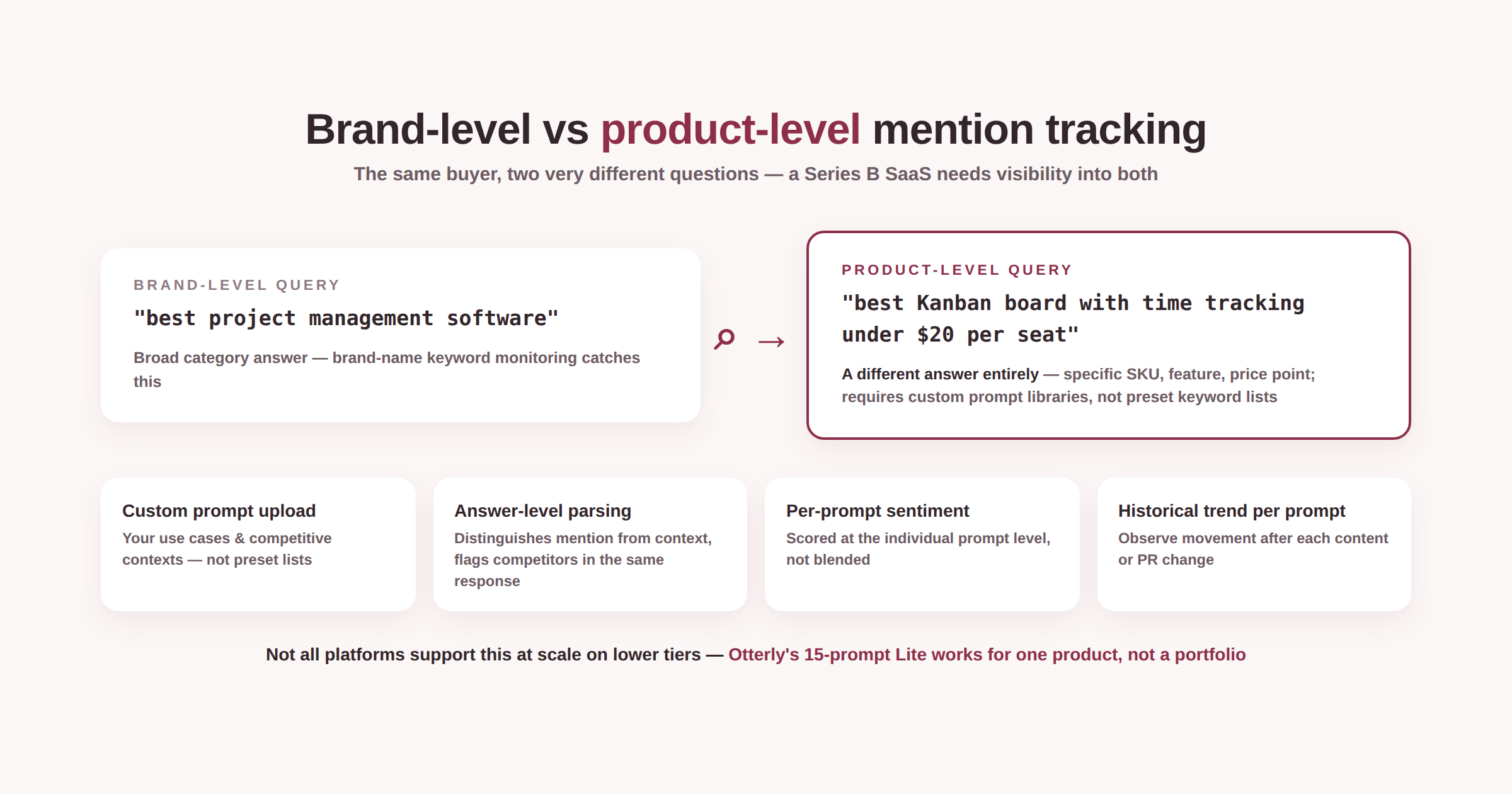
Tracking brand mentions at the product level, a specific SKU, feature name, or sub-brand, requires platforms that support custom prompt libraries, not just brand-name keyword monitoring. A brand-level query like "best project management software" surfaces a different answer than "best Kanban board with time tracking under $20 per seat," and a Series B SaaS company needs visibility into both because buyers at different evaluation stages ask different questions.
In practice, product-level tracking works like this: a team uploads a set of custom prompts mapped to specific use cases, features, or competitive contexts. The platform queries each AI engine with those prompts on a recurring schedule, parses the answers, and flags both brand and competitor mentions within the same response. Citation URL tracking identifies which specific content assets, a blog post, a comparison page, a G2 profile, are driving inclusion. Prompt-level sentiment data then shows whether the model characterized your product favorably relative to alternatives.
The platform features that enable this at scale include custom prompt upload (not just preset keyword lists), answer-level parsing that distinguishes mention from context, sentiment scored at the individual prompt level, and historical trend data per prompt so teams can observe movement after content or PR changes.
Not all platforms support this at scale on lower tiers. Otterly.ai's Lite plan caps at Not publicly disclosed prompts, workable for a single-product brand but not for multi-product SaaS. Before committing to any platform, estimate your required prompt volume: count your tracked products, multiply by the number of competitor-context queries you want, and verify that volume fits within your chosen plan.
Multi-Client Workspaces, Team Seats, and Agency-Grade Features
Agencies and Series B teams with 50 or more seats need platforms built for organizational complexity. That means separate client workspaces with isolated data environments, role-based permissions determining who can view or modify which workspace, exportable reports in formats clients can receive directly, and API access for teams that need to pipe data into their own dashboards.
Prompt volume scales with client count in ways that quickly exhaust entry-level tiers. An agency managing 20 brands, each requiring 50 tracked prompts, needs 1,000 active prompts, a volume that exceeds the top public tier of several platforms and pushes most buyers into custom enterprise contracts. Evaluate prompt capacity before evaluating features.
For Series B SaaS companies running an internal 50-seat team, the requirements shift slightly: SSO and audit logs matter for IT and security review, the ability to segment tracking by product line or market region matters for strategy, and a clear seat-pricing model avoids surprises as headcount grows. Platforms with flat-fee pricing often prove more predictable for internal teams; per-seat pricing scales poorly once headcount rises.
Among the platforms reviewed, Peec AI and Profound both publicly describe agency or multi-client features. Peec AI's Not publicly disclosed/month Agency tier and Profound's Agency plan provide documented starting points. For AthenaHQ, Goodie, and BrightEdge, workspace and seat details require a direct sales conversation. Buyers in this segment should treat "multi-client workspace" as a feature to demo specifically, not just a checkbox, because isolation and permission granularity vary significantly between vendors even when the label is identical.
AI Search Visibility for Global Brands: China, Philippines, Portugal, and Non-English Markets
Most AEO platforms are built primarily for English-language markets, and gaps show quickly for teams with genuine international scope. Real global coverage requires per-language prompt tracking, support for AI engines that are locally dominant rather than globally universal, and the ability to separate results by market, meaning a specific country plus language. AI answers differ by both, because search-enabled engines localise results by country.
China. DeepSeek has become a significant AI answer engine for Chinese-language queries. Brands targeting Chinese-speaking audiences need platforms that include DeepSeek in their engine roster, and ideally Qwen as well. Among the platforms reviewed, Peec AI and Citadex both list DeepSeek on their official sites. Platforms that exclude DeepSeek leave a meaningful blind spot for China-market tracking. Note that Baidu's AI products occupy a separate surface; no platform in this set lists Baidu AI coverage.
Philippines. English is an official language, so English-language AI engine tracking, ChatGPT, Gemini, Perplexity, covers the majority of AI-assisted discovery for most brand categories. The nuance involves Filipino and Tagalog-language queries, which are growing as local AI usage expands. Buyers targeting Filipino-language audiences should confirm whether any vendor can set up prompts in Tagalog and whether the platform returns separate tracking for Tagalog answers versus English ones.
Portugal. Portuguese-language tracking is the baseline, but European Portuguese and Brazilian Portuguese can produce meaningfully different AI answers with different sources cited, different phrasing, and different brand associations. A platform treating "Portuguese" as a single prompt language may aggregate results in ways that obscure market-specific differences. Ask any vendor how they handle Portuguese variant separation before assuming single-language support covers both markets.
General principle for multinational teams. Per-market tracking, where the platform segments results by a specific country plus language, is more accurate for AI engine monitoring than tracking language or country alone. AI answers differ by the language of the query and, because search-enabled engines localise results by country, by country as well. Platforms that report visibility by language alone may conflate English queries from Portugal, Brazil, and the UK into a single "English" bucket, obscuring where a brand actually stands in each market.
How to Choose: A Decision Framework for Four Buyer Types
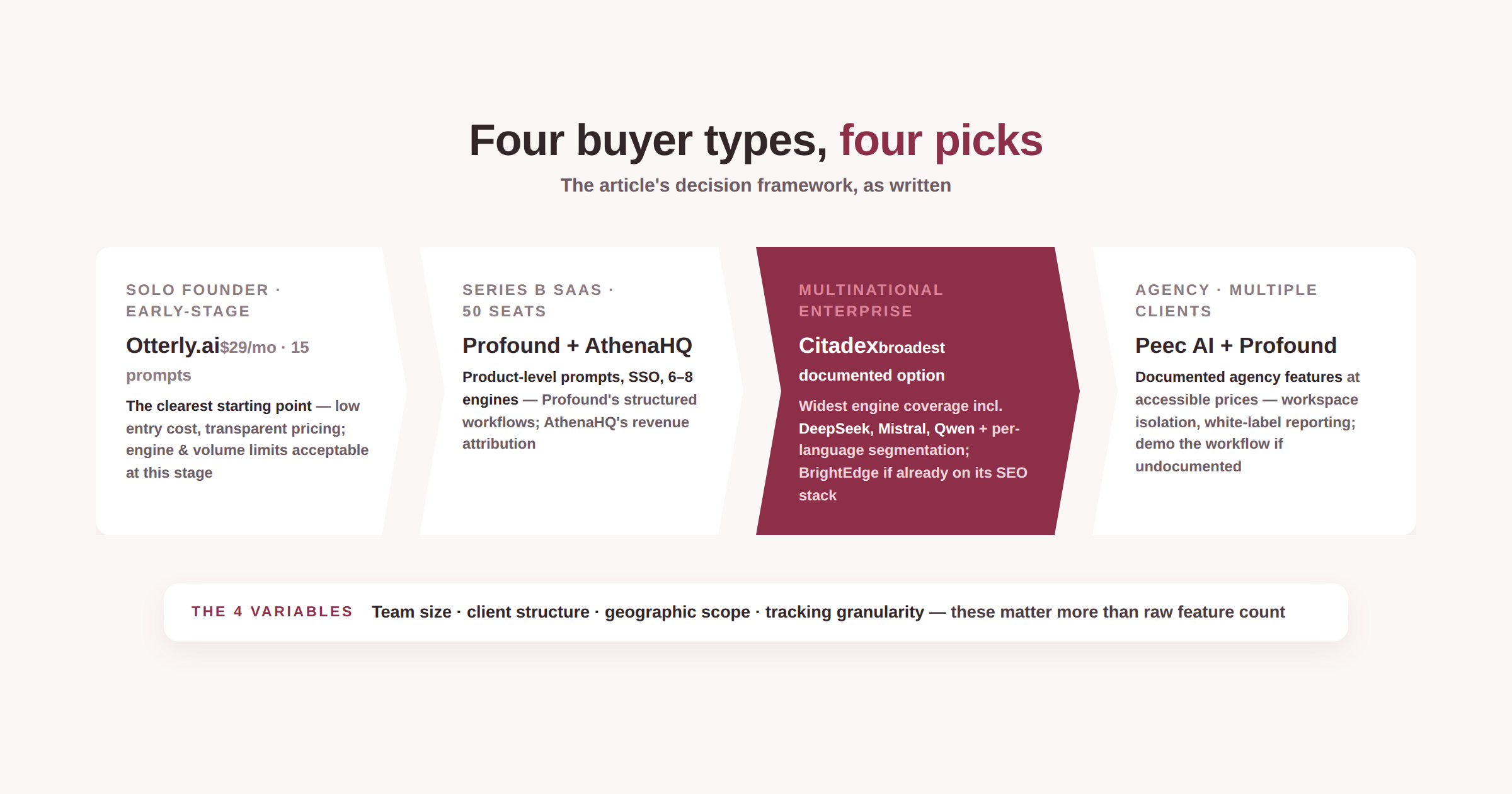
The right AEO platform follows from four variables: team size, client structure, geographic scope, and required tracking granularity. These matter more than raw feature count.
Solo founder or early-stage startup. Prioritize low entry cost, fast setup, and basic mention tracking across core engines. A free trial and transparent public pricing reduce commitment risk. Otterly.ai at $29/month for 15 prompts is the clearest starting point in this set for a team wanting to understand AI visibility before investing further. Limitations on engine count and prompt volume are acceptable at this stage.
Series B SaaS with 50 seats. This buyer needs product-level prompt customization, multi-seat access, SSO, and coverage across at least six to eight engines including Google AI Overviews and ChatGPT. Custom pricing tiers are acceptable at this budget level; the priority is depth and reliability of tracking data. Profound's structured workflow tooling and AthenaHQ's revenue attribution capability are both worth evaluating, alongside any platform offering a confirmed enterprise workspace structure. For a Series B team already selling into multiple language markets, Citadex also fits here: any-language prompt tracking across its 12-engine roster supports product-level monitoring per market from one workspace, not just the English-first engines..
Multinational enterprise brand. Multi-language tracking, DeepSeek coverage for Chinese-language markets, per-language result segmentation, and integration with the existing martech stack are non-negotiable. API access and a dedicated support relationship are worth prioritizing over feature novelty. For teams needing the widest AI-engine coverage, including DeepSeek, Mistral, and Qwen for non-English-dominant surfaces, alongside any-language prompt tracking and per-market segmentation, Citadex offers the broadest documented option. BrightEdge is strongest for teams needing AEO data inside an existing enterprise SEO platform.
Marketing agency with multiple clients. True workspace isolation, white-label reporting, high prompt volume capacity, and role-based permissions are table stakes. Peec AI and Profound both have documented agency features at accessible price points. For any platform not explicitly describing workspace isolation on its public site, request a live demo of that workflow.
Quick decision checklist before purchasing:
- List the AI engines your buyers actually use.
- List every language and market you need tracked.
- Estimate your required prompt volume per month across all products, competitors, and markets.
- Determine whether you need multi-client or multi-product workspace isolation.
- Set a realistic per-month budget and identify whether flat or per-seat pricing fits your team.
- Request a trial using your actual prompts in your actual markets before committing.
Frequently Asked Questions About AEO Tools and AI Search Visibility
Q: What is the difference between AEO and GEO?
AEO (Answer Engine Optimization) refers specifically to optimizing content for inclusion in AI-generated answers, making sure that when a model generates a response to a buyer query, your brand is cited accurately and favorably. GEO (Generative Engine Optimization) covers the broader content and distribution strategy for generative AI surfaces. Most platforms and practitioners use both terms interchangeably, and the tools reviewed here address both.
Q: Do these tools work for non-English brands?
Some do meaningfully. The key is whether a platform supports per-language prompt tracking, submitting prompts in the target language and returning results segmented by market, a specific country plus language, rather than by language or location alone. Peec AI lists 115+ languages officially. Citadex supports any-language prompt tracking. For other platforms in this set, language support details are not publicly disclosed; verify your specific target languages with the vendor before purchasing.
Q: How long does it take to see results from AEO?
Content and citation changes typically take four to twelve weeks to appear in AI-generated answers, based on practitioner experience reported across the industry, though this varies by engine, topic category, and competitive density. No platform can guarantee a specific timeline; the engines update retrieval and citation behavior on their own schedules. The more actionable framing: track a baseline at launch, make targeted content changes, and measure at six weeks and twelve weeks to assess movement.
Q: Can I track ChatGPT mentions without paying for a tool?
Manual monitoring, querying ChatGPT directly with relevant prompts and logging the results, costs nothing beyond time. It falls apart at scale: there is no historical data, no automated re-querying, no multi-engine comparison, and no way to track changes without running every query manually on a recurring schedule. For a one-time audit of a handful of queries in a single language, it works. For ongoing tracking across multiple products, markets, or competitors, it is not viable.
Q: Which AI engines should I prioritize?
For most English-language B2B brands, ChatGPT, Google AI Overviews, Perplexity, and Claude cover the majority of AI-assisted discovery. Add Gemini for consumer market exposure. Add DeepSeek and Qwen for Chinese-language audiences. For European markets, Mistral has growing usage. Engine prioritization depends on where your buyers actually search. Running a sample audit across four to six engines first will tell you more than any general rule.
Q: Are these tools different from SEO tools like Semrush or Ahrefs?
Categorically yes. Traditional SEO tools track rankings in conventional search result pages, position one through ten on a Google results page, keyword difficulty, backlink counts. AEO platforms track whether and how a brand appears inside AI-generated answers, a completely separate data infrastructure. An AI engine's answer is driven by what it can retrieve and cite at answer time, not by training data, and conventional rank tracking does not capture that signal. The two tool categories are complementary, not substitutes.
Q: How do I know if an AEO platform genuinely supports my language or market?
The most reliable method is a live demo using your actual prompts in your actual target language submitted to your actual target engine during the evaluation call. Do not rely on a "languages supported" checkbox or a number on a pricing page. Ask the vendor to run a live query in, for example, European Portuguese on Perplexity or Tagalog on Gemini, and show you the parsed output. If they cannot do that in the demo, assume it is not production-ready for your use case.