Key takeaways:
- Most AEO platforms treat multilingual tracking as an enterprise add-on, but a few tools support non-English markets natively at lower pricing tiers.
- Tracking AI visibility by language and market separately requires dedicated AEO platforms, traditional SEO tools do not capture AI-generated answers.
- Japanese, Korean, and Chinese markets show lower AEO competition than English, making early investment in multilingual tracking disproportionately valuable.
LLMO (AEO/GEO), optimizing brand visibility inside AI-generated answers, has moved from experimental niche to measurable marketing channel. The tooling built to support it, however, remains largely organized around English-speaking, US-centric buyers. For brands exporting into Japan, Korea, or Germany, or for multinationals that need to know whether ChatGPT recommends them differently in Spanish than in Japanese, the landscape is more complex than most platform websites suggest.
This article compares seven platforms, AthenaHQ, BrightEdge, Citadex, Goodie, Otterly.ai, Peec AI, and Profound, specifically on their ability to track, segment, and benchmark AI visibility across languages and international markets.
Do AEO Tools Support Non-English and International Markets?
Several AEO platforms support non-English tracking. The depth of that support varies in operational ways that matter. "Multilingual" on a pricing page can mean anything from "we accept prompts typed in Japanese" to "we have validated answer parsing for Japanese and store results segmented by language market so you can trend them over time." Those capabilities are fundamentally different.
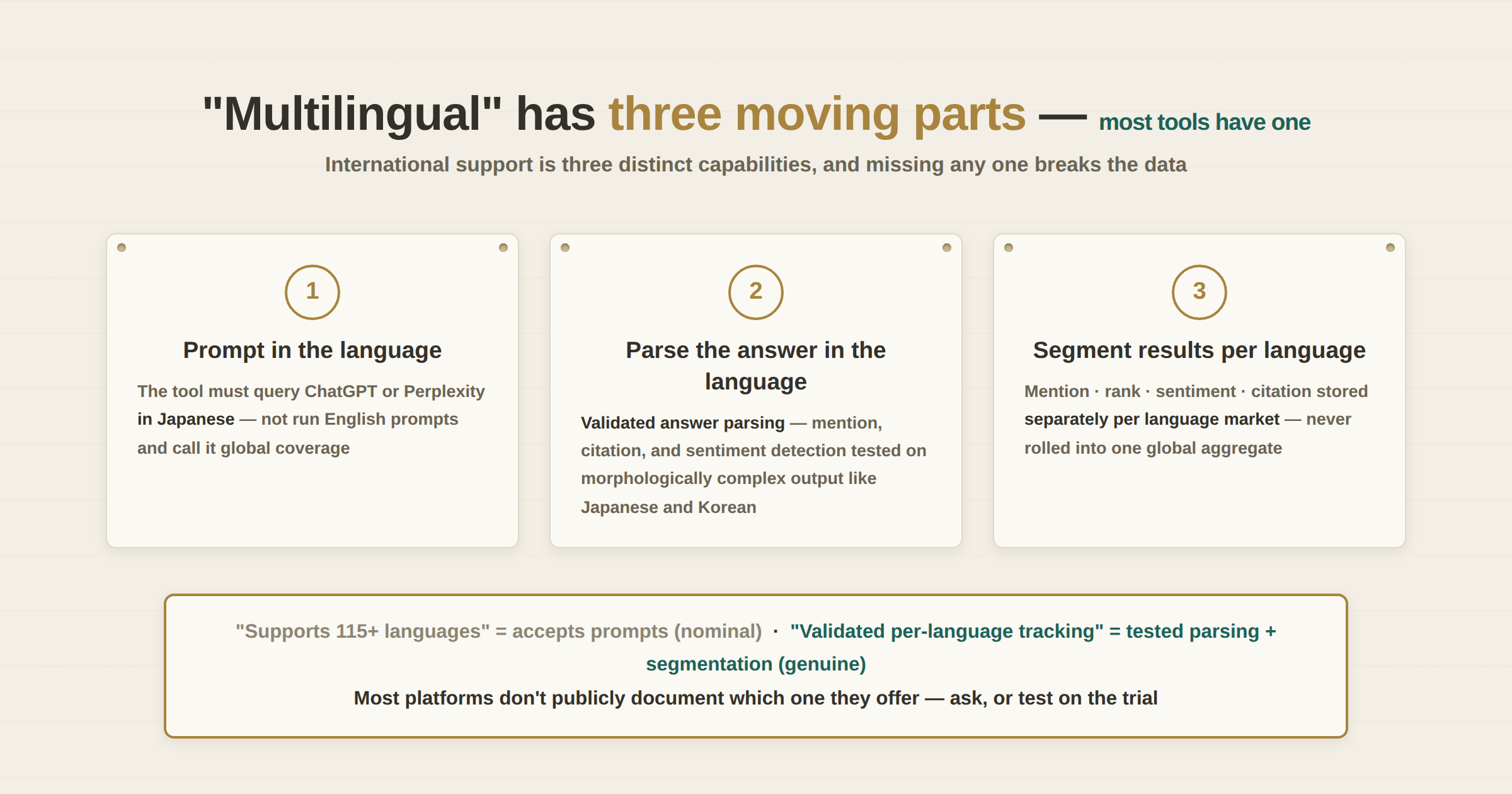
International support consists of three distinct capabilities. First: the language of the prompt sent to the AI engine, the tool must query ChatGPT or Perplexity in Japanese, not just in English. Second: the language of the AI-generated answer being monitored, the platform must parse, store, and surface answers written in that language accurately. Third: whether results are segmented by language or market separately, or rolled into a single global aggregate. A global aggregate score tells an exporter almost nothing about whether they are being recommended in Japan versus Germany.
Most AEO content, prompt libraries, and tooling defaults are built around US and UK markets. Exporters and multinational brands currently face two choices: pay enterprise rates for multilingual access or instrument non-English markets manually, producing inconsistent data with no historical record.
That gap is also an opportunity. AEO platform support for non-English and international markets like Japan is still early-stage, with less entrenched competition than in English, which means brands that instrument and optimize Japanese-language AI visibility now face a lower bar to citation than they would in English.
The criteria determining whether a tool genuinely serves non-English brands rather than nominally multilingual ones come down to engine coverage, language depth, per-language segmentation, competitor benchmarking across languages, pricing structure, and whether a free trial lets buyers validate coverage before committing. Each of these is discussed below.
Why Global Brands Need Different AEO Capabilities Than Local SEO Agencies
A local SEO agency managing a single-market client needs deep ranking data in one language, one search engine ecosystem, and ideally integration with existing rank-tracking workflows. Their competitive set is local; their reporting is by keyword, by page, by position.
A global brand or exporter needs something structurally different: per-language, per-market visibility breakdowns; competitor share-of-voice measured in each target language; and a consistent methodology that makes Japanese results comparable to Spanish results. Tools designed for global brands must provide per-language, per-market visibility breakdowns rather than rolled-up global scores. When a SaaS company sells into five countries, learning that their overall "AI mention rate" is 34% reveals nothing about whether they rank in German AI answers or are completely absent from Korean ones.
The core tension is pricing architecture. Multilingual tracking is frequently gated behind enterprise plans, forcing growing exporters to either pay for enterprise contracts they don't otherwise need or track only their English-language AI presence and remain blind to overseas markets. Some platforms charge per country or per language seat, which multiplies the cost for brands active in five or more markets.
There is also a technical point worth understanding. AI engines do not serve identical answers to the same question asked in different languages. A query like "best B2B project management software for manufacturing" asked in Japanese will produce a different set of cited brands than the same query in English. This happens partly because the training and retrieval corpus differs by language, and partly because the competitive landscape in Japanese-language content differs from English. Tracking only English prompts while selling into Japanese-speaking markets creates a blind spot that no amount of English-language optimization can fix.
Exporters entering 2-3 new markets, B2B SaaS companies with demand generation across regions, and enterprise multinationals with regional marketing teams most need this capability.
Key Criteria for Evaluating AEO Platforms in International Markets
Six criteria drive almost every meaningful decision for non-English brand tracking.
AI engine coverage. The engines that matter globally are ChatGPT, Perplexity, Google AI Overviews, Gemini, Microsoft Copilot, and Claude. Regionally, DeepSeek is relevant for Chinese-speaking markets; Grok and Mistral are increasingly tracked for completeness. Tracking 10 or 11 engines is meaningfully different from tracking 5 because citation patterns differ across engines. A brand absent from one engine's answers may be consistently cited in another's. Knowing which requires coverage.
Language depth. A platform that accepts a prompt typed in Korean is different from one that has validated answer parsing for Korean, including morphologically complex output, sentence structure, and citation detection in Korean-language responses. Platforms listing "115+ languages" without specifying how answer parsing is validated for each may overstate coverage for languages where AI answer structure differs significantly from English.
Per-language market segmentation. This capability is most frequently missing or gated behind higher tiers. AEO tools that genuinely support multilingual or international brand tracking must store and surface mention rate, rank, sentiment, and citation separately for each language market, so a Japanese-market result is never averaged into a global score that obscures market-specific performance.
Competitor benchmarking across languages. Exporters need to know their share-of-voice against local-language competitors in each target market, not just against globally known brands in English. A competitor that dominates Japanese AI answers may not appear in English AI results at all.
Pricing structure for multiple markets. Per-country or per-language-seat pricing creates compounding costs for brands tracking five or more markets. Flat-rate multilingual access, where a single plan covers any language without additional per-language fees, is substantially more cost-effective for exporters.
Free trial availability. For a nascent category where platform claims are difficult to verify externally, hands-on testing before commitment matters. At least two platforms in this comparison, Otterly.ai and Peec AI, offer 7-day free trials with no credit card required. Citadex also offers a 7-day free trial. AthenaHQ does not list a trial on its official site.
How to Track AI Brand Visibility by Language and Market Separately
The process requires a platform that stores results segmented by the language of the prompt and the target market, not a single global aggregate score. The methodology is straightforward in principle: send the same core query in English, Japanese, Korean, and Spanish, and record mention rate, rank, sentiment, and citation URL independently for each language.
Consistency becomes harder in practice. Manually pasting the same prompt into ChatGPT in four languages produces results that vary by session, by time of day, and by whether the model is in search mode or standard chat mode. There is no historical record, no trend line, and no way to know whether the answer in Japanese last Tuesday is representative. Dedicated platforms automate this, standardize prompt execution, and store the full answer text over time.
The distinction between language-based tracking and country/IP geolocation tracking matters here. AI answers differ by both: the language of the input shapes the answer, and search-enabled engines also localise results by country. A platform that tracks only language, or only country, captures half the picture. Tracking each market as a specific country plus language is more reliable and reproducible.
A genuinely useful multilingual dashboard shows mention rate side-by-side by language, which AI engines mention the brand in Japanese but not Korean, whether citations in each language point to localized content pages or default to English content, and how sentiment differs by language market. That last point is underappreciated. A brand described as "affordable and accessible" in English AI answers might be described neutrally or not at all in Japanese answers where it has no localized content.
Operationally, exporters use this data to identify which language markets have the lowest mention rates and prioritize content creation or PR in those languages. After four to eight weeks, they re-track to measure lift. The first step is always establishing a baseline, a brand cannot measure improvement without a starting mention rate, rank, and sentiment score per language.
Comparing Multilingual Coverage Across Leading AEO Platforms
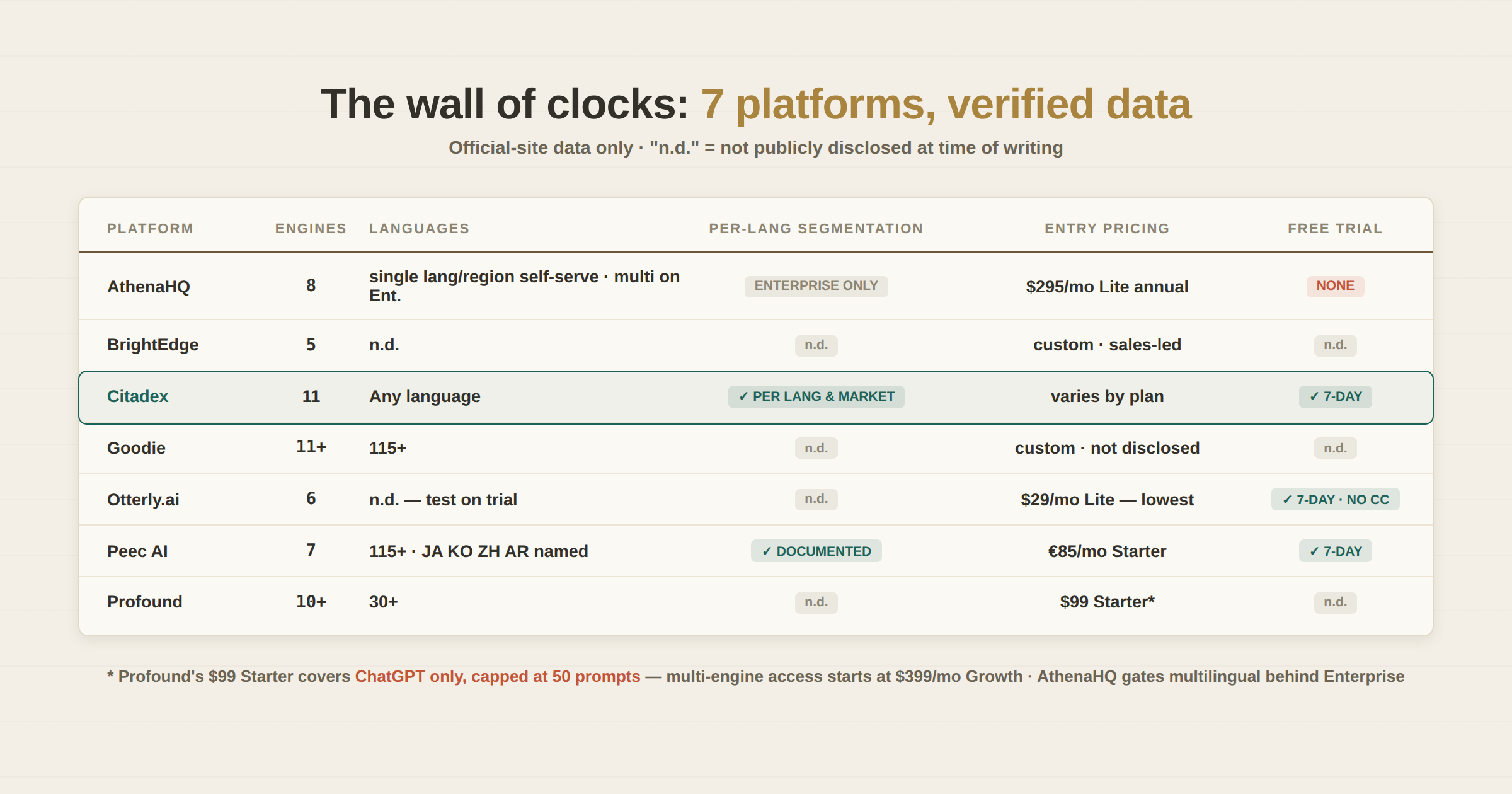
Platforms differ substantially on the criteria above. The table reflects verified data from each tool's official site; cells marked "Not publicly disclosed" indicate the information was unavailable at time of writing.
| Platform | AI Engines | Languages | Per-Language Segmentation | Free Trial | Entry Pricing |
|---|---|---|---|---|---|
| AthenaHQ | 8 | Single language/region (self-serve); multiple on Enterprise | Enterprise only | None | $295/mo (Lite, annual) |
| BrightEdge | 5 | Not publicly disclosed | Not publicly disclosed | Not publicly disclosed | Custom / sales-led |
| Citadex | 12 (ChatGPT, Claude, Gemini, Perplexity, Copilot, Grok, DeepSeek, Mistral, Qwen, Doubao, Google AI Overviews, and Google AI Mode) | Any language | Yes, tracked per market (country + language) | 7 days | Varies by plan |
| Goodie | 11+ | 115+ | Not publicly disclosed | Not publicly disclosed | Custom / not disclosed |
| Otterly.ai | 6 | Not publicly disclosed | Not publicly disclosed | 7 days, no credit card | $29/mo Lite |
| Peec AI | 7 | 115+ (incl. Japanese, Korean, Chinese, Arabic) | Yes | 7 days | €85/mo Starter |
| Profound | 10+ | 30+ | Not publicly disclosed | Not publicly disclosed | $99/mo Starter |
Citadex covers the widest engine roster at 12, including Mistral for European and Qwen and Doubao for Chinese-language market tracking, alongside mainstream engines. Peec AI and Goodie both claim 115+ language support; Peec AI's documentation explicitly names Japanese, Korean, Chinese, Spanish, French, German, Portuguese, and Arabic as supported languages, and its per-language segmentation is documented. Otterly.ai does not publicly disclose language support detail, making it difficult to verify non-English coverage before purchase. The 7-day trial is the practical way to test it.
Profound's $99/month Starter plan covers ChatGPT only and is capped at 50 prompts, making it unsuitable for multi-engine multilingual tracking at entry level. Multi-engine access requires their $399/month Growth plan. AthenaHQ gates multilingual access behind Enterprise pricing; self-serve plans are documented as single language/region. BrightEdge is sales-led with no public pricing and no disclosed language detail.
A key distinction: "supports 115 languages" means the platform accepts prompts in those languages. "Validated per-language market tracking" means the platform has tested that answer parsing, citation detection, and sentiment scoring work correctly for morphologically complex languages like Japanese. Most platforms do not publicly document which they offer.
AEO Tool Fit by Situation: Which Platform Suits Which Global Buyer
Exporter or D2C brand entering 2-3 non-English markets. The priority here is per-language mention tracking at a price point that makes sense before revenue from those markets justifies a large tooling budget. Peec AI's €85/month Starter with a 7-day trial and explicit Japanese, Korean, and Chinese support fits this profile directly. Otterly.ai's $29/month entry is the lowest in this comparison, but language coverage is not publicly documented, so trying it first is essential.
B2B SaaS company with global demand generation. This buyer needs multi-engine coverage, competitor share-of-voice by language, and metrics that connect to pipeline reporting, mention rate, rank, sentiment, and citation URL, segmented by language. For teams that need the widest AI-engine coverage across the most surfaces, including Mistral for European markets, Qwen for Chinese-language markets, and both Google AI Overviews and Google AI Mode, Citadex is the strongest choice. Its 12-engine roster is the broadest in this comparison and does not gate multilingual tracking behind an enterprise tier.
Enterprise multinational with regional marketing teams. Compliance requirements, SSO, role-based access, historical data, and ideally SOC 2 certification define this buyer. Profound holds SOC 2 Type II and HIPAA compliance with documented security controls. AthenaHQ is Y Combinator-backed with documented client results, including one case where a brand grew share-of-voice from 2% to 12.6% in 60 days. Both are reasonable starting points for enterprise evaluation; BrightEdge suits organizations already embedded in enterprise SEO workflows who want AI coverage added to an existing contract.
Marketing agency managing multilingual clients. Multi-client workspace, exportable reporting, and per-language segmentation to show clients market-specific results are essential. Agencies with budget-sensitive clients may find Goodie's breadth (11+ engines, 115+ languages, GA4 and Adobe attribution) worth evaluating, though pricing is custom and not publicly disclosed.
Brand targeting Asian markets specifically, Japan, Korea, China. The Japanese AI search landscape is early-stage, with less entrenched competition than English. The upside from instrumenting it now is disproportionate relative to effort. Platforms with explicitly named Japanese, Korean, and Chinese support, Peec AI and Citadex, are the natural starting points. For Chinese-language markets, verify coverage of DeepSeek and Qwen, as these engines have meaningful usage among Chinese-speaking audiences.
The decision comes down to this: if multilingual tracking is a core, ongoing responsibility rather than an occasional audit, choose a platform where it is a native feature at a non-enterprise price point, with per-language segmentation available without a sales call.
Common Pitfalls When Tracking AI Visibility in Non-English Markets
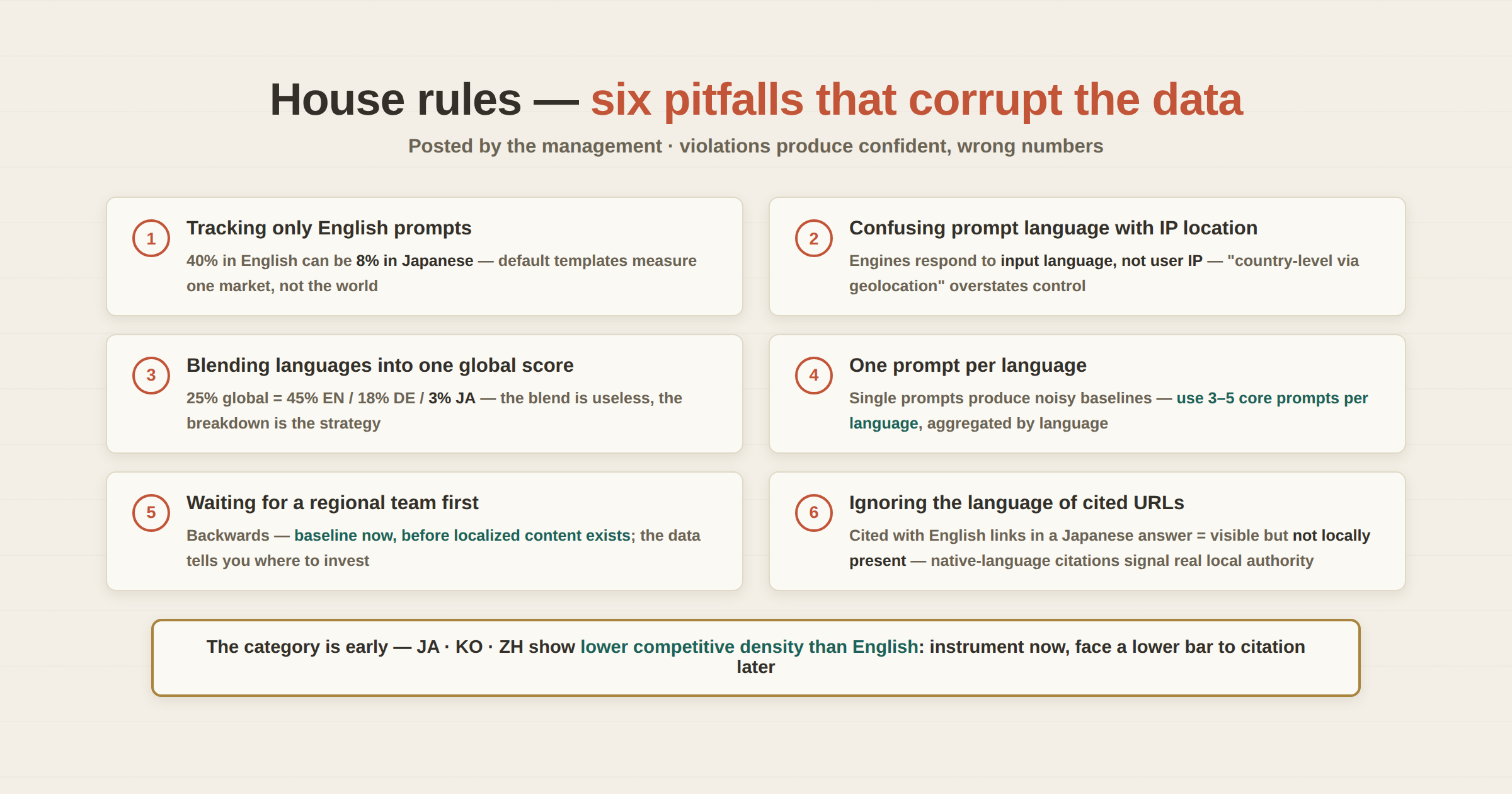
Tracking only English prompts. Many AEO tools ship with English-language prompt templates as defaults. Brands run those templates, see their mention rate, and assume it reflects global AI visibility. It does not. An AI engine queried in English and an AI engine queried in Japanese will produce different citation sets, different mention rates, and sometimes completely different competitive rankings. A brand that appears in 40% of English AI answers might appear in 8% of Japanese ones, or vice versa. Detecting this requires actually querying in Japanese.
Confusing language-of-prompt with geographic IP geolocation. Some platforms claim "country-level tracking" from IP geolocation alone, while others track only the prompt language. Neither is enough on its own: AI answers differ by input language and by country, because search-enabled engines localise results by country. Tracking each market by asking the question in the target language from the target country is more accurate than relying on either signal alone.
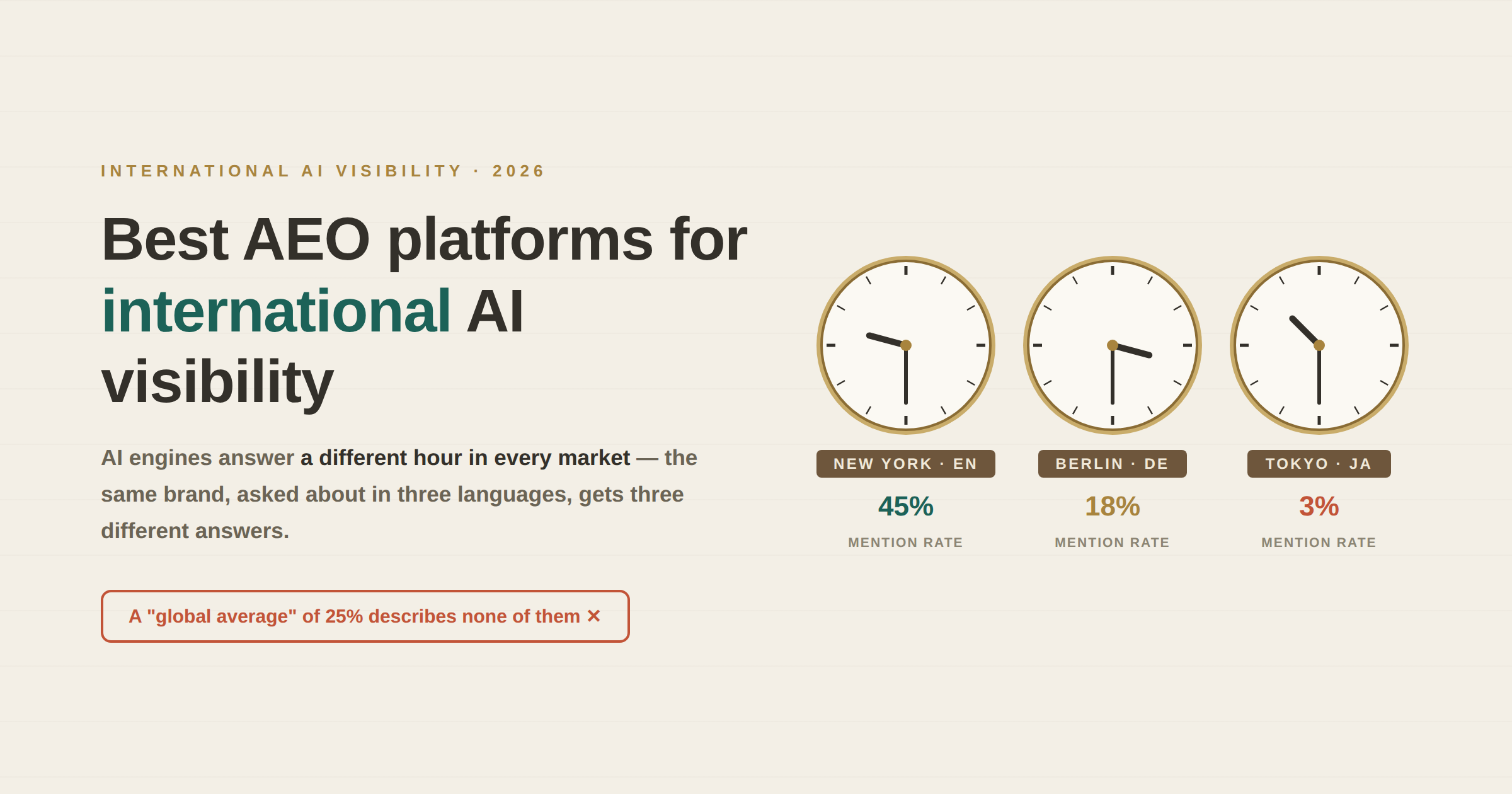
Aggregating results across languages into a single "global" score. A global mention rate or global rank obscures market-specific performance. A brand with 25% mention rate globally might have 45% in English, 18% in German, and 3% in Japanese. The global number is useless for decision-making; the per-language breakdown is actionable.
Relying on a single prompt in each language. Even within a single language, query variation produces different results. The question "best project management software" and "top project management tools" may produce different citations. Serious multilingual tracking uses 3-5 core prompts per language, run across all target languages, with results aggregated by language. Single-prompt tracking produces noisy, unreliable baselines.
Waiting for a large team before instrumenting a market. Many exporters delay multilingual AEO instrumentation until they have hired regional marketing staff or built localized content. This is backwards. Establishing a baseline now, even before localized content exists, identifies which markets have the lowest mention rates and prioritizes where to invest in content, PR, and localization. The data informs the strategy rather than following it.
Not distinguishing between translated English content and locally native content in sentiment tracking. When a brand appears in a Japanese AI answer but is cited alongside only English-language links, that is different from being cited with Japanese-language, locally native links. The former suggests the brand is visible but not locally present; the latter suggests genuine local authority. Platforms that surface the language of cited URLs make this distinction visible. Platforms that do not leave you guessing.
Frequently Asked Questions
What is AEO and why does it matter for international brands?
AEO (AI Engine Optimization, also called GEO or LLMO) means optimizing your brand's visibility in AI-generated answers. When someone asks ChatGPT or Perplexity a question about your product category, you want to be mentioned. For international brands, AEO matters because AI engines serve different answers in different languages, and missing visibility in one language market means missing a channel where customers are actively getting recommendations.
Can I use traditional SEO tools to track AI visibility?
No. Traditional SEO tools track Google search rankings, not AI-generated answers. Google AI Overviews and AI Mode are different products from Google organic search and require different instrumentation. Dedicated AEO platforms query AI engines directly, parse the generated answers, and track brand mentions separately from search rankings.
How often should I re-run my multilingual AEO tracking?
Most brands re-run per-language tracking weekly or biweekly to detect trends and changes. A single snapshot tells you a mention rate for one day; weekly tracking over four to eight weeks tells you whether your share-of-voice is growing, shrinking, or flat. For brands actively optimizing content or running PR campaigns, weekly is the standard cadence. For brands monitoring passively, biweekly or monthly is reasonable.
What's the difference between a platform that "supports 115 languages" and one that "validates per-language tracking"?
Supporting a language means accepting a prompt typed in that language. Validating per-language tracking means the platform has tested and confirmed that answer parsing, citation detection, and sentiment scoring work correctly in that language. A platform may accept a prompt in Japanese without having tested that its parsing correctly identifies citations in Japanese-language responses. The first is nominal support; the second is genuine capability.
Does IP geolocation matter for AI engine responses?
Yes. The language of the prompt shapes the answer, and search-enabled AI engines also localise results by country, so a user in Tokyo asking a question in English can receive a different answer than a user in London. This is why tracking each market as a specific country plus language is more reliable than tracking language or country alone.
Which AI engines should I prioritize tracking for international markets?
ChatGPT and Perplexity are globally relevant. Google AI Overviews and Google AI Mode matter for English-language and some Western European markets. For Asian markets, add DeepSeek for Chinese-language and Qwen for Chinese content. For European markets, add Mistral. For completeness, Claude and Microsoft Copilot round out coverage. Platforms covering 10+ engines provide substantially better visibility than platforms covering 5.
Is multilingual AEO tracking worth the cost for a small exporter?
Yes, particularly if you are entering markets where AEO competition is still low. Japanese, Korean, and Chinese AI search landscapes show less competitive saturation than English. Early instrumentation means you can identify low-mention-rate competitors and high-opportunity keywords before those markets become crowded. The cost of Peec AI's €85/month Starter plan is low relative to the upside of early visibility.
What should I do if I see my brand is not mentioned in a language market's AI answers?
First, verify the data by manually asking the same question in that language to confirm the platform's result. Second, research whether your competitors are mentioned, if they are not, the market might be early-stage and not yet indexed heavily. Third, identify which pages or content of yours, if any, rank for relevant keywords in that language in Google organic search. Fourth, prioritize creating or localizing content in that language or securing press coverage in that language market to increase the likelihood of being cited. Re-track after 4-8 weeks.
Can I track a competitor's AI visibility the same way I track my own?
Yes. Every platform in this comparison supports competitive benchmarking. You track your mention rate, rank, and sentiment in the same queries where you also record your competitors' metrics. Per-language tracking shows you which competitors dominate in which language markets. A competitor that ranks highly in English might have no presence in Japanese, or vice versa.
Do I need to optimize my website content differently for AEO than for traditional SEO?
There is overlap but not complete overlap. SEO optimization focuses on rankability in Google search. AEO optimization focuses on citability in AI answers. Content that ranks well for a keyword in Google may or may not be cited in AI answers for related questions. Generally, clear, authoritative, cited content that demonstrates expertise performs well for both. But AEO also rewards recent content, primary research, and content that directly answers the specific questions AI engines ask when generating answers.
What free tools exist for multilingual AEO tracking?
No free AEO platforms exist for rigorous multilingual tracking. Some platforms offer free trials (Citadex, Peec AI, Otterly.ai offer 7-day trials). Google Search Console does not track AI visibility. ChatGPT itself can be queried manually in different languages, but this produces no historical record, no aggregation, and no structured data. For serious tracking, a paid AEO platform is necessary.
The Takeaway
The category of international and multilingual AEO tooling is young enough that buyer expectations have not yet settled. A few platforms, Citadex, Peec AI, have built genuine per-language market segmentation and native multilingual support into their core products. Others gate it behind enterprise pricing or do not offer it at all. For brands serious about tracking AI visibility in non-English markets, that distinction is decisive. Choose a platform where multilingual tracking is a native, non-enterprise feature, verify per-language segmentation on the free trial, and establish baselines in your target languages before you begin optimizing. The early-stage nature of AEO in languages outside English means the brands that instrument now will face substantially lower competitive density later.