Key takeaways:
- Agencies need AI visibility tools that support multi-brand workspaces, repeatable reporting, and clear client-ready recommendations in one platform.
- No mainstream SEO audit tool currently integrates AI visibility natively alongside technical SEO; agencies typically run a separate AEO platform.
- The right tool depends on client volume, engine coverage, and whether you need white-label reports or deep prompt-level analytics.
- Mid-size agency, 5-20 clients, AEO as a dedicated service line. Citadex's agency plan fits this case well.
AI visibility reporting has become a concrete service-line question for agencies in 2026. Clients are asking why they don't appear when buyers ask ChatGPT or Perplexity for a recommendation in their category, and agencies need platforms that can track, report, and act on that question at scale across multiple brands. This article compares the four platforms agencies most commonly evaluate for this work: Citadex, Otterly.AI, Peec AI, and Profound. Each is examined on the criteria that actually matter for multi-client workflows: workspace structure, engine coverage, prompt management, reporting outputs, and cost at scale.
What Agencies Actually Need From an AI Visibility Reporting Tool
The starting question isn't "which tool has the most engines" but "which tool produces outputs a client can understand and act on, at the volume an agency operates."
Four requirements distinguish agency-grade AI visibility tools from single-brand monitoring products.
Multi-client workspace structure. Agencies manage brands that must stay completely isolated from each other: separate prompt sets, separate competitive landscapes, separate billing lines. A tool requiring separate logins per client or leaking data between accounts isn't workable at scale. The workspace model matters as much as the feature set.
Prompt management at scale. A single client might need 30-80 tracked prompts across category queries, comparison queries, and branded queries. Multiply that by 15 clients and bulk-add, categorize, and pause capabilities become essential. Agencies also need to distinguish between brand-name queries, where the client expects to appear, and category or use-case queries, where the real opportunity and the real gap tend to live.
Reporting formats clients can actually use. Raw mention counts don't land in a client meeting. What does: "Are we being recommended, or just mentioned? Are our competitors cited more than us? Which pages does the AI pull from, and are ours among them?" Tools that export structured reports with these distinctions built in save hours of manual assembly per client per month.
Recommendation or fix guidance. Tracking is table stakes. Agencies selling AEO as a managed service need a platform that tells them and their clients what to change, not just what the current state is. Content gap identification tied to citation sources offers the most concrete version of this.
There's also an integration gap worth naming plainly. Traditional SEO audit workflows are built around crawl health, rank tracking, and backlink data. AI engines don't expose rank positions in the same way search engines do, so the KPIs differ: mention rate, recommendation rate, sentiment trend, citation source distribution. No major SEO audit platform currently surfaces these as native KPIs inside a single client report. In practice, agencies export AI visibility data from a dedicated AEO platform and drop it manually into their broader audit decks or monthly reports. That friction isn't going away soon, so tool selection right now is about finding the best standalone AEO platform to run alongside the existing SEO stack.
The Core Platforms Agencies Are Using to Report AI Visibility in 2026
The platforms agencies most commonly evaluate for AI visibility reporting are Citadex, Otterly.AI, Peec AI, and Profound. They differ significantly in depth, engine coverage, pricing structure, and how explicitly they're built for multi-client use.
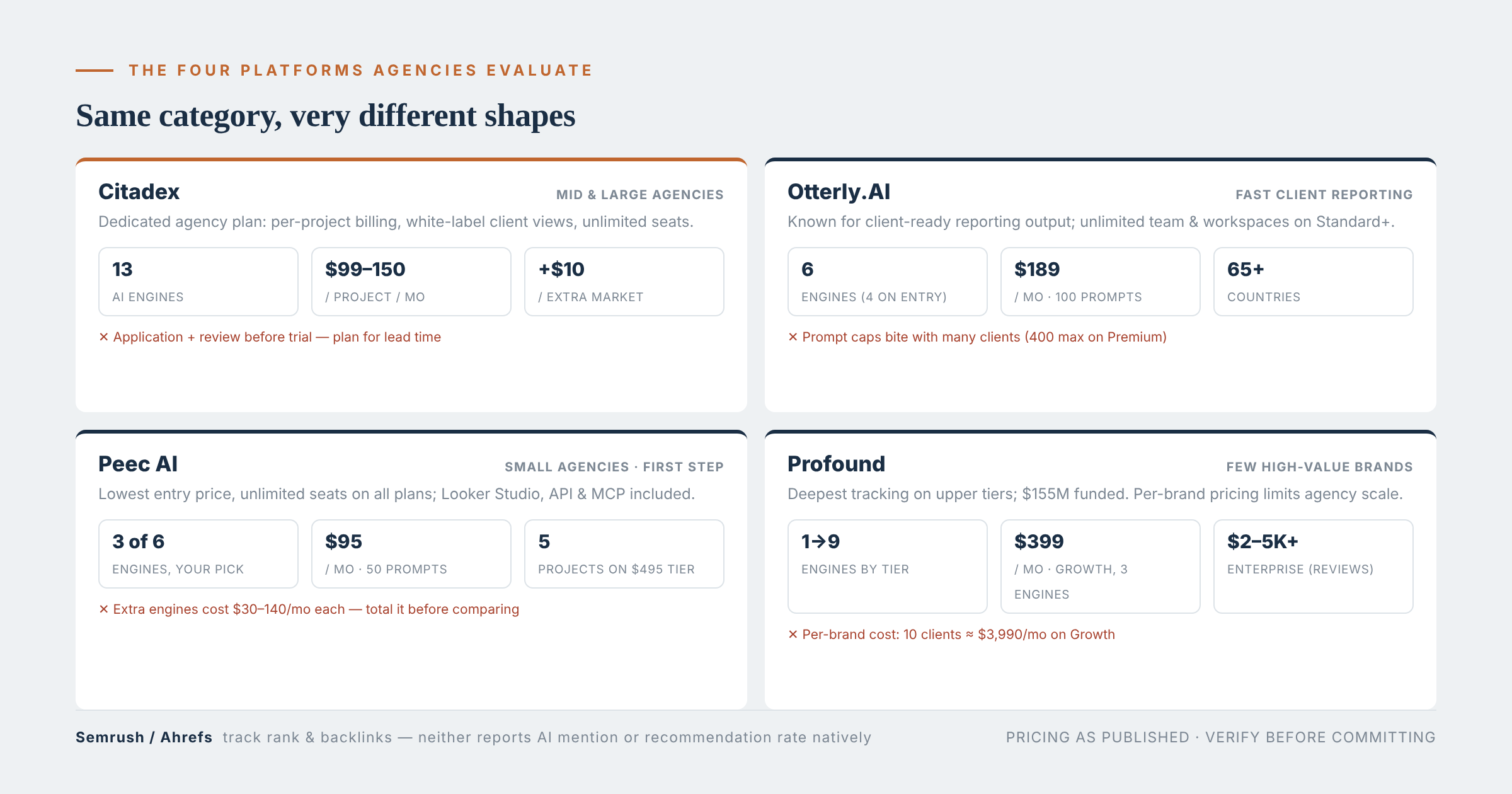
Citadex is built with an explicit agency plan: per-project billing, white-label client views, and 13 AI engines in a single account. It's positioned as a managed-service infrastructure tool, not just a monitoring dashboard.
Otterly.AI covers 6 engines and has built a reputation for actionable, client-ready reporting output. Practitioners consistently describe it as one of the more practical choices for agencies that prioritize speed to insight over maximum data depth.
Peec AI sits at a lower entry price point and supports multi-project structures on its higher tiers. It's a practical first step for smaller agencies or those testing AEO as a service line before committing to a full platform investment.
Profound is the most funded platform in this space ($155M, per public records) and excels for teams that need deep, in-brand tracking with detailed analytics. Its per-brand pricing model makes it expensive to scale across many client accounts.
Two tools that come up in agency searches belong in a different category: Semrush and Ahrefs. Both are core to agency SEO stacks for technical audits, rank tracking, and backlink analysis. Neither currently measures AI mention rate or recommendation rate as a native KPI inside client reports. Agencies looking to those products for AI visibility will need to add a dedicated AEO platform.
Citadex for Agencies: Multi-Project Workspaces and Prompt-Level Tracking
Citadex offers a dedicated agency plan with per-project billing, unlimited team seats, and coverage across 13 AI engines, built specifically for managing multiple client brands from a single account.
The agency plan structure is worth understanding before trialing. Onboarding requires an application rather than self-serve checkout; the Citadex team reviews and approves accounts before access is granted. Once approved, agencies receive a Not publicly disclosed trial that includes one project with up to three markets. Ongoing pricing runs Not publicly disclosed/project/month on a monthly basis, or Not publicly disclosed/project/month on an annual plan. Each project covers one market by default; additional markets are Not publicly disclosed/month each.
Prompt-level tracking includes several features that matter specifically for agency reporting. Citadex distinguishes between "mentioned" and "recommended" at the prompt level, a meaningful distinction for client communication: an AI engine naming a brand in passing differs from recommending it. Repeated sampling runs the same prompt multiple times per engine to produce more stable results, available on Business and agency plans. Full answer history is stored, allowing agencies to show clients how AI responses have changed over time. Citation source tracking identifies which pages AI engines pull from when answering a query and flags competitor pages cited while the client's aren't.
The AI Marketing Agent handles multi-step operational tasks with a confirmation step before execution. An agency team member can instruct it to "add 20 prompts, run detection, generate a monthly report" in a single instruction, and it will queue the steps, complete the detection, then generate the report and notify the team. Every action is logged with timestamp and confirming user, which supports client approval workflows.
Content generation (Answer Assets) produces articles in comparison, list, guide, and FAQ formats for prompts where the client isn't being recommended. Generated content routes through an approval step before publishing to connected CMS platforms including WordPress, Shopify, Webflow, Ghost, or a Citadex-hosted blog. For agencies managing content alongside visibility monitoring, that one-click publish path reduces production friction.
Every Monday the platform delivers a pre-built weekly summary: last week's performance, this week's priority tasks, and a list of suggested actions pending one-click confirmation.
One real limitation: the application-and-review process means agencies can't start immediately. Teams that need same-day access to trial a platform should factor in this onboarding lead time.
Otterly.AI for Agencies: Actionable Reporting and Ease of Use
Otterly.AI covers Not publicly disclosed platforms: ChatGPT, Google AI Overviews, Google AI Mode, Gemini, Microsoft Copilot, and Perplexity. All plans include access to 4 of the 6, with the full 6 available on higher tiers. Monitoring supports all languages; the dashboard is English-only.
For agencies, the relevant structural features are unlimited team members and workspaces on Standard and above, a public API, and support for 65+ countries. Standard starts at Not publicly disclosed/month for 100 prompts; Premium at Not publicly disclosed/month for 400 prompts. A Not publicly disclosed free trial is available.
The reporting reputation is the clearest reason agencies consider Otterly.AI. Practitioners and comparative reviews consistently describe its outputs as more directly usable for client-facing reporting than deeper analytics tools. For agencies that need to get a new client up and running and produce a first report quickly, that combination of fast setup and usable output matters.
One honest limitation: at 100 prompts on the entry plan, agencies managing multiple clients with 30-50 prompts each will hit prompt limits quickly. At scale, prompt volume constraints require careful management across the client portfolio, and the 400-prompt cap on Premium may require tradeoffs about which clients get tracked at what depth.
Profound for Agencies: Deep Tracking at a Higher Per-Brand Cost
Profound is the most thoroughly funded platform in this category with Not publicly disclosed in funding and offers the strongest option for teams that need maximum data depth on a small number of high-value brands. The cost structure creates real friction at agency scale.
Pricing, as published in public review sources: Starter at Not publicly disclosed/month tracks ChatGPT only and includes 50 prompts and 1 seat. Growth at Not publicly disclosed/month adds Perplexity and Google AI Overviews (3 engines total), 100 prompts, and 3 seats. Enterprise is custom pricing, estimated in public reviews at $2,000-5,000+/month. Profound offers a free trial on the Growth tier. Verify current pricing directly at Profound's official site before making commitments.
The cost scaling arithmetic is the central agency-specific issue. At $399/month per brand for 3 engines, an agency with 10 active clients faces $3,990/month before any enterprise negotiation. That per-brand model works well for an in-house team or an agency with a small roster of high-retainer clients. It doesn't scale cleanly to a broader client base.
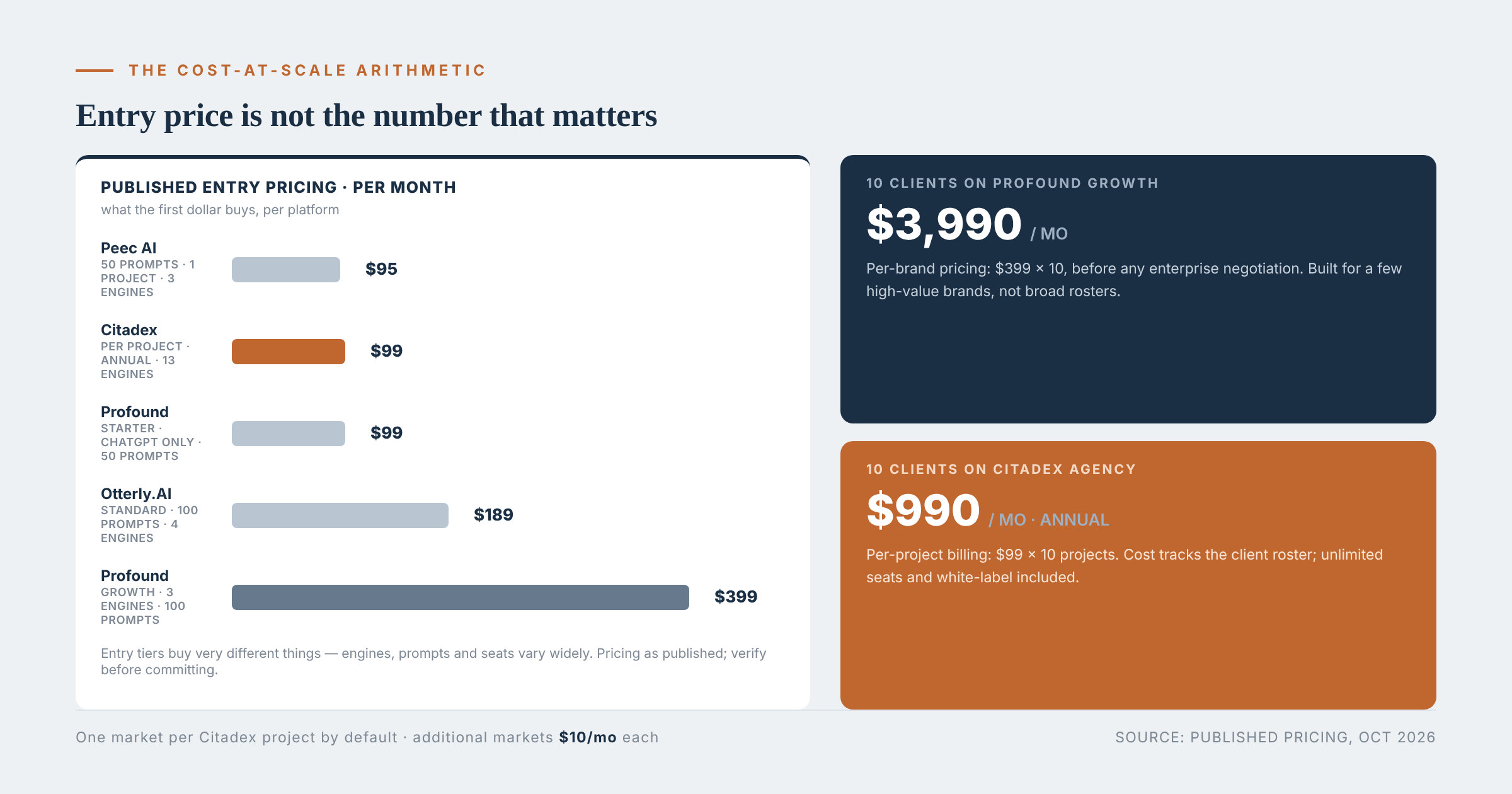
Engine coverage scales with tier: Starter covers only ChatGPT, Growth adds Perplexity and Google AI Overviews, and Enterprise reaches up to 9 engines. That tiered engine model means clients on the entry plan get a materially narrower view than those on Growth or Enterprise, which complicates standardized reporting across a mixed client portfolio.
Where Profound genuinely excels is the depth and quality of tracking on its upper tiers. For agencies with one or two flagship clients that justify the investment, or for in-house enterprise teams, it's the strongest choice for detailed visibility data. Its weakness for agency work isn't the product; it's the pricing architecture.
Peec AI for Agencies: What to Know
Peec AI's entry point is Not publicly disclosed/month for 50 prompts and 1 project, with Pro at $245/month (150 prompts, 2 projects) and Advanced at $495/month (350 prompts, 5 projects). Enterprise pricing is custom. A 7-day free trial is available. All plans include unlimited seats, which removes one common agency cost escalator.
Engine coverage works differently from most competitors: rather than a fixed roster, each plan grants access to 3 engines chosen from ChatGPT, Google AI Mode, Google AI Overviews, Microsoft Copilot, Perplexity, and Gemini. Additional engines cost $30-140/month depending on tier. The dashboard is in English; prompts support all languages. API and MCP integration are included, as is Looker Studio reporting for agencies that already use Looker for client dashboards.
For smaller agencies or those testing AEO as a new service line, Peec AI's lower entry price and unlimited-seat model is genuinely practical. The multi-project structure on Advanced (5 projects at $495/month) offers a usable agency footprint without the commitment of a larger platform.
The honest gap: the 3-engine default is narrower than what Citadex or Otterly.AI provide at comparable price points, and adding engines incrementally increases cost in ways that require careful planning. Agencies that need comprehensive engine coverage from day one should run the numbers on total cost including add-ons before comparing against platforms with broader standard coverage.
Semrush, Ahrefs, and SE Ranking are built for traditional SEO audits and rank tracking. They don't currently measure AI mention rate or recommendation rate as native KPIs in client reports. For AI visibility specifically, a dedicated AEO platform is a separate addition to that stack.
How to Choose: Matching Tool to Agency Type and Client Volume
Three variables drive the decision: the number of active client brands, the engine depth required, and whether the agency needs white-label outputs or approval-gated workflows.
Small agency, under 5 clients, generalist SEO practice. Start with Otterly.AI or Peec AI. Otterly.AI's reporting is faster to client-ready; Peec AI's lower entry price is easier to absorb while proving the service line. Accept that engine depth will be narrower than larger platforms, and plan for prompt volume limits across your client roster. Neither requires an application process.
Mid-size agency, 5-20 clients, AEO as a dedicated service line. Citadex's agency plan fits this case well. Per-project billing keeps cost predictable as the client roster grows, unlimited team seats remove a recurring cost concern, and the white-label client view means each client sees only their own data under the agency's branding. Factor in the application process: plan for the approval lead time before a new business pitch that depends on the platform being live.
Large agency or consultancy, 20+ clients or enterprise retainers. Evaluate Citadex's agency plan or Profound Enterprise. At this scale, per-project billing economics and contract terms matter more than feature comparisons. Profound Enterprise is worth evaluating for agencies with a small number of high-value clients needing maximum data depth; Citadex's per-project agency pricing scales with the number of clients, which suits broader rosters.
Agency that wants AI visibility inside a single audit report alongside technical SEO. No tool today integrates both natively. The practical workaround is exporting AI visibility KPIs from an AEO platform and including them manually in a broader audit deck or client report. Choose the AEO platform based on the criteria above, and treat the data merge as a manual step until the market produces native integration.
Decision checklist before committing:
- How many client brands will be active in the first 90 days, and how many in 12 months?
- Which AI engines do your clients' buyers actually use in their category?
- Do clients require white-labeled reports with agency branding?
- Does the workflow require client approval before changes go live?
- Does the agency also need to produce content, not just track visibility?
- Is prompt volume by client predictable, or highly variable?
Common Pitfalls Agencies Hit When Setting Up AI Visibility Reporting
The most common mistakes aren't technical; they're framing errors that produce misleading client reports and make it harder to show value over time.
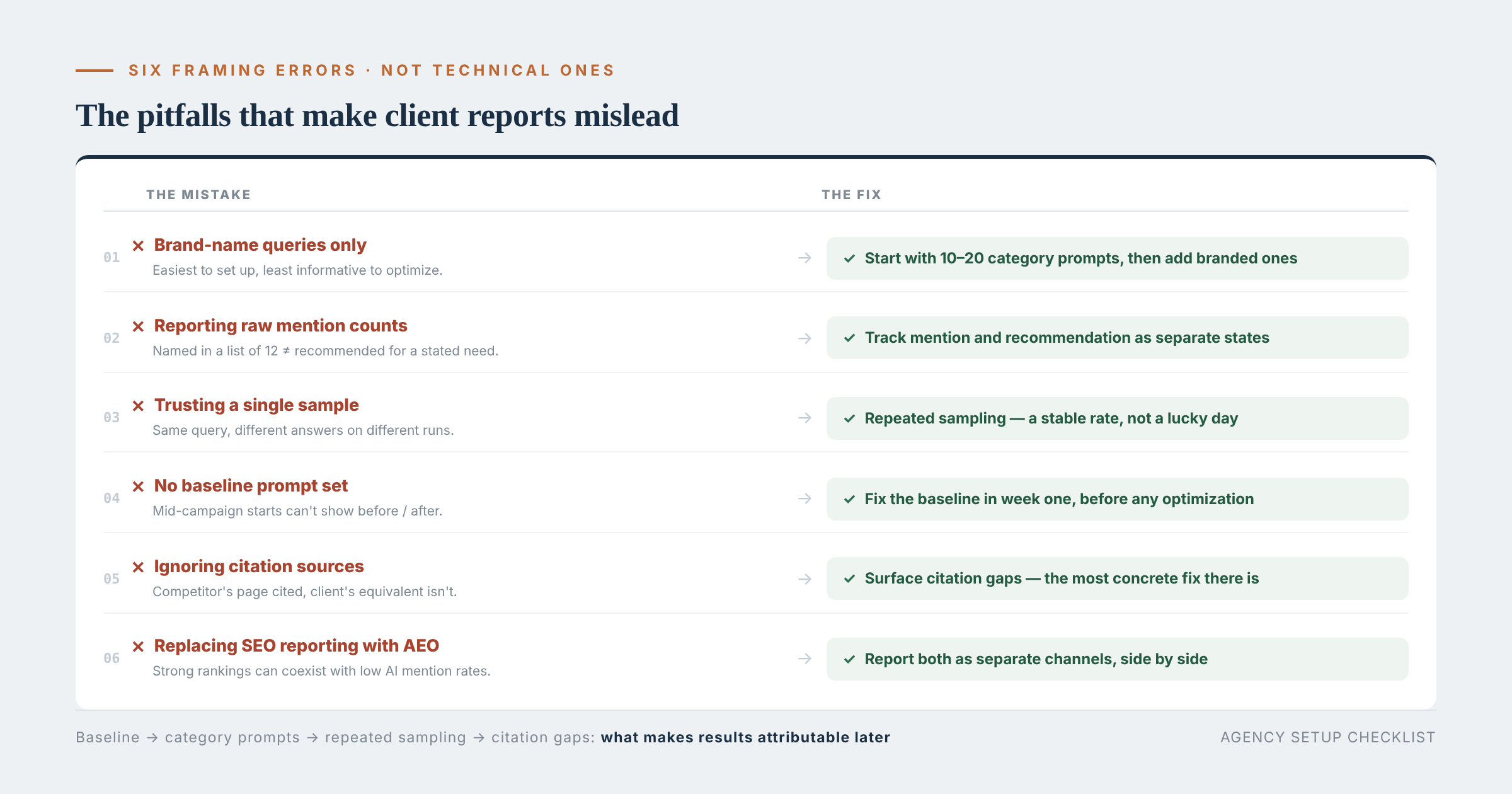
Starting with brand-name queries only. Brand queries are the easiest to set up and the least informative for optimization. Category and use-case queries deliver more value: "What CRM should a 50-person B2B company use?" or "Which email deliverability tool do experts recommend?" These are the queries where a client should appear but often doesn't, and where content changes can actually move the needle. Start with 10-20 category prompts before adding branded ones.
Reporting mention counts without the mention/recommendation distinction. An AI engine including a brand name in a list of 12 options without any recommendation signal differs significantly from an engine specifically recommending that brand for a stated need. Agencies that report raw mention rates without this distinction set unrealistic client expectations. Use tools that track recommendation state separately from simple mention.
Single-sample instability. AI engines return different answers to the same query on different runs. A snapshot taken on one day may not reflect the consistent state of the model's outputs. Reporting a single data point as definitive misleads clients about where they actually stand. Repeated sampling across multiple runs produces a stable rate; without it, a good day looks like progress and a bad day looks like regression.
No baseline prompt set. Agencies that begin tracking mid-campaign can't show before/after improvement. Establish the baseline prompt set in week one of any engagement, even before any optimization work begins. The baseline is what makes results attributable later.
Ignoring citation sources. AI answers cite specific pages. If a competitor's blog post or comparison page is regularly cited and the client's equivalent page isn't, that's an actionable content gap with a clear fix. Agencies that don't surface citation data for clients miss the highest-value optimization insight the tool provides.
Treating AEO reporting as a replacement for traditional SEO reporting. AI visibility and organic rank measure different signals. A client can have strong organic rankings and low AI mention rates, or the inverse. Client reports should present both as separate channels, not substitute one for the other. Framing AI visibility as an addition to the reporting suite also sets more accurate expectations about what optimization in each channel can deliver.
FAQ: Agency AI Visibility Reporting, Common Questions Answered
Q: What is the difference between AEO and GEO, and does my agency need to care about both?
AEO (Answer Engine Optimization) refers specifically to optimizing for AI-generated answer engines: ChatGPT, Perplexity, Google's AI Overviews and AI Mode. GEO (Generative Engine Optimization) is the broader discipline of optimizing content for generative AI outputs across any surface, including AI-assisted writing tools and co-pilots. In practice the two terms are often used interchangeably, but the distinction matters for scope. AEO has a specific measurable KPI: does the brand appear in AI-generated answers? GEO is a broader content strategy. Agencies selling a concrete reporting deliverable are usually working in AEO terms.
Q: Can I track ChatGPT mentions for a client without paying for a tool?
Manually querying ChatGPT is possible but not scalable for client work. A manual approach can't store historical answer text, run repeated samples to smooth out variability, track dozens of prompts simultaneously, or compare results across multiple AI engines. For occasional exploratory checks, manual querying works fine. For anything resembling a recurring client deliverable, a dedicated platform is required.
Q: Which AI engines should agencies prioritize tracking for clients?
ChatGPT, Perplexity, and Google AI Overviews represent the largest share of AI-answer interactions for most B2B and consumer categories in 2026. Google AI Mode is increasingly relevant for search-intent queries. Claude and Gemini matter for specific verticals and buyer demographics. Start with ChatGPT and Perplexity as a baseline for almost any client, add Google AI Overviews for clients with significant organic search presence, then prioritize additional engines based on where the client's buyers actually spend time.
Q: How long before a client sees measurable improvement in AI visibility after optimization?
Most platforms and practitioners point to a 4-12 week window as a realistic range for content changes to be picked up and reflected in AI-generated answers. The actual timeline depends on the engine, how frequently it retrieves and indexes new content, and the type of change made. Structural changes to high-authority pages tend to move faster than new content published on lower-authority domains. Set client expectations at 8 weeks for early signal.
Q: Are AI visibility tools different from SEO audit tools like Semrush or Ahrefs?
Yes. Semrush and Ahrefs are built to track organic search rankings, backlink profiles, and technical site health. They do not currently measure whether a brand appears in AI-generated answers or track mention rate, recommendation rate, or citation source distribution across AI engines. AI visibility tools are a separate product category built specifically for generative answer surfaces. Most agency stacks in 2026 run both: an SEO platform for traditional search and a dedicated AEO platform for AI visibility.
Q: Do these tools work for non-English clients?
Support varies by platform. Citadex supports multiple markets and languages and allows per-market tracking, including non-English-language markets. Otterly.AI supports monitoring in all languages across 65+ countries, with an English-only dashboard. Peec AI supports all languages for prompts, with an English dashboard. Profound does not publicly disclose language coverage. Before committing to any platform for a non-English client, verify whether the tool can run prompts in the target language and whether the reporting outputs are interpretable without a translated dashboard.