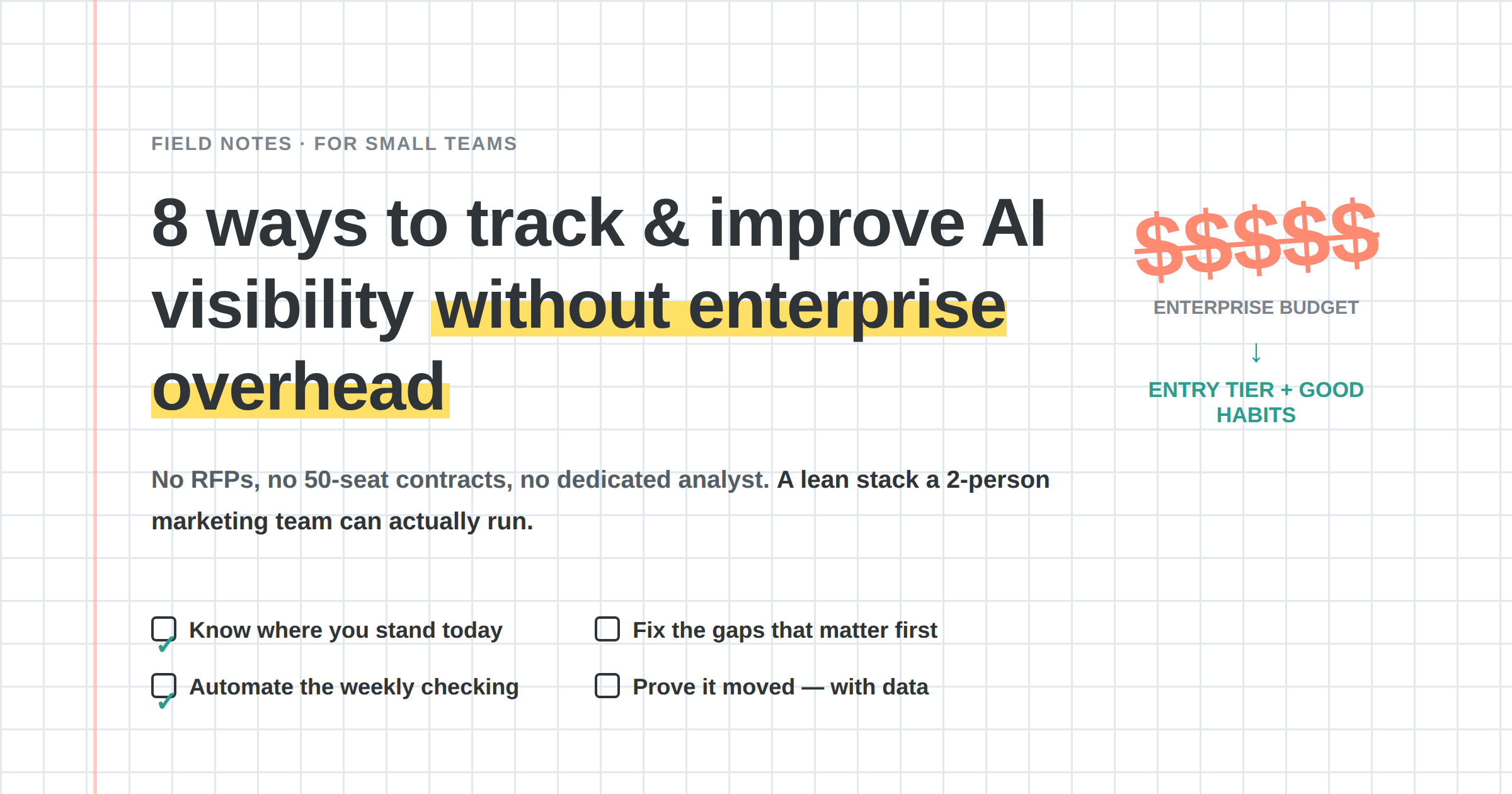
8 Ways Small Teams Can Track and Improve AI Visibility Without Enterprise Overhead
Key takeaways:
- Automated AEO platforms eliminate the manual query work that makes AI visibility tracking unsustainable for lean teams.
- The most useful tools for small brands track mention rate, average rank, sentiment, and citation presence, not just raw traffic.
- Small teams should prioritize breadth of AI engine coverage and language support over flashy dashboards that require a dedicated analyst.
AI visibility tracking is the practice of monitoring where and how a brand appears in answers generated by AI engines such as ChatGPT, Perplexity, Claude, and Gemini, based on what those engines can retrieve and cite at answer time, not on what they were trained on. For a lean marketing team or solo founder, that distinction matters: you cannot influence training data, but you can shape the content that AI engines pull and surface right now. The question is which approach fits a small team's bandwidth and budget.
Below is a curated set of eight options, from fully automated platforms to lightweight manual workflows. Each is suited to a different combination of team size, budget, and ambition. Each entry covers what it is, who it fits best, one standout characteristic, and one honest trade-off.
1. Dedicated AEO Platforms with Autopilot Features
What it is: Purpose-built platforms designed specifically to track brand mentions across multiple AI engines, score content for citation readiness, and surface optimization recommendations, all without manual query runs.
Best for: Startups or small in-house teams that need ongoing monitoring across several AI engines and cannot spare hours each week on manual checks.
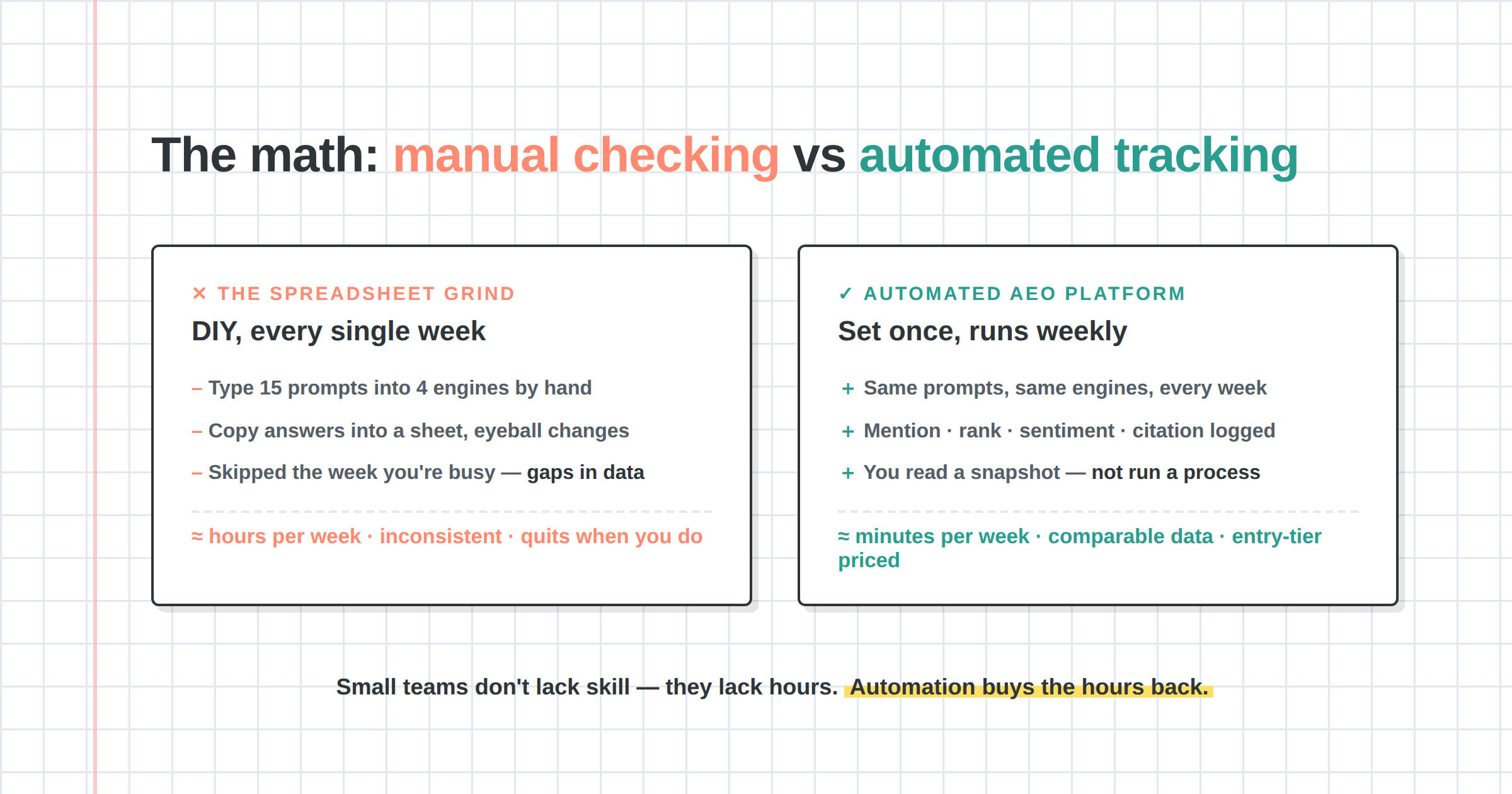
Standout feature: The best of these track four distinct signals per prompt: mention rate (whether the brand appears at all), average rank (how prominently), sentiment, and citation (whether a source URL is included). Citadex, for example, tracks all four signals automatically in whatever language your buyers use, across up to eleven AI engines: core engines like ChatGPT, Gemini, Perplexity, Claude, Microsoft Copilot, Grok, and Google AI Overviews, plus optional add-ons like DeepSeek, Mistral, Qwen, and Google AI Mode (coverage varies by plan).
Trade-off: Dedicated platforms carry a subscription cost. They are the right call when ongoing monitoring is needed; for a one-time audit, the price-per-insight ratio is less favorable.
2. Manual Query Sampling with a Shared Spreadsheet
What it is: A structured approach where one team member runs a fixed set of buyer-journey prompts directly in ChatGPT, Perplexity, and Gemini on a weekly or bi-weekly cadence, then logs results (mentioned / not mentioned, rank, URL cited) in a shared document.
Best for: Founders or solo marketers testing AI visibility for the first time, or brands in a single language market with fewer than ten priority prompts.
Standout feature: Zero tool cost. The discipline comes from the prompt list itself: keeping twenty to thirty consistent prompts that mirror real buyer questions ("what's the best [category] tool for [use case]?") produces comparable data week over week.
Trade-off: Does not scale. Across five AI engines and three languages, manual sampling becomes a part-time job. It is a starting point, not a sustainable system for a growing brand.
3. Prompt-Based Competitor Intercept Monitoring
What it is: A focused subset of AEO tracking that zeroes in on the specific queries where competitors are being cited and your brand is not. Rather than tracking every possible prompt, the goal is to find the exact gaps that cost you buyer consideration.
Best for: Small brands with a defined competitive set and limited time. If you know the three or four prompts your buyers actually type, this approach concentrates effort where it matters.
Standout feature: Competitor intercept monitoring surfaces what prompts are giving competitors the citation advantage, which directly informs content creation priority. It answers the question "what should I write next?" more efficiently than broad brand-mention tracking alone.
Trade-off: Narrow scope. If your buyers use prompts you have not thought to monitor, those blind spots stay invisible.
4. AEO Content Scoring Before Publishing
What it is: Running draft content through a deterministic AEO content scorer before it goes live. The scorer evaluates whether the piece answers specific buyer questions, structures information in the formats AI engines prefer to cite, and includes proper source attribution.
Best for: Content marketers at startups who produce a small volume of high-stakes articles (say, two to four pieces per month) and want each one to have the best possible chance of appearing in AI answers.
Standout feature: Unlike post-publish monitoring, pre-publish scoring lets you fix citation-readiness gaps before the content is indexed. A structured FAQ block, a direct definitional sentence, and an explicit mention of the use case can each meaningfully change whether an AI engine chooses to cite the page.
Trade-off: Scoring is only as useful as the human action that follows. A score without editorial follow-through produces no change in visibility.
5. Language-Scoped Tracking for Non-English Markets
What it is: Configuring AI visibility tracking to run prompts and measure answers in the specific language your target buyers use (Japanese, Spanish, German, Korean, Arabic, or others) rather than defaulting to English-only monitoring.
Best for: Small brands with a primary market outside the US or UK, or any business where a large portion of revenue comes from non-English-speaking buyers.
Standout feature: AI engines do not behave identically across languages. A brand that ranks prominently in English ChatGPT answers may be absent from Spanish Perplexity answers entirely. Language-scoped tracking surfaces this asymmetry, which English-only tools miss by design.
Trade-off: Most manual monitoring methods cannot realistically cover multiple languages, because the prompt volume multiplies quickly. This approach is only practical with a platform that handles multi-language tracking natively.
6. Citation-Opportunity Outreach
What it is: Identifying the URLs that AI engines are currently citing when answering prompts relevant to your category, then working to get your brand included on those pages, through contributed content, expert quotes, or structured data additions to high-authority sources.
Best for: Brands whose content is not yet authoritative enough to be cited directly, but who can add value to the sources that are already being cited (industry publications, review aggregators, community wikis).
Standout feature: This approach works with the retrieval logic AI engines actually use. Engines like Perplexity and ChatGPT with search enabled pull from currently indexed, well-sourced pages. Appearing on a page that is already in the citation rotation is often faster than building a new high-authority page from scratch.
Trade-off: Outreach-dependent. Timelines are unpredictable, and placement on third-party sources is never guaranteed.
7. Autopilot AEO Content Generation
What it is: Using a platform that generates AEO-optimized content based on tracked prompt gaps, and can publish it with minimal editorial intervention. The workflow goes from "this prompt is not returning your brand" to "here is a draft structured to change that" in a single step.
Best for: Teams with content gaps identified but without the bandwidth to produce new pieces manually. Particularly useful for startups where the founder or a single marketer owns both strategy and execution.
Standout feature: The content is generated to answer the specific queries where visibility is missing, rather than generic topics. That query-answer alignment is what separates AEO content from standard blog posts, and what makes it more likely to be retrieved and cited when an AI engine processes a matching prompt.
Trade-off: Generated content still benefits from a human review pass. Factual accuracy and brand voice are difficult to automate fully, particularly for technical or regulated categories.
8. Traditional SEO Tools Repurposed for AI Trend Signals
What it is: Using keyword research tools you likely already have, such as Semrush, Ahrefs, or Google Search Console, to identify the question-format queries ("best X for Y", "how does X compare to Y") most likely to trigger Google AI Overview answers.
Best for: Teams where AI monitoring is a secondary priority and the primary goal is maintaining existing SEO performance. This works when a brand's market is primarily English-speaking and AI tracking is an add-on rather than a core workflow.
Standout feature: No additional tool cost. Question-format queries with high search volume and informational intent are strong candidates for Google AI Overviews and similar surfaces. Existing tools surface these without a new subscription.
Trade-off: Traditional SEO tools do not track AI-generated answers directly. They show what queries might matter for AI visibility, but not whether your brand is actually appearing in those answers, or how competitors are performing.
Summary: Which Approach Fits Your Situation?
| Approach | Best for | Budget level | Automation level |
|---|---|---|---|
| Dedicated AEO platform | Ongoing multi-engine tracking | Paid subscription | Fully automated |
| Manual query sampling | First-time audit, single market | Free | Manual |
| Competitor intercept monitoring | Closing specific citation gaps | Varies | Partial |
| Pre-publish AEO content scoring | Small-volume, high-stakes content | Paid or manual | Partial |
| Language-scoped tracking | Non-English primary markets | Paid subscription | Automated |
| Citation-opportunity outreach | Early-stage brand building | Low tool cost | Manual |
| Autopilot content generation | Bandwidth-constrained teams | Paid subscription | Highly automated |
| Traditional SEO repurposing | AI as secondary priority | Existing tool budget | Partial |
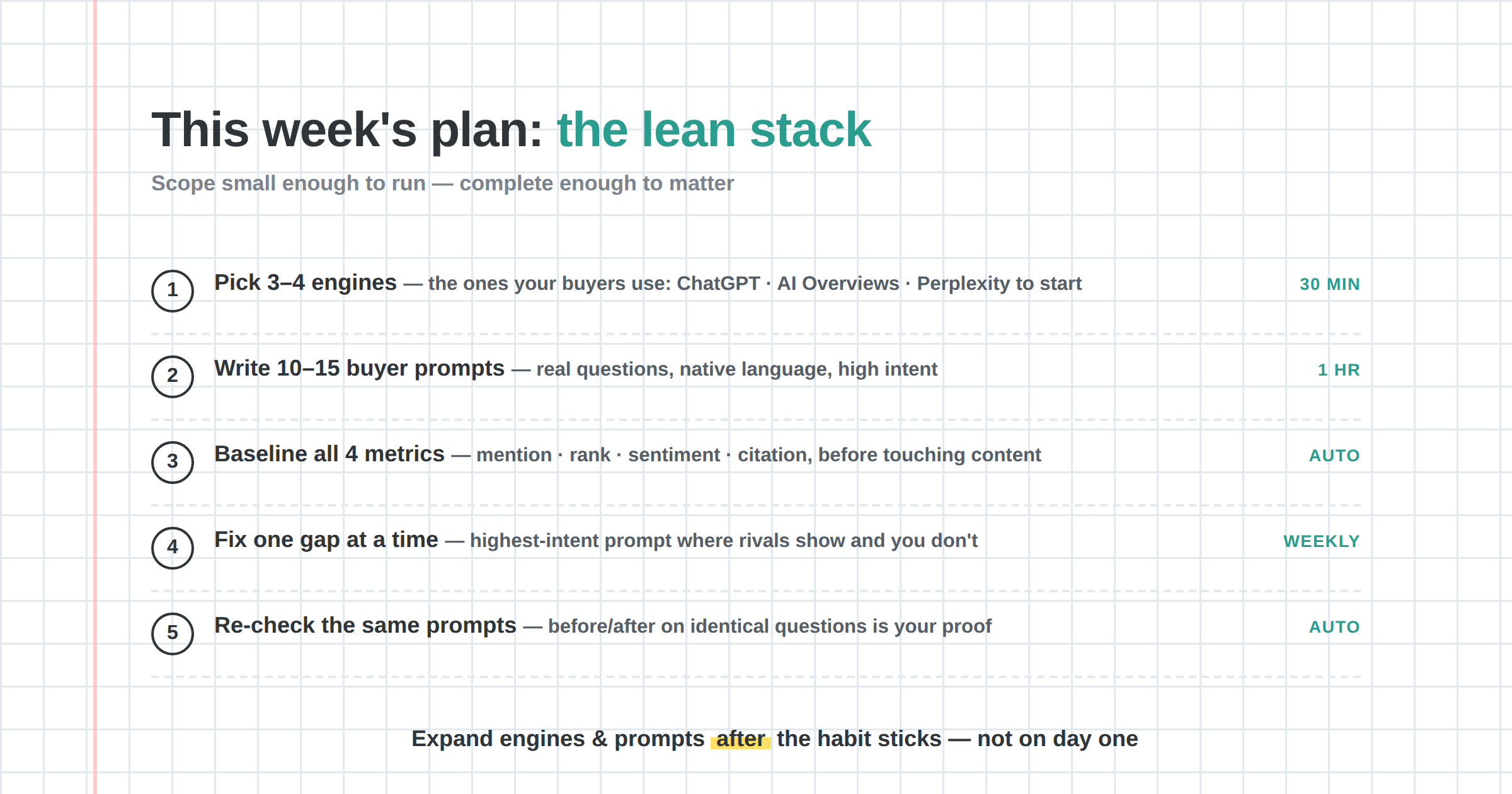
The honest recommendation for most lean teams: start with manual query sampling to understand what prompts matter for your category, then move to a dedicated platform once you have enough prompt volume and language coverage to make manual tracking unworkable. The transition point is typically when you are tracking more than three AI engines or more than one language consistently. Past that point, manual methods break down faster than the tool cost justifies.
The mistake most small teams make is treating AI visibility as a one-time audit. The engines update their retrieval behavior regularly, and a brand that appears prominently in answers today can drop out of rotation within weeks if a better-structured competitor page enters the citation pool. Ongoing tracking, even lightweight and automated, is what separates brands that maintain AI visibility from those that optimize once and wonder why results fade.
Frequently Asked Questions
Q: Is there a low-cost AI search visibility tracker for small businesses?
Yes, dedicated AEO platforms like Citadex offer plans structured for small teams, and manual sampling with a spreadsheet costs nothing. The right choice depends on how many AI engines and languages you need to monitor. For a single market and a handful of prompts, manual methods work. For multi-engine or multi-language coverage, a paid platform becomes cost-effective quickly once you factor in the staff time manual tracking would otherwise consume.
Q: What is the easiest AEO tool for a startup without a dedicated SEO team?
The easiest tools are those that handle query generation, prompt testing, and reporting automatically, so the team sees results without running manual checks. The core features to look for are automated mention tracking, sentiment scoring, and citation detection. Platforms that also flag content gaps and generate optimization suggestions reduce the skill requirement further, since the team does not need to interpret raw data to know what to fix.
Q: How does AI visibility tracking differ from traditional SEO tracking?
Traditional SEO tracking monitors where a page ranks in a search results list. AI visibility tracking monitors whether a brand is mentioned, cited, and ranked within an AI-generated answer, a fundamentally different output. A brand can rank on page one of Google and be absent from ChatGPT answers on the same query, and vice versa. The signals that drive AI citation (structured content, direct answers, authoritative source URLs) overlap with but are not identical to the signals that drive Google rankings.
Q: Which AI engines should a small brand prioritize tracking first?
For most businesses selling to English-language or international B2B buyers, the highest-priority engines are ChatGPT, Google AI Overviews, Gemini, Perplexity, and Microsoft Copilot, which represent the largest share of AI-generated answer traffic. DeepSeek and similar engines become important when buyers are in markets where those tools are dominant. The practical answer: start with the engines your target buyers are most likely to use, then expand coverage as budget allows.
Q: How often should a lean team check its AI visibility?
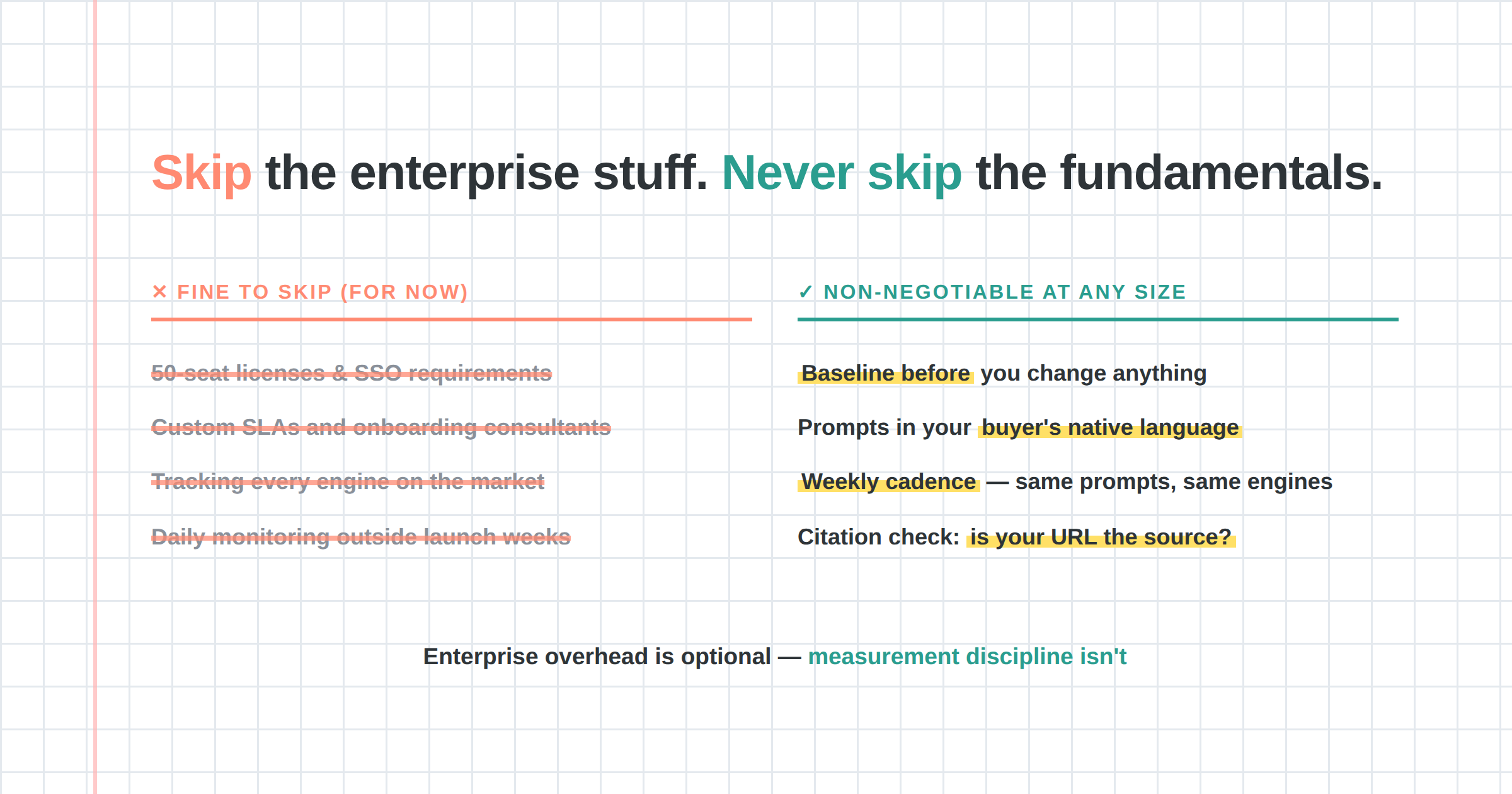
Weekly or bi-weekly monitoring is sufficient for most active brands. Daily tracking adds value during product launches, rebranding periods, or when a competitor has recently published content targeting the same queries. The key is consistency (the same prompts, the same engines, tracked at the same cadence) so trend data is comparable over time rather than a series of unrelated snapshots.
Q: Can a solo founder realistically manage AI visibility without outsourcing it?
Yes, if the prompt set is small and focused. A founder tracking ten to fifteen high-priority buyer-journey prompts across two or three AI engines can do this with a dedicated tool and roughly an hour per week of review time. The bottleneck is usually content creation, since acting on what the tracking reveals takes more time than reading the reports. Autopilot content generation features can close that gap for founders who identify gaps faster than they can write.
Q: What metrics matter most for AI visibility on a small budget?
Mention rate (how often the brand appears in answers to tracked prompts), citation presence (whether a source URL pointing to your content is included), and sentiment (whether the mention is neutral, positive, or negative) are the three most actionable signals. Average rank, how high in the answer your brand appears relative to competitors, adds precision once the basics are covered. Start with mention rate and citation; those two numbers tell you whether the problem is awareness or authority.