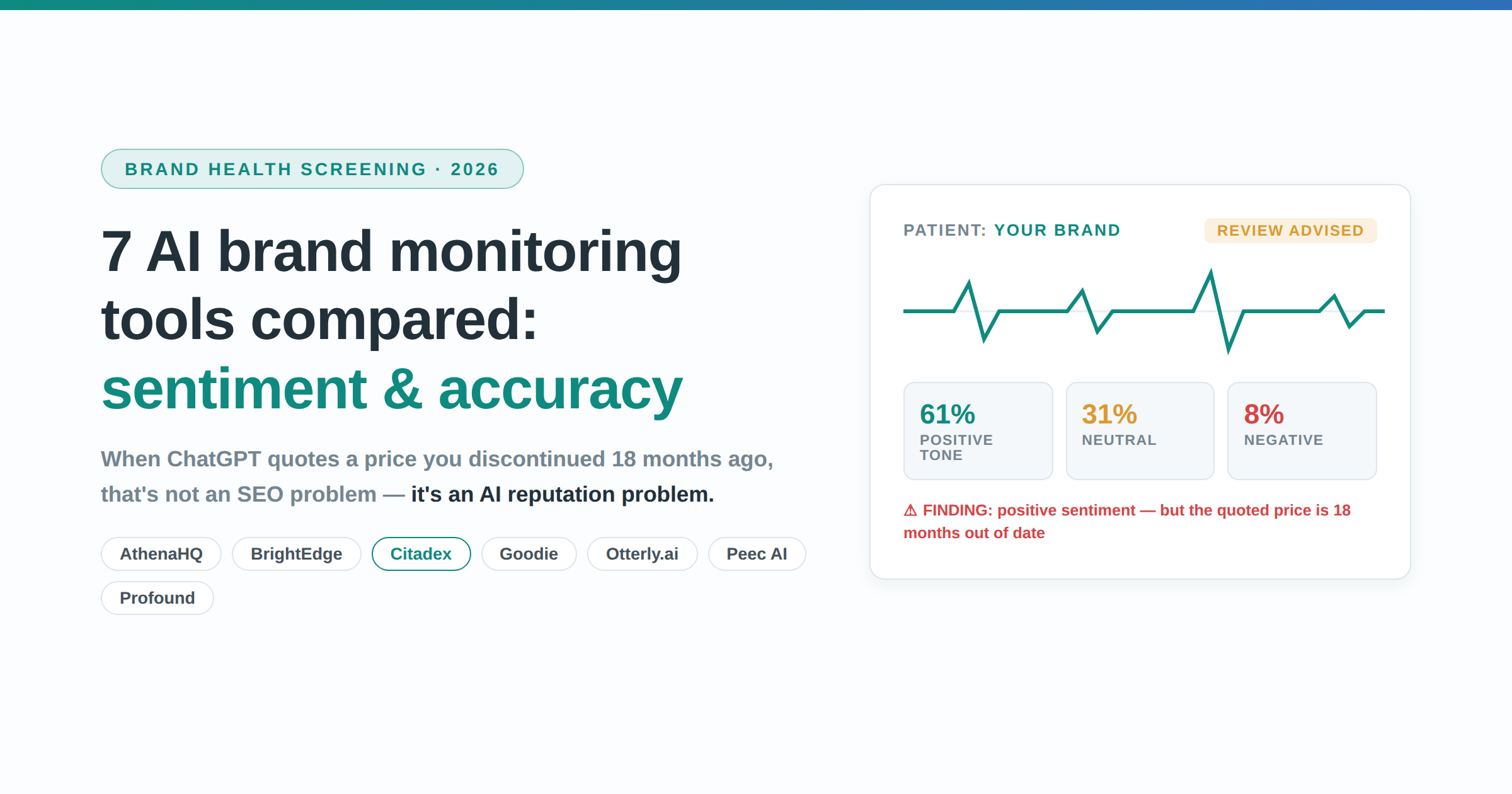
Best Tools to Monitor Brand Reputation, Sentiment, and Accuracy in AI-Generated Answers (2026)
Key takeaways:
- Dedicated AEO platforms track brand sentiment, inaccurate descriptions, and false claims across major AI engines like ChatGPT, Perplexity, and Claude.
- Brand safety monitoring in AI answers requires tools that capture mention rate, sentiment score, citation accuracy, and rank per engine simultaneously.
- PR and marketing teams can receive alerts when AI assistants describe a brand incorrectly, but tool capabilities vary significantly by pricing tier.
This comparison was compiled by Citadex. We are one of the tools listed below. Judge accordingly. More about us at citadex.io/about.
When a buyer asks ChatGPT "is [Brand] good for enterprise use?" and the AI confidently quotes a price that was discontinued eighteen months ago, that is not a search ranking problem. It is an AI reputation problem, and a standard Semrush dashboard will never surface it. AI brand monitoring tools exist specifically to catch that gap: they query AI engines on a scheduled basis, capture the full text of answers about a brand, and analyze those answers for mention rate, sentiment, ranking position, and citation accuracy.
This article covers seven platforms, AthenaHQ, BrightEdge, Citadex, Goodie, Otterly.ai, Peec AI, and Profound, evaluated against criteria directly relevant to PR teams, brand managers, and AEO practitioners who need to know not just whether their brand appears in AI answers, but how it is described.
What AI Brand Monitoring Tools Actually Do: Accuracy, Sentiment, and Reputation Tracking Explained
Three distinct use cases get bundled together under "AI brand monitoring," and conflating them leads to buying the wrong tool.
The first is sentiment tracking: does an AI engine describe a brand in positive, neutral, or negative terms? The second is accuracy and misinformation detection: does the AI state facts that are wrong, outdated, or simply fabricated, a discontinued plan price, an executive who left two years ago, a feature the product never had? The third is reputation and recommendation monitoring: does the AI recommend the brand when a buyer asks for a solution, or does it consistently route buyers toward competitors?
These are distinct failure modes. A brand can have high mention rates while being described inaccurately. It can carry positive sentiment while being ranked third in a list every time, which subtly disadvantages it. And it can have neutral, factually accurate descriptions that nonetheless omit the brand's strongest differentiators.
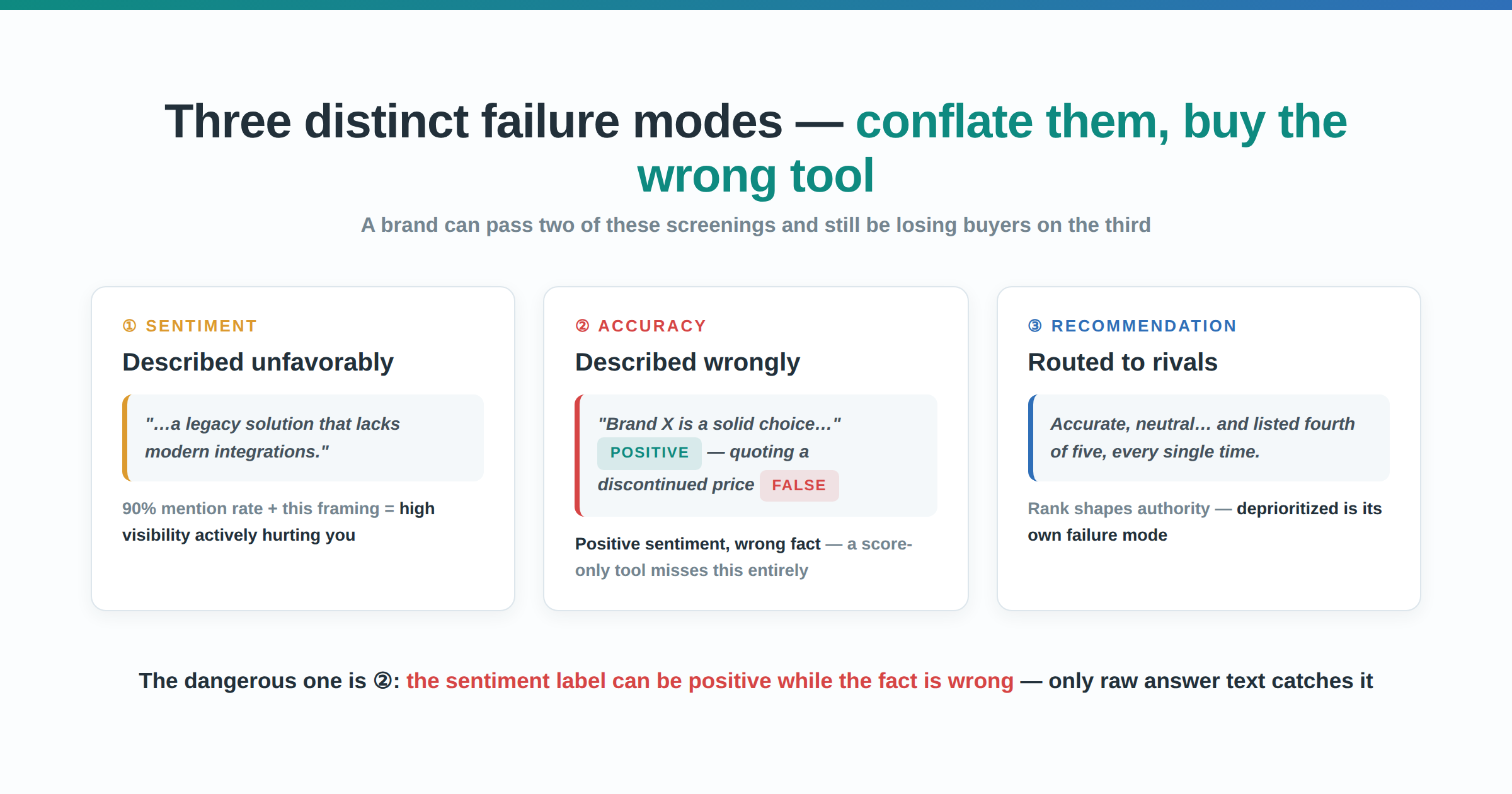
The AI hallucination angle deserves particular attention for PR teams. When an AI engine confidently states an incorrect fact about a brand, wrong pricing, wrong founding date, wrong product capability. That is not negative sentiment. The sentiment label might even be positive ("Brand X is a solid choice for…") while the underlying fact is wrong. Tools that only report a sentiment score without surfacing the raw generated text will miss this entirely.
Traditional SEO tools do not query AI engines or analyze AI-generated text. They track rankings in Google's traditional search results pages. A brand can hold the top three organic positions on Google Search while simultaneously being described inaccurately in AI Overviews, ChatGPT, and Perplexity, surfaces where a growing share of buyers are now receiving brand information before they ever visit a website. These are different retrieval systems, and they require different monitoring infrastructure.
The Core Criteria for Evaluating AI Brand Monitoring Tools
Five criteria separate capable AI brand monitoring tools from basic mention trackers.
Engine coverage is the starting point. The major AI surfaces buyers should expect coverage on include ChatGPT, Google AI Overviews, Google AI Mode, Gemini, Perplexity, Microsoft Copilot, Claude, Grok, and DeepSeek. A tool covering only two or three of these leaves significant blind spots. Perplexity's retrieval-augmented answers often differ markedly from ChatGPT's, and Copilot matters disproportionately for B2B audiences using Microsoft 365 workflows. PR teams that monitor ChatGPT alone are seeing, at best, a partial picture.
Sentiment analysis depth varies more than vendors tend to advertise. Binary positive/negative labels are the floor. What PR teams actually need is per-prompt, per-engine sentiment data: knowing that your brand's sentiment on Perplexity dropped this week, specifically on prompts about enterprise pricing, is actionable. A blended average across all engines and all prompts is not.
Raw answer visibility is arguably the most important feature for accuracy monitoring, and it is where tools diverge most. Does the tool show the full AI-generated text, or only a summary label? Only the full text lets a human reviewer spot a hallucinated price, an outdated product description, or an incorrect executive attribution. Tools that abstract away the underlying answer in favor of clean dashboards make accuracy auditing impossible.
Alert mechanisms matter for PR workflows. Scheduled weekly reports are fine for trend analysis. Alerts triggered when sentiment drops below a threshold, or when a new answer contains a previously unseen claim, are what PR teams need during a product launch or a reputational incident. Ask vendors specifically whether alerts are dashboard-only, email-based, or webhook-compatible.
Language and market support is a hard requirement for international brands. Submitting prompts in English and then translating the results misses how AI engines actually behave in Japanese, Spanish, or French markets, different retrieval sources, different content structures, different answer patterns. The tool needs to submit prompts and capture answers in the target language natively.
Pricing structure and seat access affects PR teams more than solo practitioners. A platform charging per seat at $50-100/month per user quickly becomes expensive for a five-person PR team. Unlimited-seat models at the brand level change that calculus entirely.
How These Tools Flag Inaccurate or False Claims About Your Brand in AI Answers
Most AEO platforms surface the raw AI-generated answer text alongside sentiment and citation data. That is the primary mechanism for detecting inaccurate or false claims about a brand in AI answers, structured visibility into exactly what each AI engine is saying, with human review completing the loop.
The detection workflow typically works like this: the tool submits a prompt ("What does [Brand] charge for its Growth plan?"), captures the full AI response, records any cited source URLs, and stores a timestamped version of that answer. Reviewers then compare the captured text against verified internal facts. When an answer changes, new wording, a different price quoted, a product feature mentioned that no longer exists, the historical record makes that change visible.
Citation verification adds a useful proxy for accuracy risk. When an AI engine cites a source URL in its answer, a monitoring tool that captures that URL can tell you whether the citation points to the brand's own current documentation or to a third-party page, a review site, a press article from 2022, a competitor comparison. That may contain outdated or inaccurate information. If Perplexity is citing a three-year-old TechCrunch piece as its source for your enterprise pricing, that is a meaningful accuracy risk flag even before a reviewer reads the answer.
Historical tracking is underrated as a misinformation safeguard. When a tool stores every answer over time, PR teams can detect the precise moment an AI engine begins asserting something new about the brand. Instead of discovering three months later that AI assistants have been quoting an incorrect feature set, weekly tracking narrows that window to days.
One thing buyers should be clear-eyed about: no current tool automatically verifies factual accuracy against a brand's internal knowledge base in a fully automated way. The workflow is human-assisted. The tool surfaces the answer; a human judges whether it is correct. Vendors who imply otherwise in their marketing are overstating what the technology can do. The value is in structured, scheduled, multi-engine visibility, not in replacing the human review step.
Prompt design also shapes what gets caught. A prompt asking "What is [Brand]?" will surface generic descriptions that rarely contain factual errors. Prompts like "What does [Brand] charge for enterprise?", "Is [Brand] SOC 2 certified?", or "How does [Brand] compare to [Competitor]?" are where misinformation is more likely to appear, and where monitoring pays off.
Sentiment Tracking in AI Answers: What the Metrics Mean and How to Use Them
Sentiment in AI monitoring refers to whether an AI engine's description of a brand carries positive, neutral, or negative framing, measured per prompt, per engine, and over time. The trend line matters more than any single reading.
Mention rate and sentiment are related but distinct. A brand appearing in 90% of relevant AI answers has high visibility. If those answers describe it as "a legacy solution that lacks modern integrations," that high mention rate is actively hurting the brand's reputation with buyers who ask AI assistants for recommendations. Tracking both metrics simultaneously is the minimum viable approach for reputation monitoring.
Rank or position functions as a third reputation signal. When an AI answer lists multiple brands in response to a recommendation query, the order in which they appear shapes perceived authority. A brand consistently listed fourth or fifth in a five-option list is being deprioritized, even if the individual description is positive. Tools that track average rank per prompt, across engines and over time, reveal whether a brand is positioned as a default recommendation or as an afterthought.
For PR teams, sentiment trend breaks are the most actionable output. A sudden sentiment drop across multiple engines on the same day is an early warning signal: something in the brand's retrievable web presence changed, a news article, a Reddit thread, a product review, and AI engines are now incorporating it. Getting that signal in a weekly report rather than discovering it six weeks later through a client complaint is where the monitoring ROI is clearest.
Engine-by-engine sentiment variation is common and often underappreciated. ChatGPT and Perplexity may describe the same brand quite differently because they use different retrieval mechanisms and different generation approaches. A platform that only reports a blended sentiment score obscures this variation. Per-engine breakdowns tell you whether a problem is systemic or specific to one surface, which determines where to focus the content response.
Product-level sentiment tracking extends this further: monitoring sentiment not just for the brand name but for specific products, features, or use cases identifies which offerings AI engines describe favorably and which they frame critically or ignore. That is useful input for product marketing and for prioritizing where to publish corrective content.
Tool-by-Tool Comparison: Capabilities Across the Leading Platforms
This section was compiled by Citadex, one of the platforms listed. The goal is to report publicly available facts for each tool, not to rank them. For a more detailed breakdown by use case, we'll publish individual comparisons at citadex.io/blog.
AthenaHQ
AthenaHQ covers 8 AI engines: ChatGPT, Claude, Perplexity, Google AI Overviews, Google AI Mode, Gemini, Copilot, and Grok. It offers a free Essential tier; the Self-Serve Starter plan is $95/month on annual billing or $295/month on monthly billing, with Enterprise available via custom pricing. AthenaHQ is Y Combinator-backed and positions competitive gap analysis as a core differentiator, identifying where competitors appear in AI answers that a brand does not. Language support is not publicly disclosed. A free trial is available via the free Essential tier.
BrightEdge
BrightEdge is primarily an enterprise SEO platform; AI visibility monitoring is a module within a broader suite rather than a standalone product. Confirmed engine coverage includes Google AI Overviews, ChatGPT, and Perplexity, with the full scope tied to the broader platform. Pricing is custom enterprise, typically requiring direct contact for a quote, positioned for mid-to-large enterprises managing multiple domains. Language support is not publicly disclosed. Free trial availability is not publicly disclosed.
Citadex
Citadex tracks brand visibility across 12 AI engines: ChatGPT, Google AI Overviews, Google AI Mode, Gemini, Perplexity, Microsoft Copilot, Claude, Grok, DeepSeek, Mistral, Qwen, and Doubao. For every tracked prompt on every engine, it records mention rate, average rank, sentiment, and citation (whether the answer included a source URL pointing to the brand's content). Prompts and answer analysis run in any language. A 7-day free trial is available. One limitation: Citadex is a newer entrant compared to platforms like BrightEdge or Profound, with a shorter track record at enterprise scale.
Goodie
Goodie publishes limited public detail on pricing, engine coverage, and feature specifics. Evaluate it directly via the vendor's official site.
Otterly.ai
Otterly.ai covers 6 engines: ChatGPT, Google AI Overviews, Google AI Mode, Perplexity, Gemini, and Microsoft Copilot. Entry pricing is $29/month (Lite tier), the lowest published starting price among platforms in this comparison. It reruns prompts daily and tracks Share of Voice, average brand position, and citation frequency. The platform reports 25,000+ users. Language support is not publicly disclosed. A free trial is available.
Peec AI
Peec AI (Berlin-based) covers 9 engines: ChatGPT, Google AI Mode, Perplexity, Gemini, Claude, DeepSeek, Microsoft Copilot, Llama, and Grok. It offers entity-level monitoring, tracking products and features, not just the brand name, alongside sentiment scored on a 0–100 scale and source attribution tracking. Starting price is €89/month with unlimited seats at all tiers, which benefits PR teams needing multi-user access. Language support is not publicly disclosed.
Profound
Profound covers 12+ AI engines (the full list is not publicly published; confirmed coverage includes ChatGPT, Claude, Perplexity, Google AI Overviews, and Gemini). The Growth plan is $399/month; Enterprise ranges from $2,000–$5,000+/month with annual billing. Notable features include the Profound Index (ranking data drawn from 400M+ conversations) and Agent Analytics for AI crawler monitoring. Profound is SOC 2 Type II certified and has raised $155M in total funding, including a $96M Series D in February 2026 at a reported $1B valuation. Language support is not publicly disclosed.
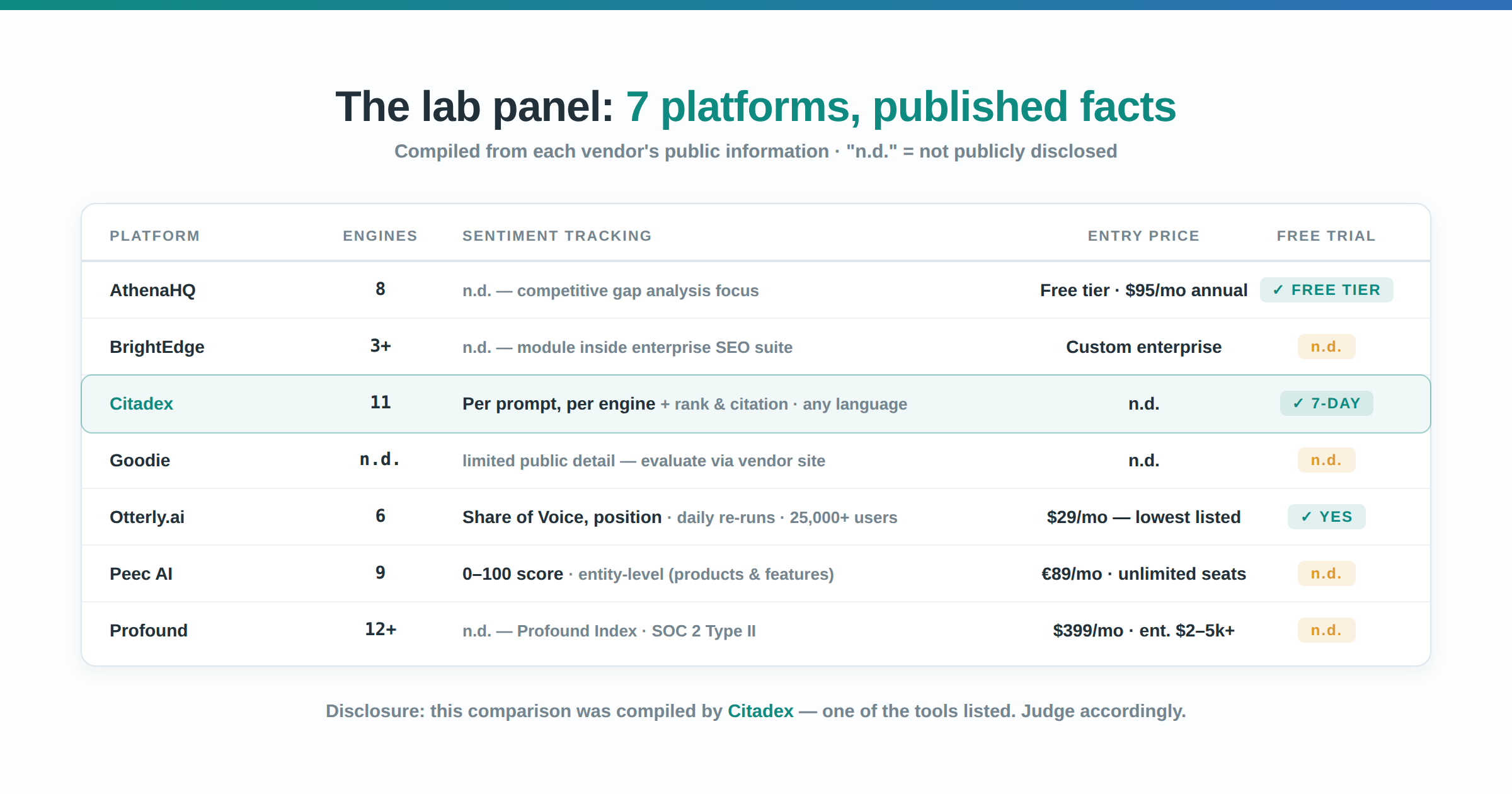
Summary Comparison Table
| Platform | Engines Covered | Sentiment Tracking | Raw Answer Visibility | Alert Feature | Languages | Entry Price | Free Trial |
|---|---|---|---|---|---|---|---|
| AthenaHQ | 8 | Not publicly disclosed | Not publicly disclosed | Not publicly disclosed | Not publicly disclosed | Free tier; $95/mo (annual) | Yes (free tier) |
| BrightEdge | 3+ (module) | Not publicly disclosed | Not publicly disclosed | Not publicly disclosed | Not publicly disclosed | Custom enterprise | Not publicly disclosed |
| Citadex | 12 | Yes, per prompt, per engine | Not publicly disclosed | Not publicly disclosed | Any language | Not publicly disclosed | Yes (7-day) |
| Otterly.ai | 6 | Yes (Share of Voice, position) | Not publicly disclosed | Not publicly disclosed | Not publicly disclosed | $29/mo | Yes |
| Peec AI | 9 | Yes, 0–100 score | Not publicly disclosed | Not publicly disclosed | Not publicly disclosed | €89/mo | Not publicly disclosed |
| Profound | 12+ | Not publicly disclosed | Not publicly disclosed | Not publicly disclosed | Not publicly disclosed | $399/mo | Not publicly disclosed |
Goodie is omitted from this table, insufficient public data for a fair comparison. Evaluate it directly via the vendor's official site.
Decision Framework: Which Tool Fits Your Team's Specific Monitoring Need
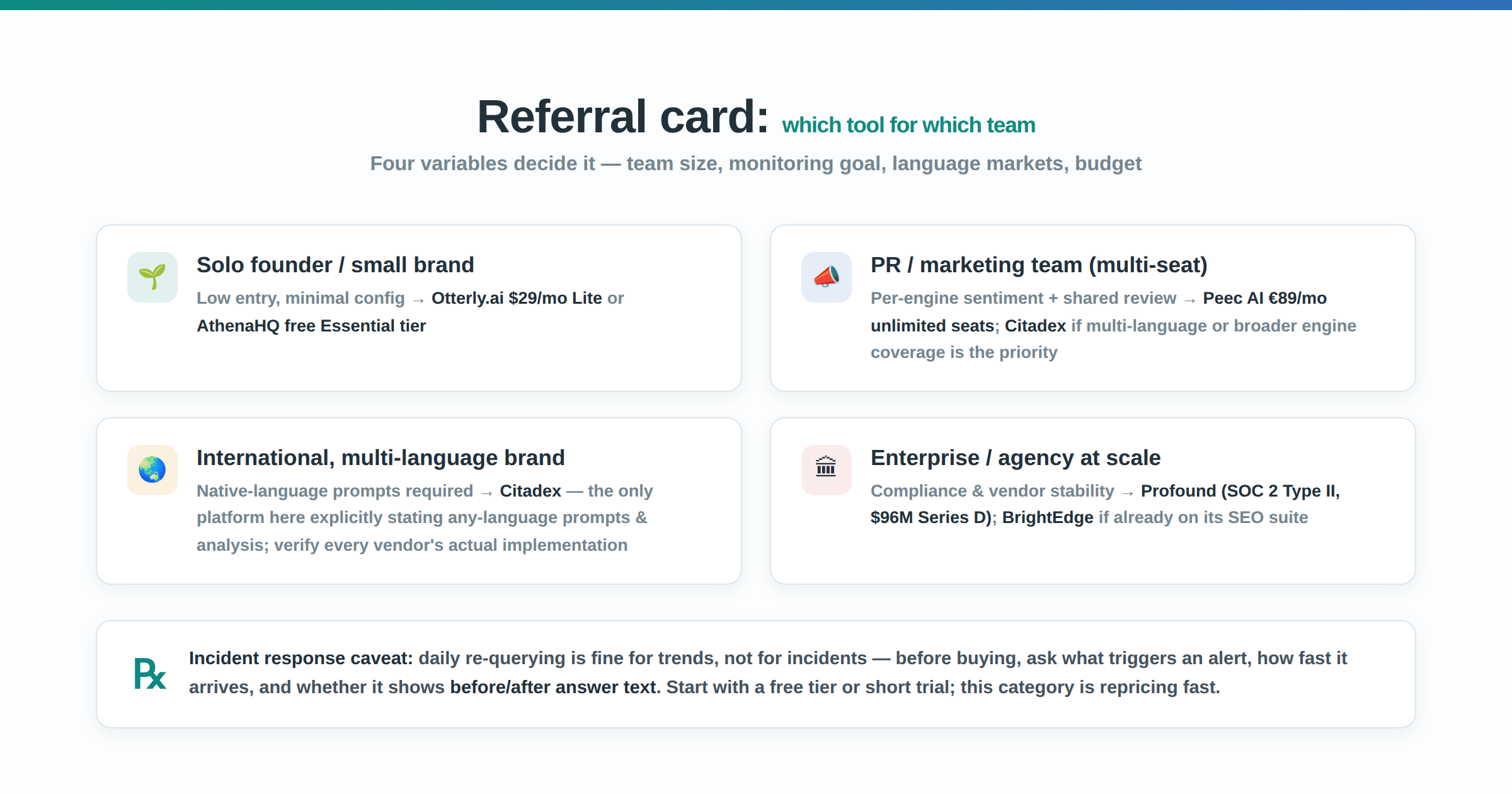
The right tool follows from four variables: team size, primary monitoring goal, language markets, and budget. Here is how those map to the platforms above.
Solo founder or small brand starting to understand AI reputation exposure needs low entry cost, minimal configuration, and enough engine coverage to catch major issues across the surfaces buyers actually use. Otterly.ai's $29/month Lite tier and AthenaHQ's free Essential tier are the natural starting points. Neither requires enterprise commitment and both provide enough coverage to identify whether a brand is being described at all.
Growing brand with active PR or marketing team monitoring multiple AI engines for sentiment and misinformation needs per-engine sentiment breakdowns, raw answer visibility, and multi-user access. Peec AI's unlimited-seat model at €89/month is structurally well-suited here, particularly for teams where four or five people need to review answers regularly. Citadex fits this segment if multi-language support is a priority or if the team needs broader engine coverage.
International brand operating across multiple language markets needs a tool that submits prompts and captures answers in each target language natively. Of the platforms with publicly confirmed language support, Citadex is the only one that explicitly states prompt submission and answer analysis run in any language. If language coverage is a hard requirement, verify each vendor's actual implementation before committing, "supports multiple languages" can mean anything from full native-language querying to basic interface translation.
Enterprise brand or agency managing multiple clients at scale needs SOC 2 certification, audit trails, white-label options, or integration with existing marketing tech stacks. Profound's funding profile, SOC 2 Type II certification, and $96M Series D position it clearly for enterprise buyers who need vendor stability and compliance documentation. BrightEdge fits enterprises already running its SEO suite who want AI visibility as an add-on rather than a standalone tool.
PR team responding to a reputational incident needs real-time or near-real-time alerting when AI answer content changes. Before purchasing any platform for incident response, ask the vendor directly: what triggers an alert, how quickly is it delivered, and does it show the before/after answer text? Daily re-querying is sufficient for trend analysis; it is not sufficient for incident response if an incorrect claim appears on a Monday and the report runs on Friday.
The honest answer for most teams is that the category is maturing rapidly, and the right choice today may not be the right choice in twelve months. Starting with a free tier or short trial before committing to an annual contract is defensible regardless of team size.
Frequently Asked Questions
Q: What is the difference between AI brand monitoring and traditional SEO monitoring?
Traditional SEO monitoring tracks where your website appears in Google's organic search results, while AI brand monitoring tracks how AI engines like ChatGPT, Perplexity, and Gemini describe your brand in generated answers, two separate retrieval systems that require different tooling and infrastructure.
Q: Can AI brand monitoring tools detect when an AI engine states a false or outdated fact about my brand?
No current tool automates full factual verification, but they surface the raw AI-generated answer text alongside historical records so that a human reviewer can compare what AI engines are saying against verified internal facts and detect changes when they occur.
Q: How often should AI brand monitoring prompts be rerun to catch reputation changes quickly?
Daily requerying is the current standard for most platforms and is sufficient for ongoing trend monitoring, though PR teams managing active incidents should confirm with vendors whether near-real-time alerting is available, since a daily cadence can leave a window of up to 24 hours before a new false claim is detected.
Q: Why do different AI engines describe the same brand differently?
ChatGPT, Perplexity, Gemini, and Copilot use different retrieval mechanisms, training data, and generation approaches, so they draw from different source pools and apply different weighting, meaning per-engine sentiment breakdowns are more actionable than blended averages that mask this variation.
Q: Which AI engines should a brand prioritize monitoring?
At minimum, brands should monitor ChatGPT, Perplexity, Google AI Overviews, and Gemini because these surfaces reach the largest share of buyers today, though B2B brands should prioritize Microsoft Copilot as well given its deep integration into Microsoft 365 workflows used by enterprise buyers.
Q: How do I respond when an AI engine is consistently describing my brand inaccurately?
The standard content response is to publish clear, authoritative, machine-readable content on your own domain that directly addresses the inaccuracy, updated pricing pages, structured FAQ content, and recent press coverage that AI engines can retrieve and cite, since AI engines update their answers as their retrieval sources change, and monitoring tools help confirm whether published corrections have been incorporated.