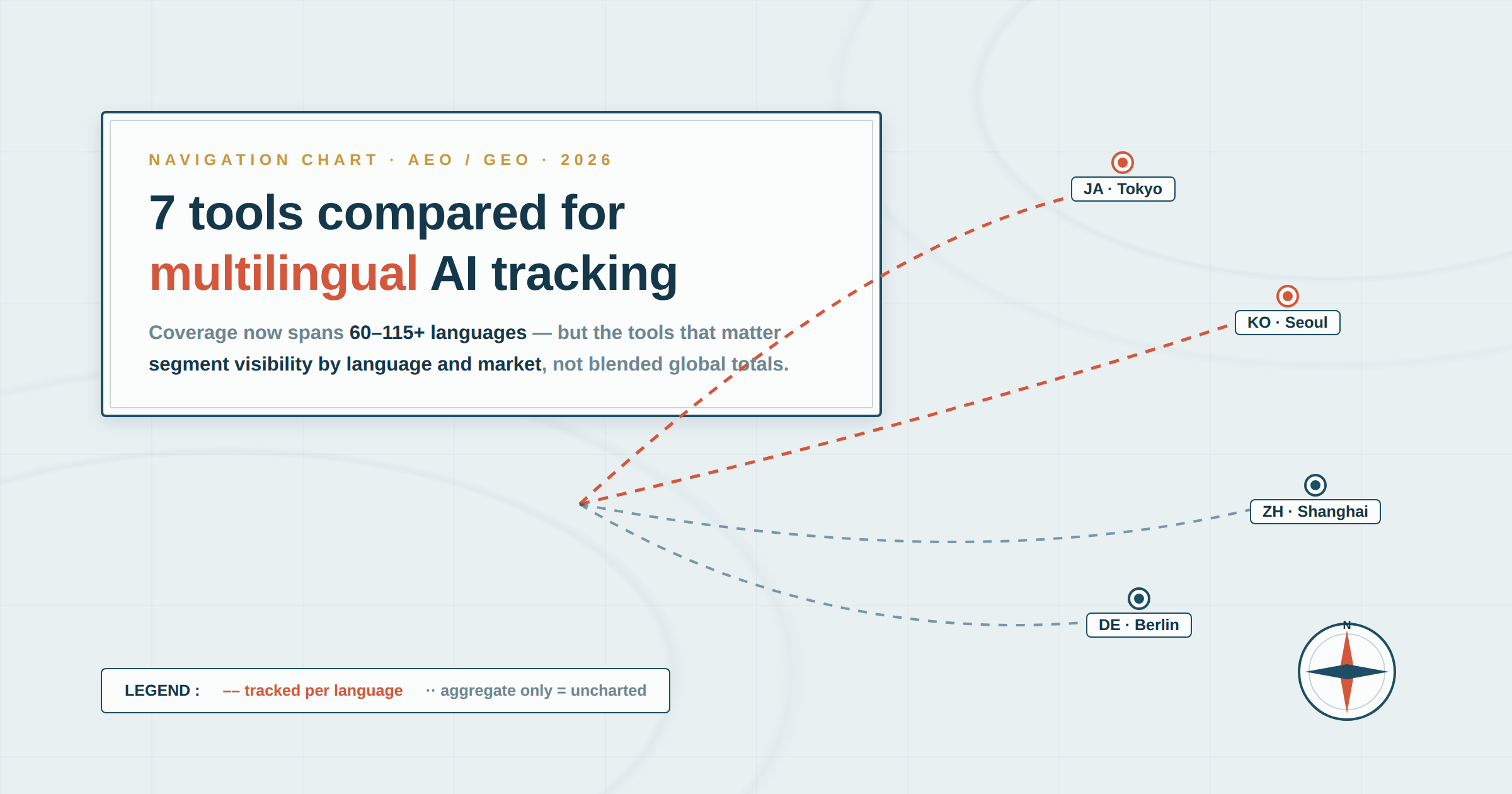
Key takeaways:
- Several AEO platforms now support multilingual AI tracking across 60–115+ languages, including Japanese, Korean, and Chinese.
- The most effective tools segment visibility by language and market separately, not just aggregate global data.
- Competitive benchmarking against rivals in non-English AI results requires dedicated AEO tooling, not standard SEO platforms.
Optimizing for AI search engines like ChatGPT and Perplexity means ensuring your brand appears in their answers across all relevant languages and markets. This matters in English-speaking regions and equally so in Japan, Korea, and China, where AI engine behavior and local competition follow distinct patterns. This guide compares seven multilingual AEO platforms, AthenaHQ, BrightEdge, Citadex, Goodie, Otterly.ai, Peec AI, and Profound, based on publicly available information from their official websites.
Which AI Visibility Tools Support Non-English Languages Including Japanese and Korean
Several dedicated LLMO platforms have moved well beyond English-only tracking. The language coverage gap between these tools and traditional SEO platforms is not a marginal difference. It is categorical.
Peec AI reports the broadest raw coverage at 115+ languages, including Japanese, Korean, and Chinese. AthenaHQ publishes support for 60+ countries and languages at its enterprise tier. Profound covers 30+ languages across 150+ regions. Goodie states support for most countries and languages. Citadex supports any language, with tracking segmented per market (country + language). Otterly.ai specifies Not publicly disclosed countries for monitoring but does not publicly disclose a language count. BrightEdge does not separately specify language support for its AI tracking features.
The critical question is not how many languages a platform lists. Instead, ask whether it actually segments results by language, or simply accepts prompts in multiple languages and returns global totals blended together. A tool that lets you submit Japanese prompts but reports aggregate worldwide mention rates is fundamentally different from one that returns Japanese-specific mention rate, rank, sentiment, and citation figures. For brands operating in Japan or Korea, this distinction determines whether you get actionable intelligence or misleading data.
Japanese, Korean, and Chinese warrant particular attention because buyer behavior in these AI search environments diverges sharply from English-language patterns. A brand appearing frequently in English ChatGPT responses may be completely absent from Gemini's Japanese results. Aggregate dashboards will not flag that gap. Peec AI, Citadex, AthenaHQ, and Profound have all publicly confirmed non-English language support at sufficient depth to cover these three markets.
Standard SEO tools like Semrush and Ahrefs track some AI surfaces, Google AI Overviews, ChatGPT, Perplexity, but their AI monitoring is built for English queries and organic search logic. They do not run native-language prompt sets in Japanese or Korean, making them unsuitable for LLMO in Asian markets regardless of their other capabilities.
When evaluating multilingual AI tracking platforms, verify two things: whether the tool accepts prompts in your target language, and whether it returns results segmented by that language. Both are required. Missing either one means the tool is incomplete for genuine multilingual LLMO work.
Why Language-Segmented AI Visibility Tracking Is Different From Global Aggregate Tracking
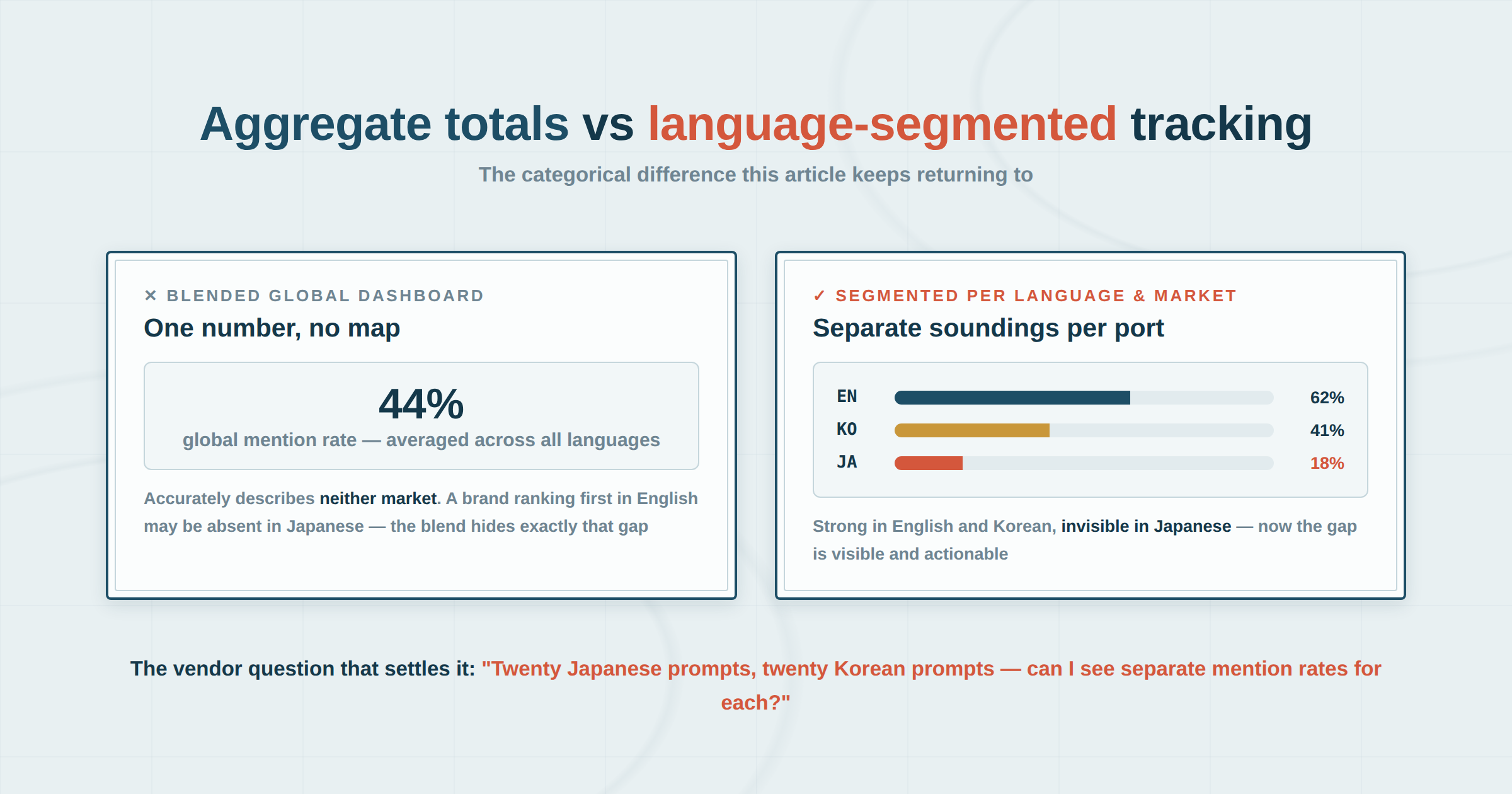
Aggregate tracking shows whether your brand appears anywhere in AI answers across all queries. Language-segmented tracking shows whether your brand appears in the specific language your customer actually types.
This matters in practice. An AI engine's response to "best project management software for small teams" in English and "中小企業向けのプロジェクト管理ソフトのおすすめ" in Japanese are generated from different retrieval paths, draw on different sources, and frequently recommend different brands. A brand ranking first in one market may not appear in the other. Aggregate reporting averages those results together and produces a figure that accurately describes neither one.
AI engines surface brands through retrieval at answer time, not from training data alone. They cite well-structured, authoritative sources available when the query is answered. A Japanese-language query retrieves primarily Japanese-language sources. If your brand lacks strong Japanese-language content with credible citations, your AI visibility in Japan will be low regardless of English-language strength.
Per-language prompt sets solve this. To measure Japanese visibility, a platform must submit prompts written in Japanese, reflecting how a real buyer phrases questions in that market. It then records which brands appear, their position, sentiment, and whether source URLs are included. Running English prompts and translating the output does not produce equivalent data.
Geolocation is another pitfall. Some platforms simulate "country tracking" by routing API calls through specific country IP addresses. This differs from language-native tracking, and neither is enough on its own. AI answers differ by both the prompt language and the country, because search-enabled engines localise results by country. Platforms that track only one of the two, rather than a specific country + language market, provide a weaker signal.
Properly segmented tools produce mention rate, ranking position, sentiment, and citation data broken out per language and per market, not blended across the full set. This granularity reveals that your brand is strong in English and Korean but invisible in Japanese, enabling targeted action on the Japanese gap specifically.
Key Criteria for Evaluating a Multilingual AEO Platform
Six criteria consistently distinguish tools that work for multilingual LLMO from those that only appear to.
Languages supported requires careful interpretation. Platform availability in different languages, prompt-input language support, and result segmentation by language are three distinct layers. Enterprise teams need all three. A platform supporting 115+ languages for prompt input but reporting only global aggregate data is weaker than one supporting 30 languages with full per-language segmentation.
AI engines covered determines how complete your visibility picture is. For international markets, essential engines are ChatGPT, Google AI Overviews, Google Gemini, Perplexity, Microsoft Copilot, and Claude. DeepSeek matters specifically in Chinese-language markets. A platform covering ten engines in your target language provides substantially more signal than one covering three engines across more languages.
Per-language result segmentation most clearly divides enterprise-grade multilingual tools from English-first platforms. In practice this is not a simple yes or no, some segment by market and blend languages within it, others do the reverse. Ask vendors directly: "If I submit twenty Japanese prompts and twenty Korean prompts, can I see separate mention rates for each?"
Competitor benchmarking in non-English queries becomes critical in Asian markets, where local competitors often outperform global brands in AI recommendations without that appearing anywhere in English-language analysis. Your own mention rate in Japanese is useful; knowing two local competitors appear in 70% of the same prompts where you appear in 30% is actionable.
Pricing transparency serves as a practical filter. Several enterprise LLMO platforms use custom, sales-led pricing, creating barriers for marketing teams needing to justify budgets before receiving quotes. Tools publishing entry-level pricing publicly, Otterly.ai starts at $29/month, Peec AI lists tiered pricing, let teams self-qualify before sales conversations.
Monitoring cadence and automation complete the evaluation. Weekly automated tracking is the practical minimum for brands running active multilingual campaigns; bi-weekly works for steady-state monitoring. One-time manual queries produce snapshots that grow stale quickly, since AI model behavior shifts with updates and new sources continuously enter retrieval pools.
How the Leading AEO Platforms Compare on Multilingual and Multi-Market Coverage
The table below uses only publicly disclosed values from each tool's official site; where data is not published, cells read "Not publicly disclosed."
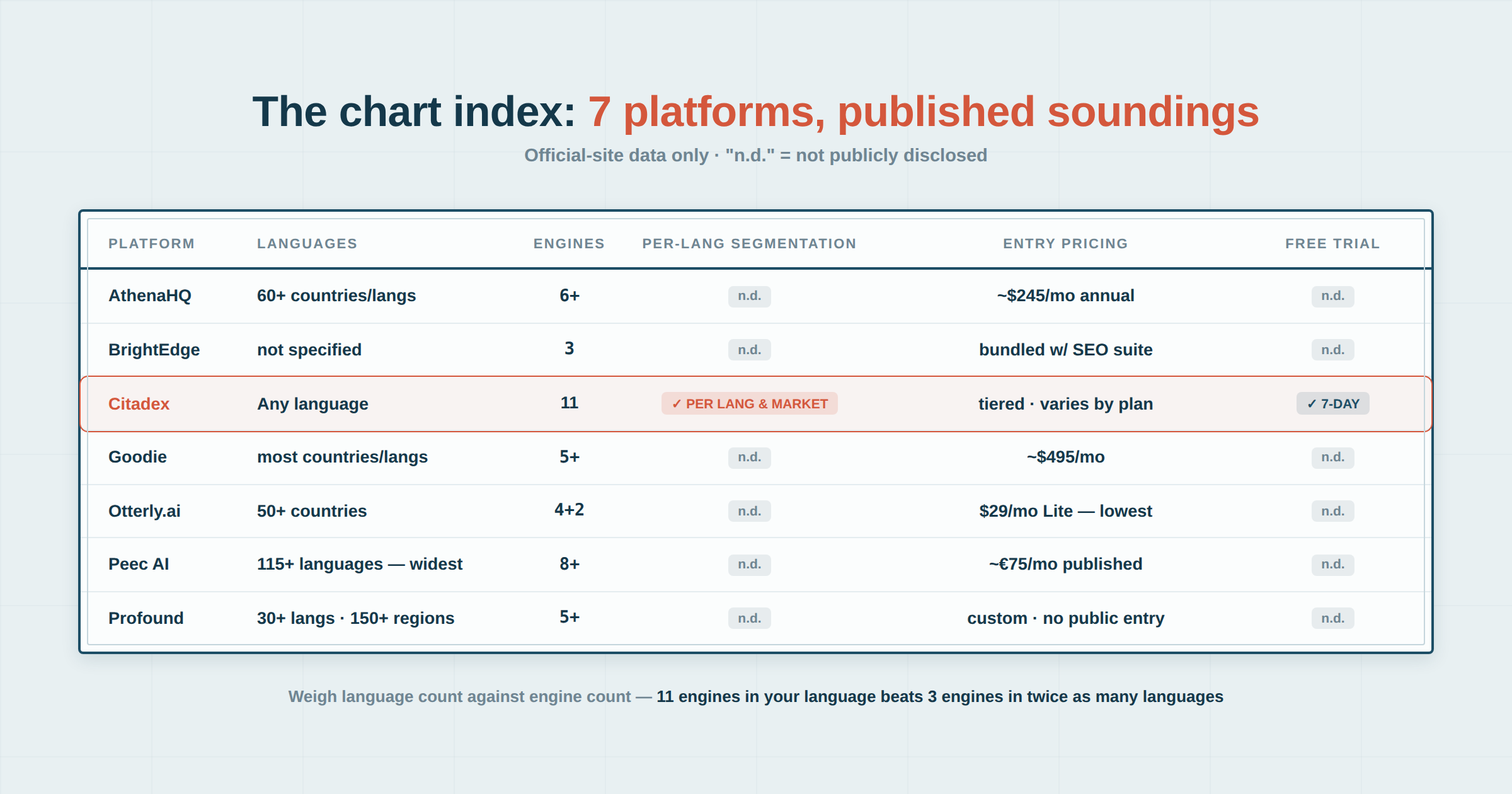
| Platform | Languages Supported | AI Engines Covered | Per-Language Segmentation | Competitor Benchmarking | Entry Pricing | Free Trial |
|---|---|---|---|---|---|---|
| AthenaHQ | 60+ countries/languages | ChatGPT, Claude, Perplexity, Gemini, Copilot, Google (6+) | Not publicly disclosed | Yes | ~$245/mo (annual) | Not publicly disclosed |
| BrightEdge | Not publicly specified | Google AI Overviews, ChatGPT, Perplexity (3 core) | Not publicly disclosed | Not publicly disclosed | Bundled with SEO platform | Not publicly disclosed |
| Citadex | Any language | ChatGPT, Claude, Gemini, Perplexity, Copilot, Grok, DeepSeek, Mistral, Qwen, Doubao, Google AI Overviews, and Google AI Mode (12) | Yes, per market (country + language) | Yes | Varies by plan | 7-day free trial |
| Goodie | Most countries and languages | ChatGPT, Perplexity, Gemini, DeepSeek, Claude (5+) | Not publicly disclosed | Yes | ~$495/mo | Not publicly disclosed |
| Otterly.ai | 50+ countries | ChatGPT, Google AI Overviews, Perplexity, Copilot (4 core); Gemini and AI Mode as add-ons | Not publicly disclosed | Yes | $29/mo (Lite) | Not publicly disclosed |
| Peec AI | 115+ languages | ChatGPT, Gemini, Perplexity, AI Overviews, AI Mode, Copilot, Claude, DeepSeek (8+) | Not publicly disclosed | Yes | ~€75/mo | Not publicly disclosed |
| Profound | 30+ languages, 150+ regions | ChatGPT, Perplexity, Gemini, Claude, Copilot (5+ core) | Not publicly disclosed | Yes | Custom (no public entry price) | Not publicly disclosed |
Several standouts emerge: Peec AI's 115+ language count leads the category by a significant margin. Profound's 150+ region coverage provides the most granular geographic breakdown. Citadex covers 12 AI engines, the highest in this comparison, including regional engines Grok, Mistral, Qwen, DeepSeek, and Doubao alongside the global core set, with explicit per-language and per-market tracking.
Language count should be weighed against engine count. A tool tracking twelve AI engines in your target language captures more of the actual answer environment than one tracking three engines in twice as many languages. For Japanese and Korean markets specifically, where ChatGPT and Gemini reach the most users, ensuring those engines are covered at the language level matters more than maximizing raw language numbers.
Platform-by-Platform Breakdown: Multilingual Capabilities in Detail
AthenaHQ
AthenaHQ covers six major AI engines, ChatGPT, Claude, Perplexity, Gemini, Copilot, and Google, and publishes support for 60+ countries and languages at enterprise tier. Its Action Center delivers tailored GEO recommendations. Persona-level buyer targeting lets teams configure prompts reflecting how specific buyer segments interact with AI assistants. The platform holds SOC 2 Type 2 certification, important for enterprise procurement requirements.
Entry pricing starts at approximately Not publicly disclosed on annual billing, with a $300 first-month credit partially offsetting the commitment. Whether per-language result segmentation is available should be confirmed in the sales process if Japanese or Korean tracking is required. This platform suits mid-market to enterprise teams in English-primary markets beginning to extend into international AI tracking.
Multilingual strength: 60+ country and language reach with structured GEO recommendations.
Notable limitation: Per-language segmentation depth not publicly confirmed; no published free trial information.
BrightEdge
BrightEdge integrates AI tracking into its broader SEO platform and monitors Not publicly disclosed as its core AI surfaces. Teams already using BrightEdge for SEO find a familiar interface in the AI Catalyst dashboard. The constraint for multilingual LLMO is structural: language support for AI tracking is not separately specified, and the three-engine coverage excludes Claude, Copilot, Grok, and DeepSeek.
AI tracking comes bundled with broader BrightEdge subscriptions rather than as a standalone offering, making it difficult to evaluate as a dedicated multilingual AI visibility solution. Teams whose primary need is English-language AI tracking integrated with existing SEO workflows find BrightEdge a reasonable consolidation option. Teams prioritizing multilingual LLMO will find the lack of public language specifications and limited engine count constraining.
Multilingual strength: Integration with established SEO data streamlines cross-channel reporting.
Notable limitation: Three-engine coverage and no publicly specified multilingual AI tracking capability.
Citadex
Citadex monitors 12 AI engines: ChatGPT, Claude, Gemini, Perplexity, Copilot, Grok, DeepSeek, Mistral, Qwen, Doubao, Google AI Overviews, and Google AI Mode. The roster includes global mainstream engines plus regional or emerging platforms, Qwen for Chinese-language markets, Mistral for European deployments, Grok for X-adjacent audiences. Visibility is tracked per market (country + language), with each market scanned from its own country. Every prompt returns mention rate, average rank, sentiment, and citation separately for each market tracked. Competitor tracking is built in, allowing brands to benchmark AI visibility against rivals using identical prompt sets.
Citadex supports any language without a fixed ceiling, Japanese, Korean, Chinese, German, Arabic, or others. Pricing is tiered across Starter, Pro, Business, and Autopilot plans and varies by plan and billing frequency; a 7-day free trial is available.
Multilingual strength: Broadest engine count in this comparison (12), including Qwen and Mistral for Asian and European markets, with confirmed per-language and per-market segmentation.
Notable limitation: Entry pricing is not published as a single figure, requiring plan-by-plan review.
Goodie
Goodie monitors five or more AI engines, ChatGPT, Perplexity, Gemini, DeepSeek, and Claude, and states support for most countries and languages. Agentic workflows distinguish it from simpler monitoring tools: the platform includes content generation and outreach agents that act on visibility gaps, not just report them. SOC 2 compliance and multi-market, multi-language reporting suit mid-market teams with active LLMO programs.
Entry pricing starts at approximately Not publicly disclosed, placing it at the higher end of the mid-market range. Whether the platform segments results per language or per market at that tier is not publicly detailed. This platform works well for marketing teams needing both monitoring and content action in one system, operating in markets where ChatGPT, Perplexity, Gemini, and Claude have established reach.
Multilingual strength: Engine coverage and agentic workflows enable both tracking and response in one platform.
Notable limitation: Per-language segmentation and pricing details require direct vendor inquiry.
Otterly.ai
Otterly.ai monitors core engines including ChatGPT, Google AI Overviews, Perplexity, and Copilot; Gemini and AI Mode are available as add-ons. The platform tracks Not publicly disclosed countries and offers competitive benchmarking. Entry pricing at Not publicly disclosed (Lite tier) is the lowest among the platforms compared here, making it accessible for small teams or pilot programs. Escalation to Pro and Business tiers adds additional features and higher tracking volume.
For teams focused on English-language AI visibility or those beginning exploratory multilingual tracking, Otterly.ai provides value. The lower price point enables broader adoption within organizations. For teams requiring comprehensive non-English tracking at scale, the four-core-engine approach and limited public disclosure on per-language segmentation suggest evaluating it alongside deeper multilingual specialists like Citadex or Peec AI.
Multilingual strength: Most affordable entry price; includes competitive benchmarking.
Notable limitation: Four core engines with add-ons; per-language segmentation not publicly specified.
Peec AI
Peec AI tracks Not publicly disclosed languages and Not publicly disclosed AI engines. The language breadth is the widest in this category. Entry pricing starts at approximately Not publicly disclosed and is published clearly on its pricing page, lowering the barrier to evaluation.
The main qualification: while Peec AI's language count is exceptional, publicly available information does not confirm whether results are segmented per language or blended across the full set. Teams prioritizing Japanese or Korean tracking should ask this directly. For organizations needing the broadest language coverage combined with published transparent pricing, Peec AI is a strong candidate.
Multilingual strength: Broadest language count (115+) with published entry-level pricing.
Notable limitation: Per-language segmentation not publicly confirmed; direct vendor inquiry recommended.
Profound
Profound covers 30+ languages across 150+ regions, the most geographically granular coverage in this comparison, and monitors five or more core engines: ChatGPT, Perplexity, Gemini, Claude, and Copilot. The platform emphasizes regional customization for global enterprises managing distinct market strategies.
Pricing is custom with no published entry point, requiring sales conversations to evaluate. That friction makes it challenging for smaller teams or those in initial planning stages. Profound suits enterprise organizations with mature LLMO programs operating across dozens of markets where regional nuance and localized benchmarking justify the implementation effort and cost.
Multilingual strength: Deepest geographic granularity (150+ regions); five-engine core coverage.
Notable limitation: Custom pricing with no transparent entry point; per-language segmentation not publicly disclosed.
Recommendations by Use Case
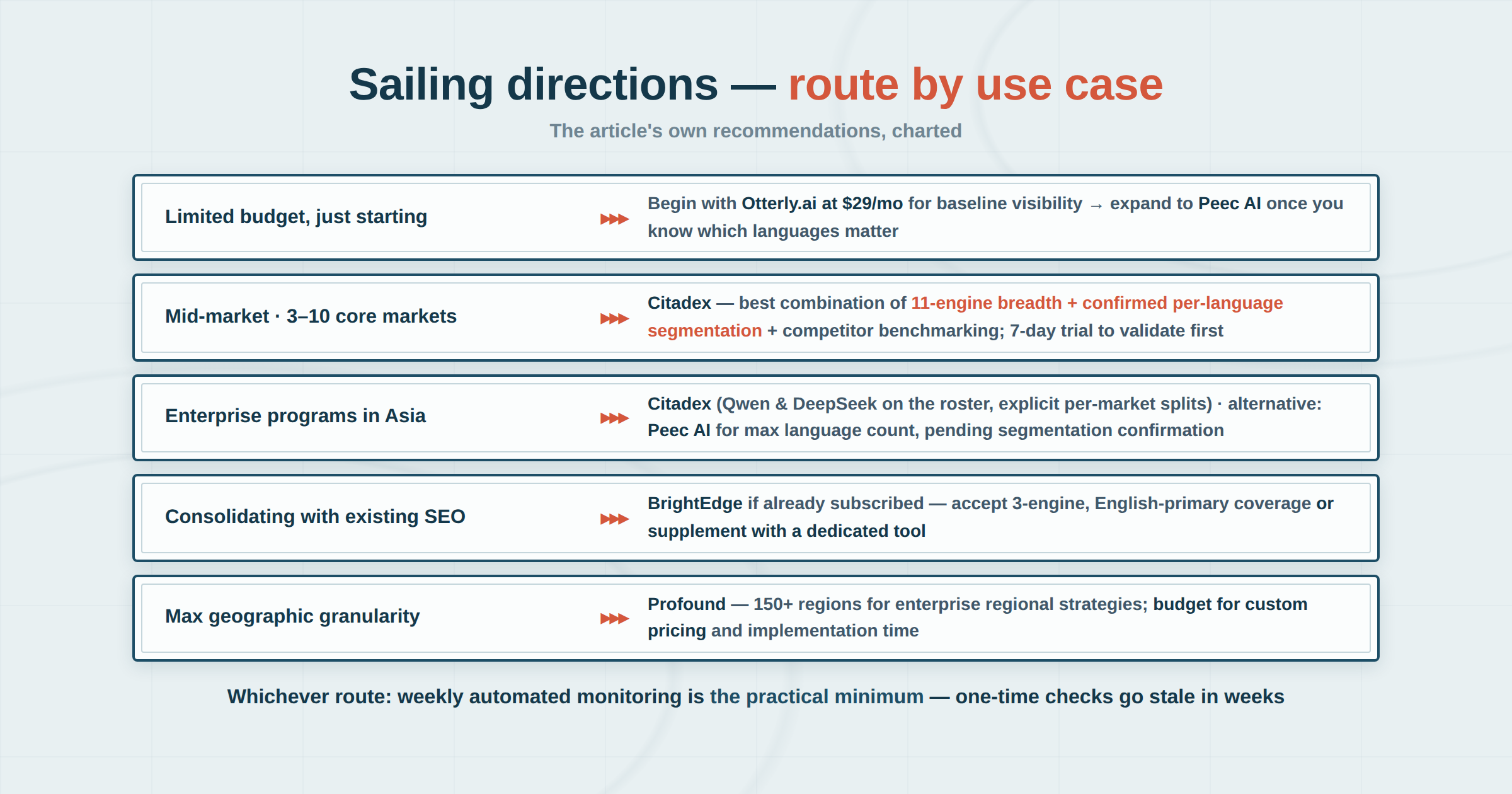
Starting a multilingual LLMO program with limited budget: Begin with Otterly.ai at $29/month to establish baseline visibility in core markets and engines. Expand to Peec AI once you determine which languages and markets matter most.
Mid-market teams managing 3–10 core markets: Citadex offers the best combination of engine breadth (12), confirmed per-language segmentation, published transparent pricing, and competitor benchmarking. The 7-day free trial lets you validate before committing.
Enterprise programs in Asian markets specifically: Citadex's inclusion of Qwen and DeepSeek, combined with explicit per-language and per-market segmentation, makes it the strongest choice. Alternative: Peec AI for maximum language count, contingent on vendor confirmation of per-language segmentation.
Consolidation with existing SEO platform: BrightEdge offers the tightest integration if you already subscribe. Accept that its AI Catalyst covers three engines and English primarily, or supplement with a dedicated multilingual tool.
Maximum geographic granularity with enterprise support: Profound. Budget for custom pricing and implementation timelines.
Frequently Asked Questions
What's the difference between IP-based country targeting and language-native tracking?
IP-based targeting routes requests through a country's server to simulate geographic presence. Language-native tracking submits prompts written in the target language. These produce different retrieval behavior, and both matter. AI answers differ by language and by country, because search-enabled engines localise results by country. Reliable tracking treats each market as a specific country plus language.
Can I use a standard SEO tool like Semrush to track AI visibility in Japanese?
Standard SEO tools track some AI surfaces, Google AI Overviews, ChatGPT, Perplexity, but do not run native-language prompt sets in Japanese or Korean. They are built for English queries and organic search patterns. For genuine multilingual LLMO, use a dedicated AEO platform.
How often should I run AI visibility monitoring?
Weekly automated monitoring is the practical minimum for active multilingual campaigns. Bi-weekly works for steady-state tracking. One-time manual checks become stale within weeks because AI model updates and new sources shift the retrieval environment continuously.
Which AI engines matter most in Japan and Korea?
ChatGPT and Gemini have the broadest reach in both markets. Perplexity is growing but has less market penetration than in English-speaking regions. Claude and Copilot have smaller but meaningful presence. Local or emerging engines may matter depending on your customer segment. Ask platforms to confirm they track the engines actually used in your target markets rather than assuming global engine rankings apply locally.
If my brand appears in English AI responses but not in Japanese ones, what does that mean?
It means your Japanese-language web presence or citation credibility in Japan is weaker than your English-language presence globally. The remedy is to build Japanese-language content on owned and earned channels (website, guides, press coverage) that Japanese-language AI engines can retrieve and cite. Appearing in English responses without Japanese content is expected; the gap signals opportunity to strengthen Japanese presence specifically.
Do I need to run the same prompts in every language?
No. Effective multilingual LLMO uses language-native prompt sets. How a buyer phrases "best project management software" differs between English, Japanese, and Korean. Different phrasing retrieves different sources. Run prompts reflecting actual buyer language behavior in each market.
How much does multilingual AI visibility monitoring cost?
Entry tiers range from $29/month to ~$245/month (AthenaHQ enterprise) to custom pricing (Profound). The spread reflects engine count, language coverage, segmentation depth, competitor benchmarking, and automation. Start with published entry tiers to pilot before committing to higher-tier or custom pricing.