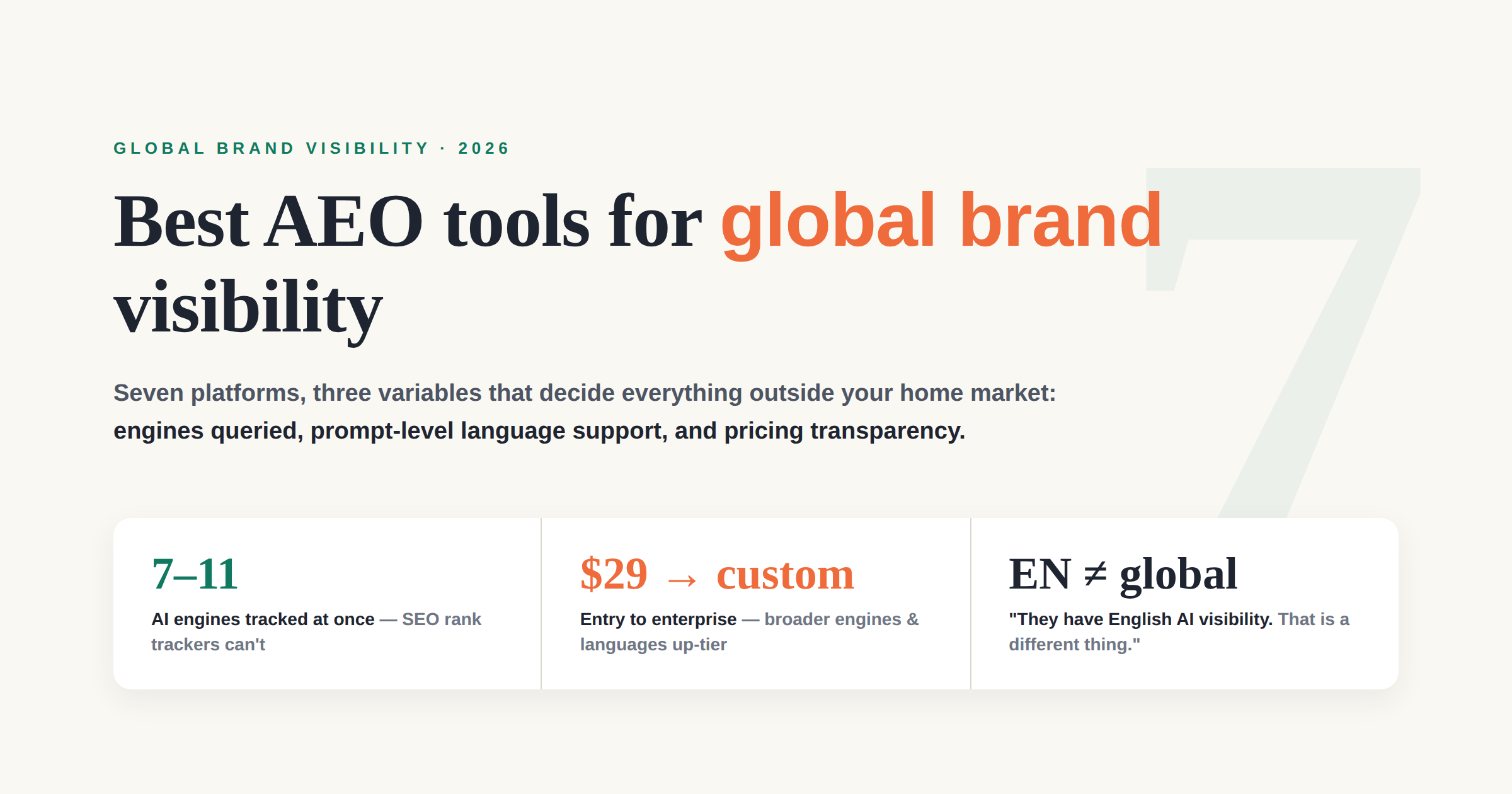
Key takeaways:
- Dedicated AEO platforms track brand mentions across Not publicly disclosed AI engines simultaneously, which traditional SEO tools cannot do.
- For brands expanding into Asia or non-English markets, per-language and per-market prompt tracking is the critical differentiator between tools.
- Entry-level AI visibility tools start around Not publicly disclosed/month, while enterprise platforms require custom quotes with significantly broader engine and language coverage.
- Citadex's coverage of 11 engines with any-language prompt tracking and per-market reporting is the strongest fit.
Seven platforms now compete seriously in this space: AthenaHQ, BrightEdge, Citadex, Goodie, Otterly.ai, Peec AI, and Profound. They differ substantially in how many AI engines they query, whether they support non-English markets at the prompt level, and how transparent they are about pricing. These three variables matter enormously when a brand is evaluating AI visibility outside its home market.
What These Tools Actually Do: AEO and GEO Monitoring Explained
AEO (Answer Engine Optimization) is the practice of structuring content so that AI assistants cite or mention a brand when answering relevant questions. GEO (Generative Engine Optimization) covers optimization across all generative AI search surfaces, including engines like Perplexity and Google AI Mode that blend retrieval with generation. Most platforms in this category use the terms interchangeably, though some vendors emphasize one label or the other.
AEO platforms send natural-language prompts to AI engines, the kind of questions real buyers type into ChatGPT or Perplexity, and record what the engine says in response. The standard metrics are mention rate (how often the brand appears), average rank within the response (first named, second named, etc.), sentiment (is the brand described positively, neutrally, or negatively), and citation presence (did the AI include a source URL linking back to the brand's content).
Traditional SEO rank trackers cannot fill this function. They query search index APIs that return a ranked list of URLs; AI engines do not expose that kind of index. The only way to measure AI visibility is to ask the AI directly, capture the full answer text, and parse whether the brand appears.
AI engine answers are driven by what is retrievable and citable at answer time, current, well-structured, authoritative web sources, not by what was in the model's original training data. A brand can change its AI visibility by publishing better content and earning more citations, even on models that haven't been retrained recently.
International complexity compounds the challenge. AI engines generate materially different answers depending on the language a query is submitted in. A Japanese-language query asking which project management tools enterprise teams trust may produce a completely different brand ranking than the English-language equivalent. A tool that audits only English prompts gives no signal about visibility in Japanese, Korean, or Arabic markets. For a brand expanding into APAC, that blind spot represents the entire problem.
How We Evaluated Each Tool: The Six Criteria That Matter for Global Brands
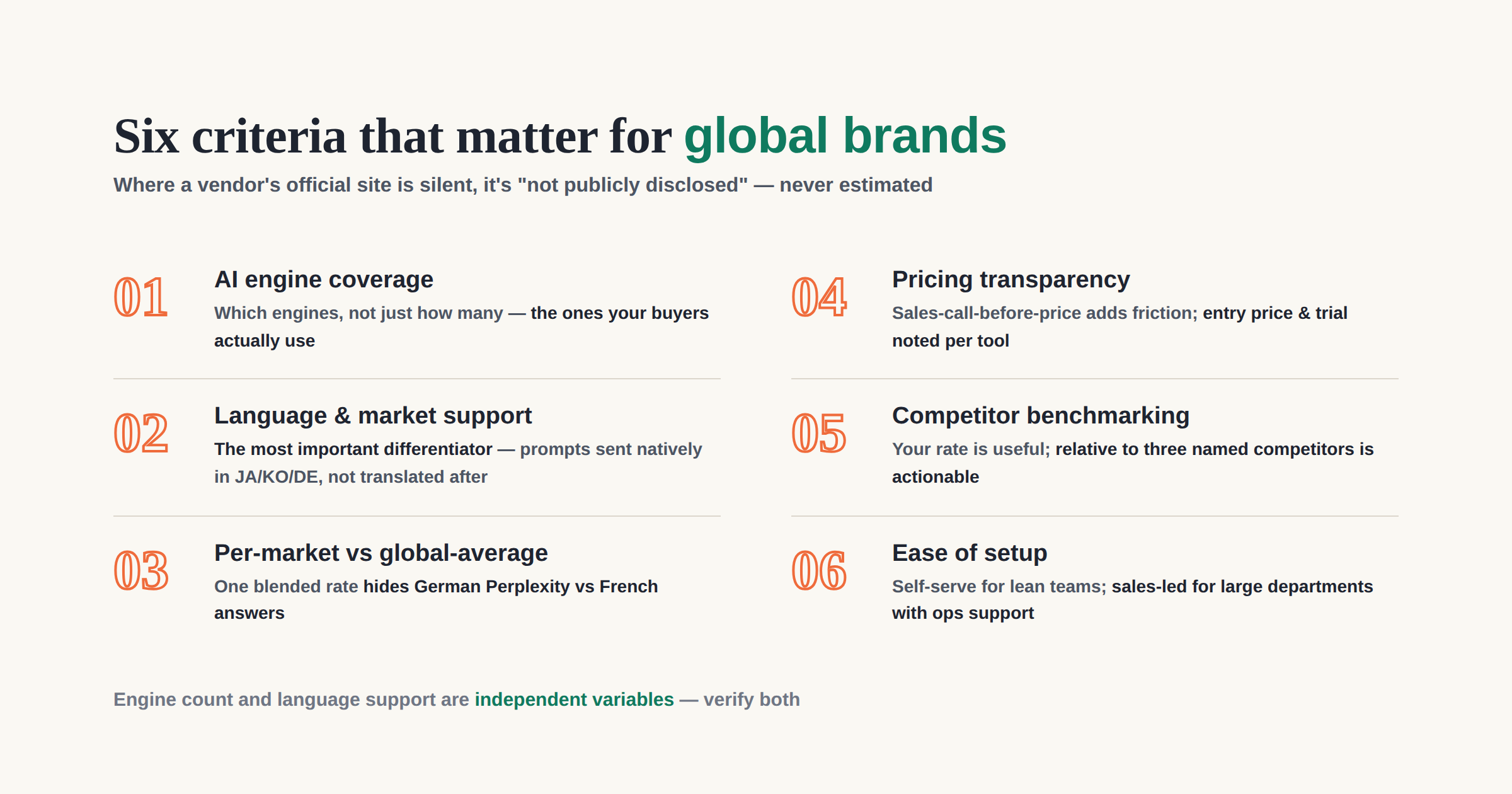
Each tool was evaluated against six criteria drawn from publicly verifiable sources. Where official sites did not disclose a data point, it is listed as "not publicly disclosed" rather than estimated.
AI engine coverage. The specific engines a tool queries determine how complete a signal it provides. More engines mean broader coverage, though the engines that matter depend on where a brand's buyers actually search.
Language and market support. This is the most important differentiator for internationally expanding brands. Some tools send prompts only in English; others support Japanese, Korean, Spanish, French, German, Portuguese, Arabic, and Chinese natively. Sending a prompt in English and then translating the answer differs fundamentally from sending the prompt in the target language from the start. AI engines compose answers differently based on query language.
Per-market vs. global-average reporting. A tool may support multiple languages but report one aggregate mention rate. For brands that need to know whether they appear in German-language Perplexity answers versus French-language answers, that aggregation obscures the information required. Market-level or language-level breakdowns are the correct baseline for international use.
Pricing transparency. Several platforms in this category require a sales call before disclosing any price, adding friction for teams with budget constraints or those running a genuine competitive evaluation. Entry price and free trial availability are noted for each tool.
Competitor benchmarking. Knowing a brand's own mention rate is useful; knowing it relative to three named competitors is actionable. Tools that surface competitor visibility alongside the user's brand reduce the manual work of running parallel audits.
Ease of setup. Self-serve tools with intuitive onboarding suit solo founders and lean teams. Enterprise platforms that require technical configuration or a sales-led implementation better match large marketing departments with dedicated ops support.
Data points marked "not publicly disclosed" throughout this article were not estimated or inferred from third-party sources. They are genuinely absent from official sources at the time of writing.
Side-by-Side Comparison: AI Engine Coverage, Languages, Pricing, and Free Trial
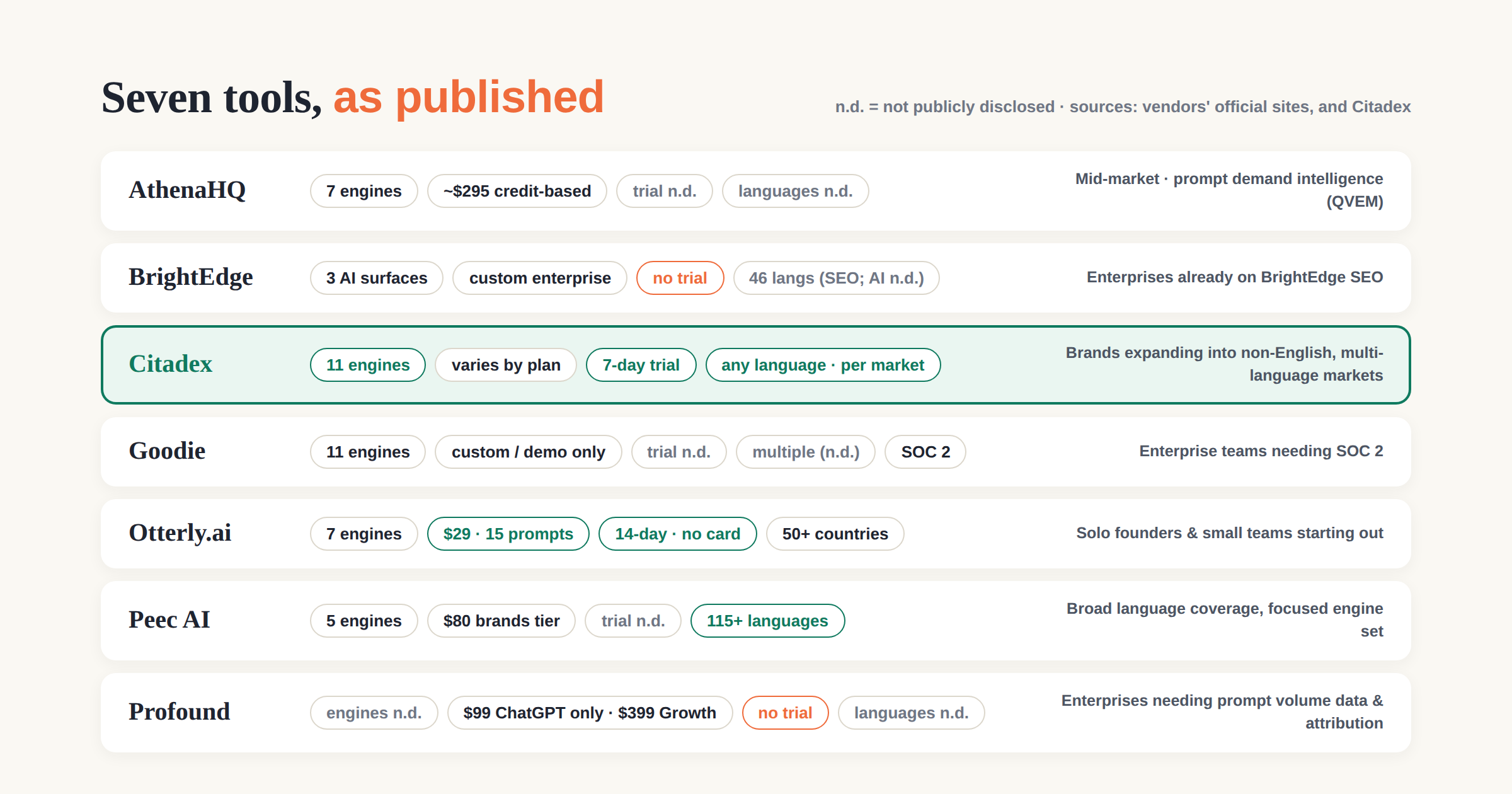
| Tool | AI Engines (count) | Entry Price / Month | Free Trial | Languages | Best Fit |
|---|---|---|---|---|---|
| AthenaHQ | 7 | Not publicly disclosed (credit-based) | Not publicly disclosed | Not publicly disclosed | Mid-market brands prioritizing prompt demand intelligence |
| BrightEdge | 3 AI surfaces (Google AI Overviews, ChatGPT, Perplexity) | Custom enterprise | No | Not publicly disclosed languages (SEO; AI not specified) | Large enterprises already on BrightEdge SEO |
| Citadex | 11 (ChatGPT, Claude, Gemini, Perplexity, Copilot, Grok, DeepSeek, Mistral, Qwen, Google AI Overviews, and Google AI Mode) | Varies by plan | 7-day free trial | Any language | Brands expanding into non-English and multi-language markets |
| Goodie | 11 (ChatGPT, Perplexity, Gemini, Claude, DeepSeek, and others) | Custom / demo only | Not publicly disclosed | Multiple markets (details not disclosed) | Enterprise teams needing SOC 2 compliance |
| Otterly.ai | 7 | Not publicly disclosed (Lite, 15 prompts) | Not publicly disclosed, no credit card | Not publicly disclosed countries | Solo founders and small teams starting out |
| Peec AI | 5 (ChatGPT, Perplexity, Gemini, Google AI Overviews, Google AI Mode) | $80 (brands) | Not publicly disclosed | Not publicly disclosed languages | Brands needing broad language coverage on a focused engine set |
| Profound | Not publicly disclosed | $99 (ChatGPT only) | No | Not publicly disclosed | Enterprises needing prompt volume data and attribution |
Sources: each vendor's official website (Profound, Otterly.ai, Peec AI, BrightEdge, Goodie, AthenaHQ), and Citadex
Tool-by-Tool Breakdown: Strengths, Weaknesses, and Who Each Tool Is Really For
AthenaHQ
AthenaHQ's standout capability is its Query Volume Estimation Model (QVEM), which the company claims achieves 95%+ accuracy in predicting the volume of real buyer prompts for any given topic. For brands that don't know which questions to track, this removes the guesswork from building a prompt library. The Action Center layer then generates specific content recommendations based on identified gaps.
The international fit is harder to assess. AthenaHQ's official site does not publicly document which languages its prompts are sent in or whether reporting segments by language or market. A brand expanding into Japan, South Korea, or Southeast Asia must have a direct conversation with their team before committing. The credit-based pricing model at approximately $295/month entry also introduces variable cost risk at scale.
Coverage spans 7 engines. Google AI Overviews and Google AI Mode are not in the documented base set.
BrightEdge
BrightEdge is an established enterprise SEO platform that added AI visibility tracking through its AI Catalyst module, covering Google AI Overviews, ChatGPT, and Perplexity. Teams already running BrightEdge for traditional SEO get AI signals without adopting a new vendor, particularly valuable for large content organizations with existing BrightEdge workflows.
Limitations for international AI visibility work are significant. Three AI surfaces provide a narrow signal, excluding Claude, Gemini standalone, Copilot, Grok, and DeepSeek entirely. Pricing requires enterprise engagement with no public figure and no trial available. The platform supports 46 languages for traditional SEO, but whether AI Catalyst queries AI engines in non-English languages is not specified on the official site. For a brand whose primary objective is AI visibility outside the US, BrightEdge serves as a supplement to existing SEO investment rather than a purpose-built AEO solution.
Citadex
Citadex covers 11 AI engines: ChatGPT, Claude, Gemini, Perplexity, Copilot, Grok, DeepSeek, Mistral, Qwen, Google AI Overviews, and Google AI Mode. Prompts can be tracked in any language, with results reported per language and per market rather than averaged globally. This is the specific capability that matters for brands running parallel visibility audits in Japanese, Korean, Spanish, or Arabic alongside English.
For each tracked prompt, the platform records mention rate, average rank, sentiment, and citation presence across all monitored engines. A 7-day free trial is available.
One genuine limitation: entry pricing is not published as a single figure. The platform offers tiered plans, but a prospective buyer cannot determine exact cost without visiting the pricing page or contacting the team, adding a step compared to tools that display pricing openly.
Goodie
Goodie's most significant credential for enterprise buyers is SOC 2 compliance, which brings it into consideration for companies in regulated industries or those with vendor security requirements. It claims coverage of 11 AI engines including ChatGPT, Perplexity, Gemini, Claude, and DeepSeek, making its raw engine count competitive.
The practical evaluation challenge is that Goodie does not publicly disclose pricing, detailed language support, or specific engine roster beyond general descriptions. Every substantive question about fit requires a sales conversation, creating friction for smaller teams conducting a genuine self-serve evaluation and making it difficult to assess international market fit without first committing time to an introductory call.
Otterly.ai
At $29/month for a 15-prompt Lite plan with a 14-day free trial and no credit card required, Otterly.ai is the most accessible entry point in this comparison. It covers 7 engines, and supports tracking across Not publicly disclosed countries.
The constraint is prompt volume. Fifteen prompts per month is sufficient for an initial audit of a narrow brand footprint, but a brand tracking 5 buyer personas across 3 markets will exhaust that budget quickly. Grok, DeepSeek, Mistral, and Qwen are not in Otterly's engine set. Whether its country support extends to sending prompts natively in Japanese, Korean, or Arabic, rather than tracking geographic segments of English-language results, is not explicitly documented. For a first test of AI visibility, it is the right starting point; for ongoing multi-market monitoring, the per-prompt limits and engine gaps create friction.
Peec AI
Peec AI's most notable specification is language support: Not publicly disclosed languages, the broadest stated language coverage among tools in this comparison with a published number.For a brand whose buyers are distributed across many linguistic markets, that breadth matters. The interface is reported as clean and fast to onboard.
The engine coverage is narrower: 5 engines (ChatGPT, Perplexity, Gemini, Google AI Overviews, Google AI Mode). Claude, Copilot, Grok, DeepSeek, Mistral, and Qwen are not in the documented set. At $95/month for the brand tier, the cost-to-engine ratio is less favorable than some alternatives. Otterly.ai delivers 7 engines at $29/month, and Profound's $99/month Starter covers ChatGPT with a more detailed analytics layer. Peec AI's value case rests primarily on language breadth, making it relevant for brands with broad linguistic coverage needs but a focused engine priority.
Profound
Profound's tiered entry pricing gives it a genuine advantage for small brands that want to start small and scale. A ChatGPT-only Starter at $99/month lets a team validate AI visibility before committing to a broader subscription; the Growth plan at $399/month expands to 3 engines. The platform's Prompt Volumes dataset, containing a large corpus of real user prompts, is a meaningful differentiator for enterprises trying to prioritize which queries to track.
The limitation for international use is that language and market support details are not publicly documented on the official site. Whether Profound sends prompts in Japanese or Korean, and whether reporting segments by language, is not verifiable without a sales call. For a brand whose primary objective is APAC or non-English AI visibility, that gap in public documentation is a meaningful evaluation obstacle. Full multi-engine coverage at the Growth tier also requires a $399/month commitment, which prices out lean international teams doing exploratory work.
The International Visibility Gap: Why Most Tools Underserve Non-English Markets
Most AEO platforms were built around English-language, US-market defaults. Their prompt libraries, benchmark datasets, and dashboards assumed a single-language brand operating in a single region. That architecture creates a structural gap for brands whose buyers search in Japanese, Korean, Mandarin, or Arabic.
AI engines compose answers differently based on the language of the query. The sources they retrieve, the brands they name, and the framing they use can all shift when the same semantic question is asked in a different language. A Japanese-language prompt asking which accounting software mid-sized manufacturers trust will surface a different answer than its English equivalent, and that difference may be entirely invisible to a tool that only audits English prompts.
Genuine per-language tracking requires the platform to send prompts in the target language from the start, not to translate the English answer after the fact. Reporting must also break out mention rate and sentiment per language or market independently, allowing a brand to see whether it is visible in Japanese-language ChatGPT answers versus German-language Perplexity answers rather than receiving a single blended global score.
For brands expanding into Japan and Southeast Asia, engine priorities also shift. ChatGPT has broad penetration across these markets; Gemini is significant where Google holds dominant search share; DeepSeek has meaningful usage in Chinese-language contexts. A tool that covers only English-language prompts on US-dominant engines gives no meaningful signal for those audiences.
English, Japanese, Chinese, Korean, Spanish, French, German, Portuguese, and Arabic together cover the substantial majority of global AI usage. A brand that audits only English is auditing only a fraction of the market it is entering and may be improving content that lifts English-language visibility while its Japanese-language AI presence remains entirely untracked.
Most international marketing teams run an English audit, see decent results, and conclude they have AI visibility. They have English AI visibility. That is a different thing.
Decision Framework: Which Tool Fits Your Situation
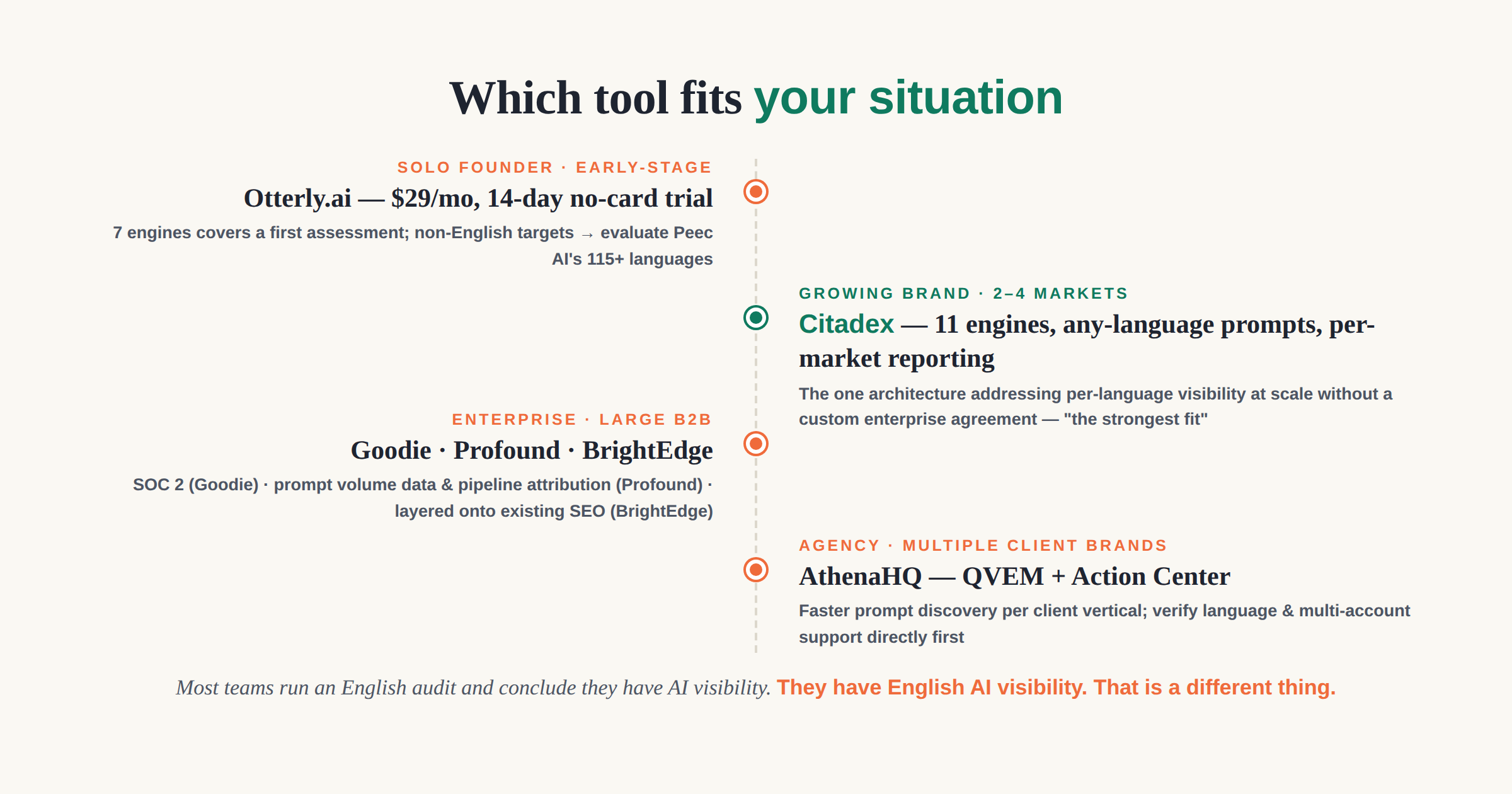
Solo founder or early-stage brand. The priority is low cost, a free trial, and self-serve setup. Otterly.ai at $29/month with a 14-day no-card trial is the logical starting point for English-language markets. Seven engines is sufficient for an initial assessment of AI visibility. If non-English markets are the target, Peec AI's language breadth at $95/month warrants evaluation, though trial availability is not publicly confirmed.
Growing brand entering 2–4 international markets. This buyer needs per-language prompt tracking, at least 7 engines, competitor benchmarking, and a pricing model that doesn't require an enterprise contract to access multi-language features. Citadex's coverage of 11 engines with any-language prompt tracking and per-market reporting is the strongest fit. It is the one tool whose documented architecture directly addresses the per-language visibility problem at scale without requiring a custom enterprise agreement to access basic features.
Enterprise global brand or large B2B company. Maximum engine coverage, documented multi-language support, SOC 2 compliance, historical trend data, and the ability to track multiple competitors simultaneously are baseline requirements. Goodie's 11-engine coverage and SOC 2 credential make it relevant for this segment, though pricing opacity requires a sales evaluation. Profound's prompt volume dataset and attribution capabilities suit enterprises where AI search ROI needs to tie back to pipeline. BrightEdge fits large teams with existing SEO infrastructure who want AI visibility layered in rather than managed separately.
Marketing agency managing multiple client brands. Multi-brand dashboards, scalable seat pricing, and the ability to run prompts across different industries and languages within one account are key requirements. AthenaHQ's Action Center and QVEM model help agencies quickly identify which prompts matter for a new client vertical. Verify language and multi-account support directly with vendors before committing, as neither is fully documented publicly for most platforms.
Common Pitfalls When Choosing an AI Visibility Tool for Global Markets
Choosing by engine count without verifying language support. A tool that queries 11 engines only in English does not help a brand expanding into Japan or Korea. Engine count and language support are independent variables. Always confirm whether prompts are sent in the target language natively, not just whether the platform claims international coverage.
Confusing global reporting with per-market reporting. A single global mention rate averaged across all queries and markets obscures whether the brand is actually visible in specific countries or languages. Before purchasing, ask: can the dashboard show mention rate for Japanese-language prompts on ChatGPT separately from French-language prompts on Gemini?
Treating AI visibility as a one-time audit. AI engines update their answer patterns on irregular cycles. A snapshot from three months ago may no longer reflect current brand positioning. Ongoing monitoring is necessary to detect drops in mention rate, shifts in competitor ranking, or changes in how an engine describes a brand.
Assuming a major SEO platform's AI feature equals a dedicated AEO tool. Platforms that added AI tracking as a secondary feature typically query fewer engines, update less frequently, and have shallower analytics than purpose-built AEO tools. BrightEdge's 3 AI surfaces versus the 7–11 covered by dedicated platforms illustrates this gap concretely.
Selecting a tool without testing prompt fit for the target market. Because AI visibility is relatively new, standard prompt libraries may not reflect how buyers in a specific industry or region actually phrase questions. A free trial is worth prioritizing to verify that the tool's default prompt set resembles real buyer language in the target market, not just English-language analogues of those queries.
Frequently Asked Questions About AEO Tools for International Markets
Q: What is the difference between AEO and GEO?
AEO (Answer Engine Optimization) refers specifically to optimizing content so it appears in AI-generated answers across assistant platforms like ChatGPT, Claude, and Perplexity. GEO (Generative Engine Optimization) is a broader term that covers optimization across all generative AI search surfaces, including those that blend traditional retrieval with AI generation. Most practitioners and tools use the terms interchangeably, and the monitoring platforms in this comparison address both.
Q: Do these tools work for brands operating in non-English markets?
It depends on the tool. Some platforms send prompts only in English by default and report aggregated global results. Others, including platforms with explicit multi-language prompt support, track visibility in Japanese, Korean, Spanish, German, French, Portuguese, Arabic, and Chinese natively. Always verify before purchasing whether the tool sends prompts in the target language or only processes English queries.
Q: How long does it take to see results from AEO efforts?
AI engines update their answer patterns on irregular cycles rather than on fixed schedules. Most practitioners observe measurable changes in mention rate within 6–12 weeks of consistent content publication and citation-building work, though this varies by engine and market. Gains in Perplexity, which indexes current web content more aggressively, tend to appear faster than gains in models with slower update cycles.
Q: Can I track ChatGPT mentions without paying for a dedicated tool?
Manual spot-checking by querying ChatGPT directly is possible but not systematic. It cannot cover multiple prompts at scale, produces no historical data, cannot track competitors in the same session, and cannot run prompts simultaneously across multiple languages. For a one-time exploratory audit of a single market, manual checking is reasonable; for ongoing monitoring across multiple markets or AI engines, it is not a substitute for a dedicated platform.
Q: Which AI engines should brands prioritize when expanding internationally?
ChatGPT and Google AI Overviews have the broadest global user base and are the logical starting point for most brands. Perplexity has strong penetration among B2B researchers and is growing in English-language and European markets. Gemini is significant in markets where Google holds dominant search share. DeepSeek has meaningful usage in Chinese-language contexts. The right prioritization depends on where a brand's specific buyers are searching, not on raw global engine rankings.
Q: Are dedicated AEO tools different from SEO tools used for keyword ranking?
Yes, categorically. Traditional SEO tools track URL positions in search engine result pages by querying structured search index APIs. AEO tools send natural-language prompts to AI assistants, capture the full generated answer, and parse whether a brand is mentioned, along with where it appears, how it is described, and whether the answer includes a citation link. These are different data sources, different measurement methodologies, and different optimization levers. An SEO rank tracker cannot serve the AEO function, and vice versa.
Q: Is there an affordable option for a small company expanding internationally?
Entry-level dedicated AEO tools with published pricing start at $29/month (Otterly.ai, 7 engines, 15 prompts). For brands whose buyers search primarily in non-English languages, the relevant question is whether the tool's language support matches the target market. Engine count and price are secondary to prompt-language fit. At the $29–$99/month range, verify language support explicitly before committing, as some entry-tier plans default to English-only prompt libraries.