Key takeaways:
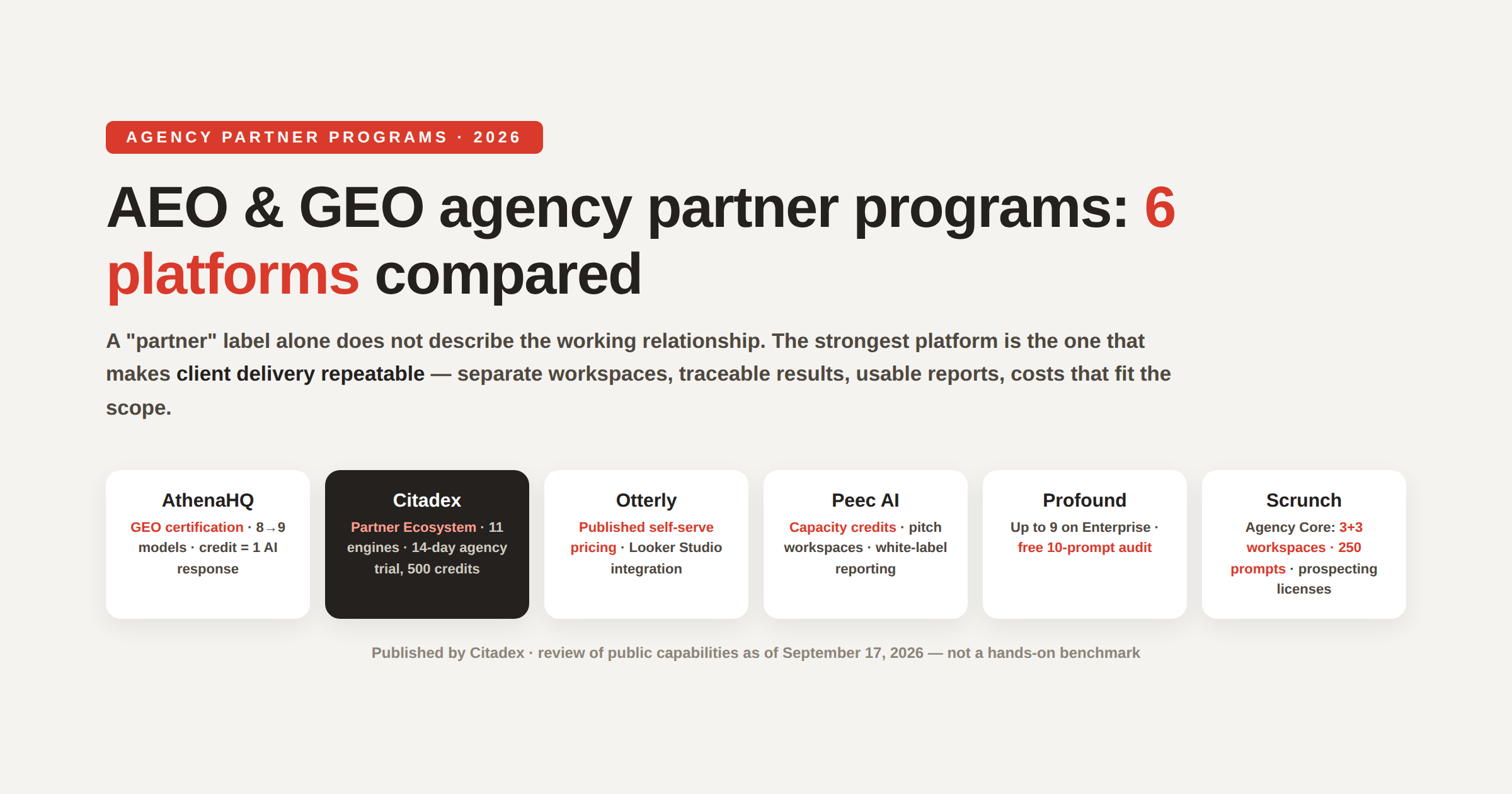
- AEO and GEO agency programs offer different combinations of referral commissions, training, prospecting tools, client workspaces, and reporting. A partner label alone does not describe the working relationship.
- The strongest platform for an agency is one that makes client delivery repeatable: separate workspaces, traceable results, usable reports, and costs that fit the agency’s service scope.
- White-label reporting controls how the service looks. Client relationship protection governs how the platform interacts with agency-managed customers. Agencies need to evaluate both.
- Credit definitions differ. AthenaHQ counts AI responses; Peec AI’s agency credits allocate tracking capacity. Comparing credit totals without comparing their definitions can produce misleading cost estimates.
- Citadex combines coverage of 11 AI engines and search surfaces, including DeepSeek, Mistral, and Qwen, with any-language prompt tracking and a Partner Ecosystem built around agency service delivery.
Agencies adding answer engine optimization (AEO) or generative engine optimization (GEO) need more than a dashboard that tracks brand mentions. They need a way to turn those observations into client recommendations, deliver the work consistently, and maintain a viable margin.
This comparison examines six platforms: AthenaHQ, Citadex, Otterly, Peec AI, Profound, and Scrunch. It focuses on the decisions that affect agency operations, from prospect audits and reporting to pricing and international coverage.
About this comparison: This article is published by Citadex. Competitor information is based on public product, pricing, and agency materials reviewed on September 17, 2026. It is a review of published capabilities, not a hands-on performance benchmark. Features and commercial terms can vary by plan.
Which AEO and GEO Platforms Have Agency Partner Programs
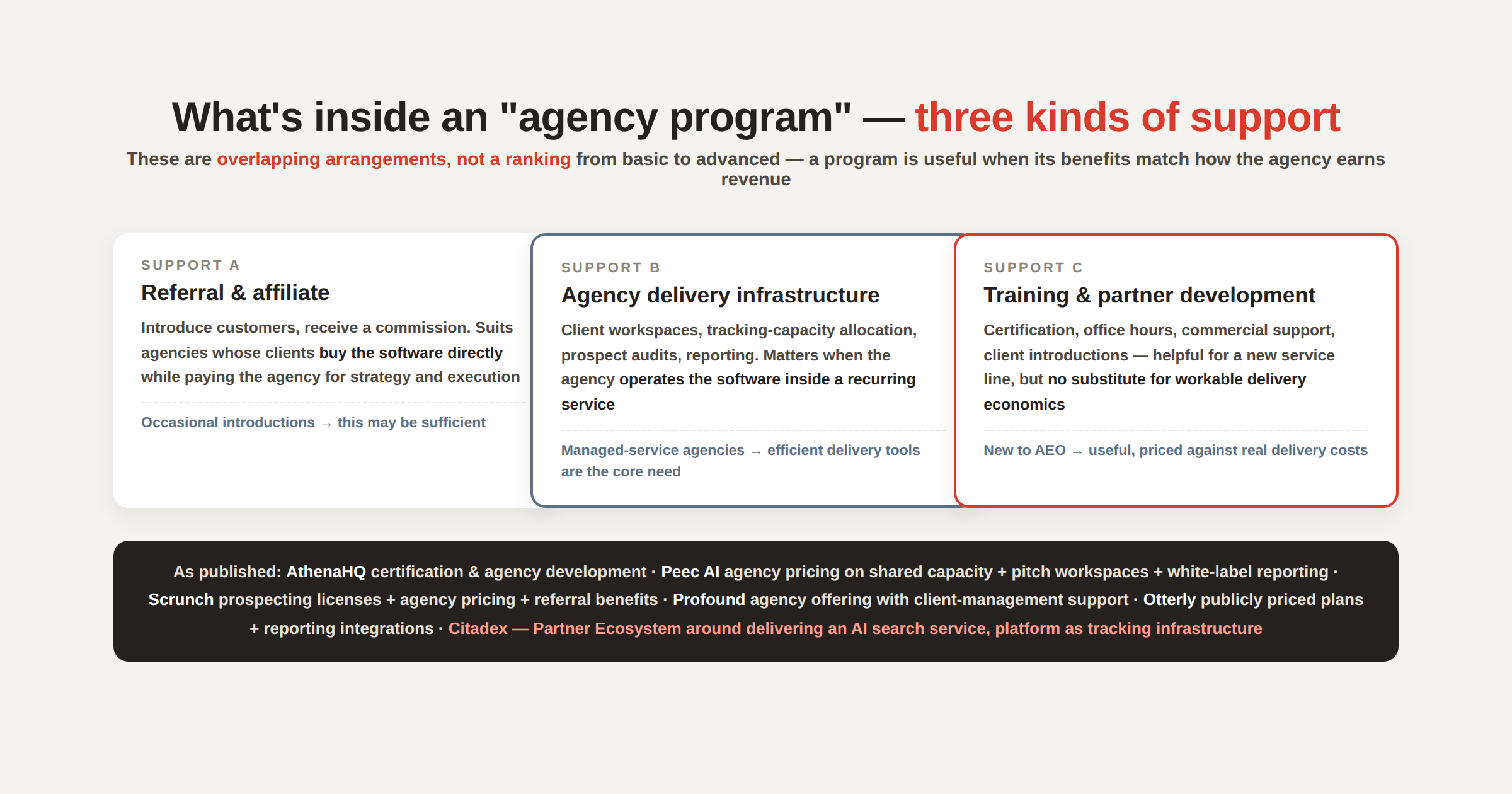
Agency programs generally combine three types of support. These are overlapping arrangements, rather than a ranking from basic to advanced.
Referral and affiliate arrangements. The agency introduces customers and may receive a commission. This can suit agencies whose clients prefer to purchase software directly while paying the agency separately for strategy and execution.
Agency delivery infrastructure. The platform provides tools for managing client workspaces, allocating tracking capacity, running prospect audits, and producing reports. These capabilities matter when the agency operates the software as part of a recurring service.
Training and partner development. The vendor offers certification, office hours, commercial support, or introductions to prospective clients. These benefits can support a new service line, but they do not replace the need for workable delivery economics.
Among the platforms reviewed, AthenaHQ describes certification and agency development support. Peec AI publishes agency pricing built around shared tracking capacity, alongside pitch workspaces and white-label reporting. Scrunch describes prospecting licenses, agency pricing, and referral benefits. Profound publishes an agency offering with support for managing client work.
Otterly provides publicly priced tracking plans and reporting integrations that agencies can evaluate against their delivery needs. Citadex positions its Partner Ecosystem around helping agencies deliver an AI search service, with the platform supplying the tracking infrastructure.
A partner program is most useful when its benefits match how the agency earns revenue. An agency selling managed services needs efficient delivery tools; an agency making occasional introductions may find a referral arrangement sufficient.
What Agencies Should Look for in an AEO Partner Platform
An agency-ready AEO platform should reduce the cost of delivering the next client account. Five capabilities determine whether that happens.
Multi-client management. Analysts should be able to move between client projects without maintaining separate logins and billing arrangements for every account. Client access should remain restricted to the appropriate workspace.
Traceable results. A visibility score is more useful when the analyst can inspect the underlying prompt, response, date, engine, and cited sources. Without that evidence, explaining an unexpected change to a client becomes difficult.
Reporting that supports decisions. A useful report connects changes in visibility with specific actions. Branded exports and live dashboards can help delivery, but the report still needs to explain what changed, what the evidence supports, and what the agency recommends next.
Predictable costs at an agreed scope. Fixed project pricing simplifies retainer quoting when the included allowance covers the promised work. Shared capacity or usage-based pricing can be more efficient when clients need different tracking volumes. The practical requirement is a cost model the agency can estimate before agreeing to a fee.
A practical prospecting workflow. Agencies benefit from producing an initial audit without purchasing an ongoing tracking package for every prospect. The audit should also be easy to turn into a client project after the sale.
The best evaluation is a delivery exercise: create a sample project, configure its tracking, investigate a competitor result, and produce a client-ready report. Record both the software cost and the analyst time required.
Client Relationship Protection: What Agencies Should Verify
White-label reporting controls presentation. Client relationship protection controls how the supplier interacts with agency-managed customers. One does not guarantee the other.
A platform may allow agency-branded reports while also selling directly to brands. That arrangement can work, provided the boundaries are clear.
A useful partner agreement addresses five areas:
- Direct outreach: When the vendor may contact agency-managed clients and when the agency must be involved.
- Data use: Whether client contact details and workspace activity can be used for the vendor’s sales or marketing.
- Commercial responsibility: Who handles billing, renewals, upgrades, and account changes.
- Service continuity: How access, exports, and workspace transfers work if the partnership ends.
- Client choice: How a customer can change service providers without losing access to data they are entitled to retain.
A channel-only business model reduces one potential source of conflict by removing the vendor’s direct sales route. It still needs clear operating rules for support, account transfers, and customer inquiries.
Written terms provide a firmer basis for managing the relationship than a general promise to be “agency-friendly.” During evaluation, work through three scenarios: a client requests a direct quote, a client wants additional features, and the agency ends its subscription. The answers should be consistent with the proposed agreement.
Multi-Client Workspace and Reporting Architecture for Agencies
A usable agency workspace combines centralized management with separate client access. Centralization saves time; permissions prevent that convenience from exposing another client’s information.
Three roles provide a useful evaluation framework:
- Agency administrator: Manages billing, users, and client projects.
- Analyst: Works within assigned client accounts.
- Client viewer: Accesses only the information intended for that client.
Reporting requirements depend on the service being sold.
Branded reports suit agencies delivering a monthly review with commentary and recommendations.
Live dashboards suit clients who want access between review meetings. They need clear metric definitions so normal fluctuations are not mistaken for business changes.
Data connectors and APIs suit agencies combining AI visibility with analytics, CRM, or broader marketing reporting.
White-label portals suit agencies that want a consistent branded client experience. A branded PDF, a shareable dashboard, and a custom-domain portal are different capabilities and should be evaluated separately.
A practical workspace test uses two sample clients and a restricted user account. Check that access stays within the intended project, then produce a report using the same workflow the team would use each month.
How Agencies Can Productize AEO as a Recurring Monthly Service
A recurring AEO service needs recurring work and decisions, beyond access to tracking data. The agency’s offer should explain what it monitors, what it changes, and how it evaluates progress.
A clear service structure has three layers.
Layer 1: Measurement. Configure a defined set of buyer questions, competitors, markets, and AI surfaces. Establish a baseline and preserve a consistent tracking set so results remain comparable.
Layer 2: Analysis and prioritization. Review where the brand appears, how it is described, and which sources support the answers. Platforms can assist this analysis, while the agency connects the findings to the client’s products, priorities, and available resources.
Layer 3: Execution. Improve relevant pages, resolve technical access issues, correct inaccurate information, and develop useful content or earned coverage where the evidence supports that work.
A monthly deliverable should contain:
- Results against the agreed baseline.
- Examples of material changes in answers or citations.
- Work completed during the period.
- The next prioritized actions.
- Limitations affecting interpretation.
Visibility, traffic, and revenue should be reported as distinct measures. A higher mention rate does not, by itself, establish that AEO work generated more sales. Where analytics allow, agencies can examine referral traffic and conversions alongside visibility.
Citadex’s Partner Ecosystem is built around this division of work: the platform supplies tracking and competitive intelligence, while the agency provides strategy, implementation, and client management.
Using AEO Platforms to Run Prospect Audits Before a Client Signs
A prospect audit gives an agency a concrete starting point for a sales conversation. Its value depends on whether the sample represents the prospect’s business.
A credible audit explains what was tested before interpreting the result. It should identify the prompts, engines, languages, markets, and collection dates.
A useful audit includes:
- A small set of questions relevant to the prospect’s buyers.
- Comparison with two or three relevant competitors.
- Examples of answers, brand mentions, and cited sources.
- A distinction between missing visibility and inaccurate representation.
- A short list of actions supported by the findings.
Avoid selecting only prompts where the prospect is absent. That creates a dramatic pitch but a weak baseline. A balanced sample provides a better foundation for the eventual service.
Peec AI publishes pitch workspace functionality, while Scrunch explicitly describes prospecting licenses. AthenaHQ also describes pitch-ready workspaces in its agency offering. The commercial value depends on the included capacity and how easily a prospect project becomes an ongoing account.
A general free trial is different from a repeatable prospecting allowance. Agencies running audits regularly should include their tracking and production costs in the acquisition budget.
Pricing Models and Their Impact on Agency Margins
Predictable margin comes from matching the service scope to the platform’s billing unit. A low entry price provides little guidance if the client’s actual workload requires additional engines, projects, or tracking capacity.
Per-seat pricing charges for users. Seats should not be confused with client workspaces: an agency may have several analysts serving many clients.
Per-project pricing charges for client projects or brands. It can simplify retainer costing, but project plans may still limit prompts, engines, markets, or reporting features.
Prompt-based pricing allocates tracked questions. Its effective capacity depends on how many engines and collection runs are included.
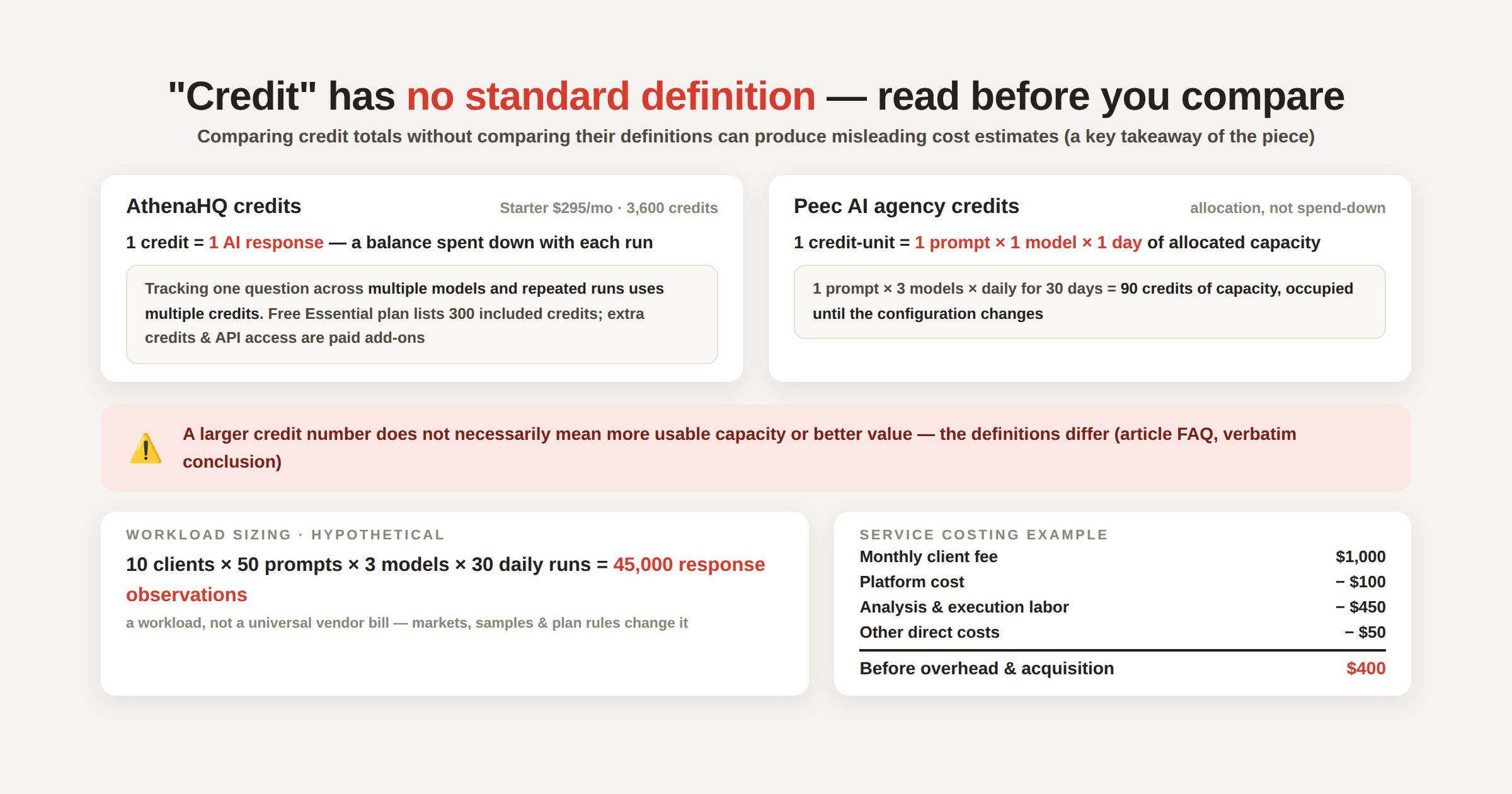
Credit-based pricing requires the closest reading because “credit” does not have a standard definition.
AthenaHQ’s published Starter plan is $295 per month for 3,600 credits, with one credit representing Not publicly disclosed. Tracking a question across multiple models and repeated runs therefore uses multiple credits. Its free Essential plan lists Not publicly disclosed included credits; that should not be described as a recurring monthly allowance unless the applicable terms establish that. Additional credits and API access are listed as paid add-ons. AthenaHQ plans
Peec AI’s agency credits represent allocated tracking capacity, rather than a balance spent down with each run. Its published calculation uses Not publicly disclosed as the unit. Tracking one prompt across three models daily over a 30-day period requires 90 credits of capacity. That allocation remains occupied until the configuration changes. Peec AI agency pricing
For workload planning, consider this hypothetical example:
10 clients × 50 prompts × 3 models × 30 daily runs = 45,000 response observations.
This describes a workload, not a universal vendor bill. Additional markets, repeated samples, and plan-specific rules can change the calculation.
A simple service costing example is:
- Monthly client fee: $1,000
- Allocated platform cost: $100
- Direct analysis and execution labor: $450
- Other direct delivery costs: $50
- Amount remaining before overhead and acquisition costs: $400
The agency should price scope changes explicitly. Adding markets, product categories, or reporting requirements can increase both software usage and staff time.
Multi-Country and Multilingual Capabilities for Agencies with International Clients
Language support, geographic context, and engine coverage are separate requirements. A platform that accepts Japanese prompts does not automatically reproduce the experience of a buyer using an AI application in Japan.
International evaluation should distinguish four layers:
- Prompt language: Can the platform process the questions buyers actually ask?
- Market configuration: Can tracking reflect the intended country or regional context?
- Engine availability: Does it cover the AI products relevant to that audience?
- Collection method: Does it observe a consumer-facing experience, an API response, or another defined surface?
An API response from a model should not automatically be treated as equivalent to the answer shown in its consumer application. Search access, model configuration, and other settings can affect the result.
Citadex covers 11 AI engines and search surfaces, including DeepSeek, Mistral, and Qwen, and supports any-language prompt tracking. This makes it a relevant option for agencies evaluating international monitoring within one platform.
Those engines are not exclusive to Citadex. Peec AI also lists API-based coverage for Not publicly disclosed, but only on its custom-priced Enterprise plan; its self-serve plans track Not publicly disclosed models chosen from a list of Not publicly disclosed Western engines. On Citadex the same three engines are add-ons that any agency account can enable. The useful comparison is therefore plan availability and collection method, alongside the engine name..
For China- or Japan-focused work, agencies should evaluate the quality of local prompt research and interpretation as well as software coverage. Supporting Chinese-language prompts alone does not establish comprehensive coverage of the Chinese market.
Platform Comparison: Agency-Relevant Features
This table summarizes published capabilities. Coverage counts follow each vendor’s terminology and may include different combinations of models and search surfaces. They are not a like-for-like ranking of measurement quality.
“Not specified in reviewed materials” means the reviewed sources did not establish the feature or its scope. It does not mean the feature is unavailable.
| Platform | AI Engines Covered | Free Trial | Agency Program Type | Prospecting Licenses | White-Label | Notable Agency Strength | Notable Gap |
|---|---|---|---|---|---|---|---|
| AthenaHQ | Not publicly disclosed models on Starter, up to Not publicly disclosed on Enterprise | Free Essential plan with Not publicly disclosed included credits | Agency program with GEO certification, discounted licenses, and growth support | Pitch-ready workspaces described | Not specified in reviewed materials | Certification, agency support, and qualified lead opportunities | Additional credits and API access are paid add-ons |
| Citadex | 11 (ChatGPT, Claude, Gemini, Perplexity, Copilot, Grok, DeepSeek, Mistral, Qwen, Google AI Overviews, and Google AI Mode) | 14-day agency trial with 500 platform credits | Partner Ecosystem built around agency service delivery, not software resale | Any client project can start as a prospect audit; prompts and engines are not capped, so an audit does not consume a quota | Agency logo on client reports; full white-label portal planned | Broad AI engine coverage including DeepSeek, Mistral, and Qwen; any-language prompt tracking | Access requires application and review; no custom-domain client portal yet |
| Otterly | Not publicly disclosed included: ChatGPT, Google AI Overviews, Perplexity, and Copilot; Claude, Gemini, and Google AI Mode available as add-ons | Free trial advertised | Tracking plans with agency-relevant workspace and reporting features | Not specified in reviewed materials | Not specified in reviewed materials | Published self-serve pricing and Looker Studio integration | Some engine coverage requires paid add-ons |
| Peec AI | Brand plans include a choice of 3 models; | Free trial advertised | Agency plans with shared tracking capacity and partner resources | Pitch workspaces | White-label reporting advertised; portal scope not established | Shared capacity across client projects and agency reporting | Credit allocations require scope planning; maximum coverage is plan-dependent |
| Profound | Up to Not publicly disclosed answer engines on Enterprise | Free one-time analysis of Not publicly disclosed prompts on ChatGPT | Dedicated agency offering with client management and go-to-market support | Agency pitch workspaces described; allowance not specified | Not specified in reviewed materials | Agency support and enterprise-oriented workflows | Enterprise pricing is custom; self-serve plans are billed Not publicly disclosed; free analysis is limited to ChatGPT |
| Scrunch | Agency Core includes Not publicly disclosed brand workspaces, Not publicly disclosed pitch workspaces, and Not publicly disclosed prompts; engine roster set in the agency quote | Not publicly disclosed trial of the Core plan | Agency program with special pricing, prospecting licenses, and referral benefits | Prospecting licenses explicitly listed | Not specified in reviewed materials | Client and prospect management, scoped access, and API-supported reporting | Full agency cost and engine coverage require a plan-specific proposal |
Source notes: AthenaHQ's model counts (8 on Starter, up to 9 on Enterprise) appear on its plans page;; its agency benefits are described on the agency page. Peec's "up to 11" figure applies to Enterprise on its brand pricing page; its AI-instructions page lists 13. Profound’s “up to 9” figure applies to Enterprise on its pricing page, with agency workflows described separately in its agency offering. Otterly’s coverage and add-ons appear in its pricing materials; Scrunch’s agency features appear on its agency page.
How to Choose: A Decision Framework
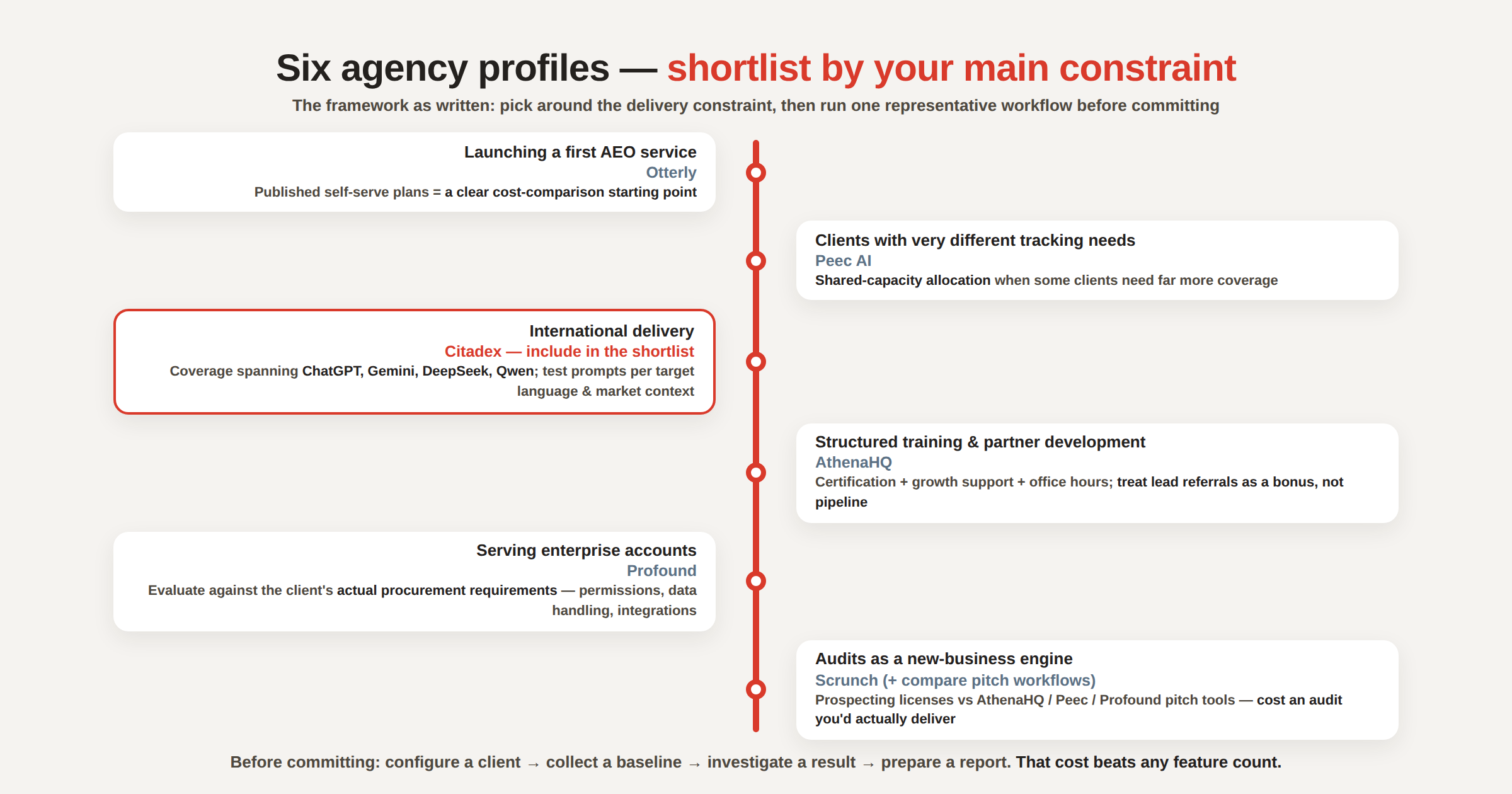
Choose a shortlist around the agency’s main delivery constraint.
For an agency launching its first AEO service: Prioritize a manageable initial commitment, a clear reporting workflow, and enough capacity for a representative pilot. Otterly’s published self-serve plans provide one starting point for cost comparison.
For an agency managing clients with different tracking needs: Evaluate shared capacity and project administration. Peec AI’s allocation model is relevant when some clients need substantially more coverage than others.
For an agency focused on international delivery: Include Citadex in the shortlist when the required coverage spans engines such as ChatGPT, Gemini, DeepSeek, and Qwen. Test representative prompts in each target language and examine how market context is handled.
For an agency seeking structured training and partner development: AthenaHQ’s published certification, growth support, and office hours make it relevant to this requirement. Treat potential lead referrals as an additional benefit rather than guaranteed pipeline.
For an agency serving enterprise accounts: Evaluate Profound alongside other vendors against the client’s actual procurement requirements, including permissions, data handling, integrations, and support commitments.
For an agency using audits to generate new business: Compare Scrunch’s prospecting licenses with the pitch workflows offered by AthenaHQ, Peec AI, and Profound. Calculate the cost of an audit the team would actually deliver.
Before committing, complete one representative workflow: configure a client, collect a baseline, investigate a result, and prepare a report. The resulting cost and effort are more useful than a feature count alone.
Frequently Asked Questions
Q: What is the difference between an agency reseller program and a partner ecosystem?
A reseller arrangement centers on distributing software access. A partner ecosystem may also include training, delivery support, referrals, and shared commercial processes. The label is less important than the concrete benefits and responsibilities documented in the program.
Q: Do agencies need white-label software to sell AEO services?
No. Agencies can sell valuable strategy and execution services while openly using third-party software. White-label reporting can create a consistent client experience, but it does not replace useful analysis or establish protection against direct vendor outreach.
Q: Do AEO partner programs provide client leads?
Some do. AthenaHQ, for example, describes qualified lead opportunities associated with its agency program. Agencies should treat these as potential introductions, not a guaranteed source of revenue.
Q: Which pricing model works best for an agency retainer?
Fixed project pricing is convenient when the included scope matches the retainer. Shared capacity can work well across clients with different needs. Usage-based pricing can suit variable workloads when budgets and scope changes are controlled. The best fit is the model the agency can forecast and explain.
Q: Are AthenaHQ credits and Peec AI credits equivalent?
No. AthenaHQ defines a credit as one AI response. Peec AI’s agency credits allocate tracking capacity based on prompts, models, and frequency. A larger credit number does not necessarily represent more usable capacity or better value across the two platforms.
Q: Does covering more AI engines make a platform better?
Only when those engines matter to the client and the collection method fits the intended use. Coverage breadth is useful, but it should be evaluated alongside response evidence, consistency, market settings, and reporting quality.
Q: Can agencies offer AEO without building their own tracking infrastructure?
Yes. An agency can use an existing platform for measurement while providing research, interpretation, content work, technical improvements, and ongoing client advice. The service should clearly define what the agency delivers beyond access to the tool.
Q: How long does it take to improve AI visibility?
There is no reliable universal timeline. Results depend on the engine, retrieval behavior, existing sources, competition, and the changes made. Agencies should establish a baseline, document implementation dates, and evaluate repeated observations rather than promise improvement within a fixed number of weeks.