Key takeaways
- Most buyers evaluate these tools on feature-list length. That's the wrong lens. The real question is coverage — and coverage gaps stay invisible until you measure them.
- The biggest blind spot is language. In our own scans, a brand named in English disappears from the same query in another language about 56% of the time — a gap English-only tools never surface.
- The right choice comes down to one thing: do you need ongoing, comparable data across many engines and languages, or a one-time snapshot of a single market?
Choosing between AI-visibility approaches comes down to concrete trade-offs — engine coverage, language breadth, automation, competitor intelligence, and whether the tool tracks not just if your brand is mentioned but whether it's ranked and cited. The category spans dedicated Answer Engine Optimization (AEO) platforms, manual monitoring in a spreadsheet, and traditional SEO suites that have bolted on a few AI signals. Each fits a different operational profile. Below, I evaluate them against clear criteria — whether you're switching away from a tool that misses your markets, or deciding for the first time.
Here's the blunt version up front: the tool with the longest feature list rarely wins. The tool that actually queries the engines and languages your buyers use does.
What Decision Criteria Actually Separate These Approaches?
Six dimensions do most of the work. Evaluated concretely, they cut through the marketing language.
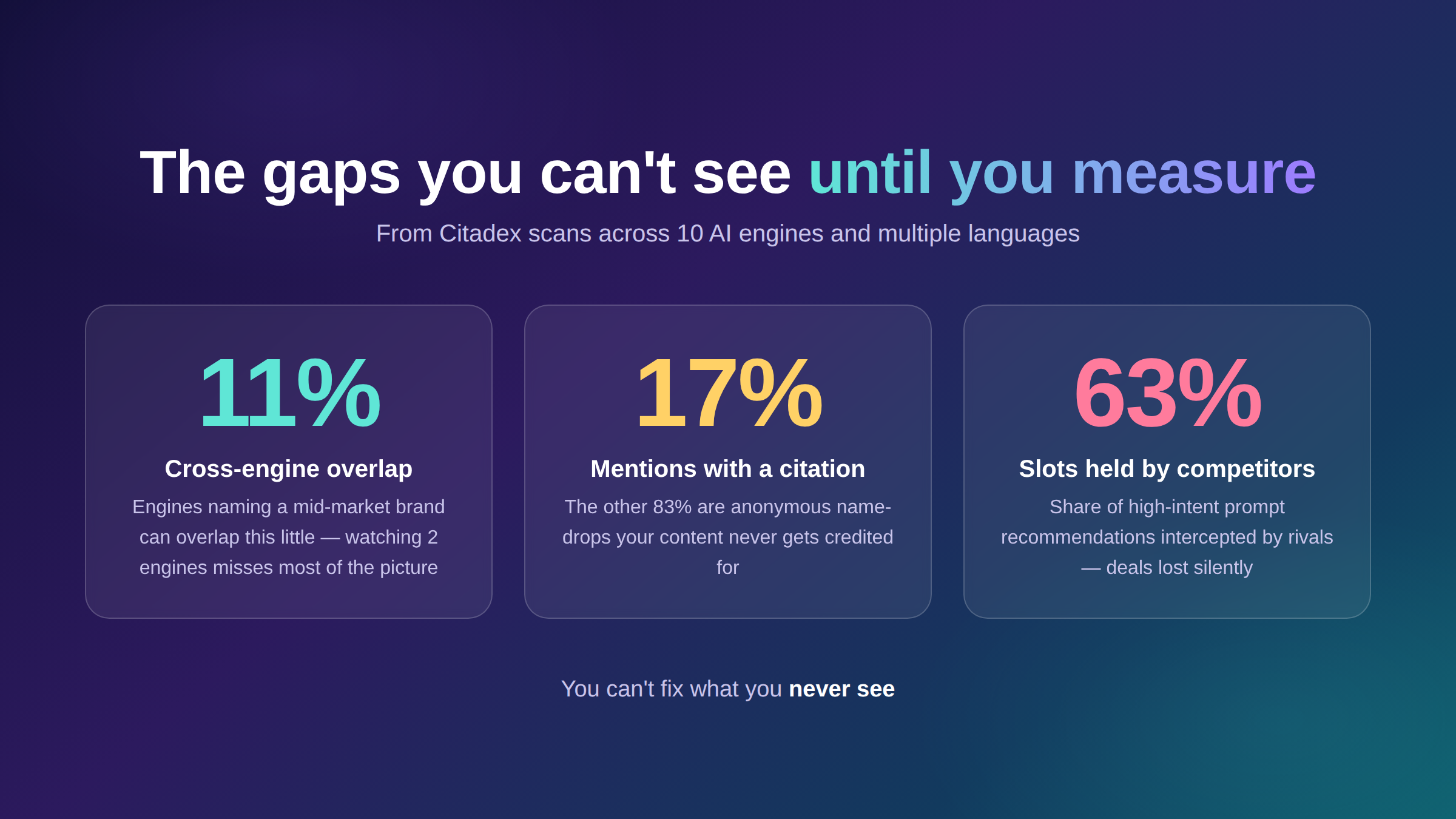
1. AI engine coverage. Which surfaces does the tool query systematically? Cover only two or three and you get a partial picture as buyers move between ChatGPT, Google AI Overviews, Perplexity, Copilot, Claude, and the rest. This isn't hypothetical: for vertical and mid-market brands, we've seen the set of engines that name a brand overlap by as little as 11% — meaning a tool watching only the two best-known engines can miss the large majority of where you're winning or losing. Citadex queries ten surfaces: ChatGPT, Google AI Overviews, Google AI Mode, Gemini, Perplexity, Copilot, Claude, Grok, DeepSeek, and Meta AI.
2. Language and market support. Some tools track English and a handful of Western European languages. Others analyze prompts and answers in any language your buyers actually use — Japanese, Chinese, Korean, Arabic, Portuguese, Spanish. This is the single most underestimated criterion. AI answers diverge by language, not just geography: in our scans, a brand present in the English answer is missing from the same query in another language about 56% of the time. If you sell across borders and your tool only reads English, you are flying blind in every other market.
3. What's measured per prompt. A mention count isn't enough. You need whether the brand appears at all, where in the answer it lands, the sentiment, and — critically — whether the answer cites a source URL pointing to your content. That citation signal is where most tools go quiet. In our scans, of all the answers that mentioned a brand, only about 17% included a citation link — the other 83% were anonymous mentions the brand couldn't attribute or build on. If you can't see citations, you can't tell whether you're being credited or just name-dropped.
4. Competitor intelligence. Tracking your own brand tells half the story. The other half is interception — when a rival is recommended in a prompt you should own. This is common and expensive: across a set of high-intent export-product prompts we analyzed, competitors held roughly 63% of the recommendation slots. Monitoring for that pattern tells you exactly which prompts to prioritize, because those are the ones actively costing you deals.
5. Automation and alerting. Manual checks are slow and inconsistent. Automated platforms run the same prompts on a schedule and alert you when something moves — a prompt that used to name you stops, or a competitor takes your slot. That's the difference between catching a visibility drop in days versus discovering it a quarter later.
6. Optimization integration. Some platforms stop at tracking; others connect the data to action — scoring content for retrievability or flagging the specific sources an AI pulls from so you know where to earn a mention. That's the line between a dashboard you watch and a workflow that changes the outcome.
At a Glance: Which Approach Fits Which Scenario?
- Global brand, 5+ markets, ongoing monitoring → Dedicated AEO platform
- One-time audit of a single English-language market → Manual monitoring
- Primarily traditional SEO, AI as a secondary signal → SEO suite with AI features
- Actively defending against competitor displacement → Dedicated AEO platform with competitor tracking
- Budget-constrained first look at AI visibility → Manual monitoring first, then migrate to a platform
Dedicated AEO Platforms vs Manual Monitoring
Manual monitoring — querying ChatGPT, Perplexity, and others by hand and logging results in a spreadsheet — is fine for a first look and genuinely useful for building intuition about your category. It falls apart with scale. Effort grows linearly with every added prompt, engine, and language, while data quality drops, because answers vary between sessions and human interpretation drifts.
The value of a dedicated platform is systematic testing: the same prompts, the same engines, the same languages, on a fixed cadence — producing comparable time-series data that actually shows whether a content change moved the needle.
The scale problem is easy to underestimate. One brand we tracked ran 100 prompts across all ten engines and every target language and found it was absent from more than 70 of them across every major engine. No spreadsheet workflow surfaces that in a usable, repeatable way — and certainly not weekly.
Dedicated AEO Platforms vs Traditional SEO Suites (Ahrefs, Semrush, etc.)
Suites like Ahrefs and Semrush are excellent at what they were built for — rankings, crawl health, backlinks, keyword research — and several have added modules that flag whether a domain shows up in Google's AI Overviews. That's helpful when AI monitoring is secondary to core SEO.
But it isn't a substitute for systematic AI-answer monitoring, and the gap is methodological: an SEO suite measures what appears on a search results page; an AEO platform measures what appears inside an AI-generated answer — a different retrieval and ranking process entirely. A brand can sit at #1 on Google and be absent from ChatGPT and Perplexity for the same query, and vice versa. SEO-suite AI features also tend to stop at Google's AI surfaces and rarely read mention, rank, or citation across conversational engines in multiple languages.
If consolidating tools matters more than depth, a suite with AI signals is a reasonable start. If your buyers are actively asking AI assistants what to buy, it will leave you guessing.
How Do Dedicated AEO Platforms Differ From Each Other?
"Dedicated AEO platform" is now a category, not a single product. Tools like Profound, Otterly, and Peec all monitor brand visibility in AI answers, and Citadex sits in that same category. So when you compare them, ignore feature-list length and hold each to the same concrete questions:
- How many engines, really? Most tools cover the famous three (ChatGPT, Perplexity, Google). Coverage thins out at Grok, DeepSeek, Meta AI, and both Google AI surfaces (Overviews and AI Mode) — which is exactly where that 11% overlap bites.
- How many languages, really? "Multilingual" often means English plus a few European languages. Ask specifically about Japanese, Chinese, Korean, and Arabic if those are your markets.
- Citation, or just mentions? Given only about 17% of mentions carry a citation, a tool that ignores the citation signal is hiding your most actionable data.
- Competitor interception, or just self-tracking?
For reference, Citadex's own coverage is ten answer surfaces (ChatGPT, Google AI Overviews, Google AI Mode, Gemini, Perplexity, Copilot, Claude, Grok, DeepSeek, Meta AI), prompt-and-answer analysis in any language, mention/rank/sentiment/citation on every prompt, competitor interception, and daily, weekly, or custom scan cadences. Use those as a yardstick — whatever tool you pick.
Pros and Cons
Dedicated AEO platforms — Consistent automated tracking across many engines and languages; the four signals (mention, rank, sentiment, citation) make trends legible; competitor-interception alerts create offensive and defensive plays; some connect tracking to optimization. Trade-offs: costs more than a spreadsheet, more onboarding than a bolt-on module, and more depth than a single-market team may need.
Manual monitoring — Free, flexible, fast for a one-off, and great for building category intuition. Trade-offs: doesn't scale past a handful of prompts, inconsistent between sessions, and gives you no history, alerts, or competitive benchmark.
SEO suites with AI features — Consolidates into a familiar workflow and covers traditional search alongside AI signals. Trade-offs: AI coverage is usually narrow (often just Google AI Overviews), rarely tracks rank or citation across conversational engines, and isn't built for multi-language prompt testing.
When to Choose Each
Choose a dedicated AEO platform when you operate across multiple international markets and languages, need coverage beyond Google's AI surfaces, want to catch competitor interceptions, need reliable alerting on visibility drops, or want to move from watching to improving.
Choose manual monitoring for a one-time baseline audit, a very narrow niche with only a few prompts to watch, or when budget rules out tooling for now.
Choose an SEO suite when AI is secondary to core SEO, your markets are mostly English, Google's AI surfaces are all you care about, and consolidation beats comprehensiveness.
Recommendation
The decision isn't which tool has the most features — it's matching the tool's coverage to your monitoring scope and goals.
If you need to know whether you show up in AI answers to buyer-journey queries across multiple languages and engines, a dedicated AEO platform is the structurally correct choice. A 56% language gap, an 11% cross-engine overlap, and competitors holding 63% of the slots in prompts you should own are not problems a spreadsheet or an SEO bolt-on can catch at scale — and you can't fix what you never see.
If you're just starting, manual monitoring is a legitimate first step: use it to learn which prompts matter and which engines your buyers use. Once that groundwork is done, migrating to a platform that runs those same prompts automatically is the natural next move.
The core question is simple: do you need ongoing, comparable data across many AI engines and languages — or a one-time snapshot of a single market? Your answer picks the tool.
Frequently Asked Questions
Q: What's the most important feature when comparing AI visibility tools?
Engine coverage first — a tool watching two or three surfaces misses most of the picture (for mid-market brands we've seen cross-engine overlap as low as 11%). Then check what it records per prompt: mention, rank, sentiment, and citation together tell the story; a mention count alone doesn't.
Q: Do these tools really need multiple languages?
For any brand in more than one language market, yes. AI engines answer the same question differently by language — in our scans a brand in the English answer is missing from another language about 56% of the time. Track by language, not just by country, because the prompt's language drives the result, not the user's location.
Q: How is AI-answer visibility different from SEO rank tracking?
SEO tracks where a page ranks on a results page. AEO tracks whether your brand is mentioned inside an AI answer, where it lands, whether it's cited with a source URL, and the sentiment. Different signals entirely — you can win one and lose the other for the same query.
Q: What metrics should a dedicated AEO platform track?
At minimum, four per prompt/engine/language: mention rate, rank, sentiment, and citation. Citation matters most — only about 17% of mentions carry one, and it's the signal that tells you whether your content is actually being credited as a source.
Q: How do competitor-interception alerts work?
They fire when an engine names a rival for a prompt you should own — not just "you're absent," but "a competitor is being recommended instead." In one set of high-intent export prompts we looked at, competitors held roughly 63% of those slots. Those are your highest-priority targets.
Q: Is manual monitoring viable long-term?
For a one-off audit, yes. Long-term, no — responses vary between sessions, there's no comparable history or alerting, and effort scales linearly with prompts, engines, and languages. Ongoing work needs automation.
Q: What should I check before switching tools?
Three things: coverage gaps (does it track the engines and languages your current tool misses?), metric depth (mention/rank/sentiment/citation, or just counts?), and optimization integration (does it connect tracking to action?). More engines but fewer metrics isn't always an upgrade.